Expert Reputation Management for Local South African Brands
Your brand’s reputation is being shaped online right now, whether you’re managing it or not. To manage your local brand’s reputation in South Africa, claim your Google Business Profile, monitor local mentions, and respond politely to all reviews within 24 hours. A rating below 4.0 stars can cost local businesses up to 70% of potential customers.
Key Takeaways: Reputation Management for Local South African Brands
- Over 85% of South African consumers say online reputation directly shapes their buying decisions — your digital presence is your first impression.
- Cultural diversity, social media speed, and infrastructure challenges like load shedding create unique reputation risks for local South African brands.
- Brand South Africa’s national strategy offers a proven blueprint that local businesses can adapt to build trust and competitive credibility.
- Google Reviews directly impact your local search visibility — how you respond to negative feedback can make or break customer trust.
- There are five practical steps you can take right now to protect and strengthen your brand reputation before a crisis hits.
In South Africa’s fast-moving digital landscape, a single unaddressed review or viral complaint can unravel years of hard-earned trust within hours. Local brands face a competitive environment where consumers are more informed, more vocal, and quicker to switch loyalties than ever before. The businesses that thrive are those that treat reputation not as a reaction to problems, but as a proactive strategy built into everything they do.
85% of South African Consumers Judge Your Brand Online First
Before a customer walks through your door or places an order, they’ve already Googled you. Research confirms that more than 85% of South African consumers say online reputation directly shapes their purchasing decisions. That means your Google profile, your reviews, your social media presence, and even how you respond to complaints are doing the selling — or the repelling — long before any human interaction takes place. A study published in the South African Journal of Business Management further confirmed that online reviews and platform trust substantially affect sellers’ perceived reputation and directly influence consumer purchasing decisions.
Why Local South African Brands Face Unique Reputation Challenges
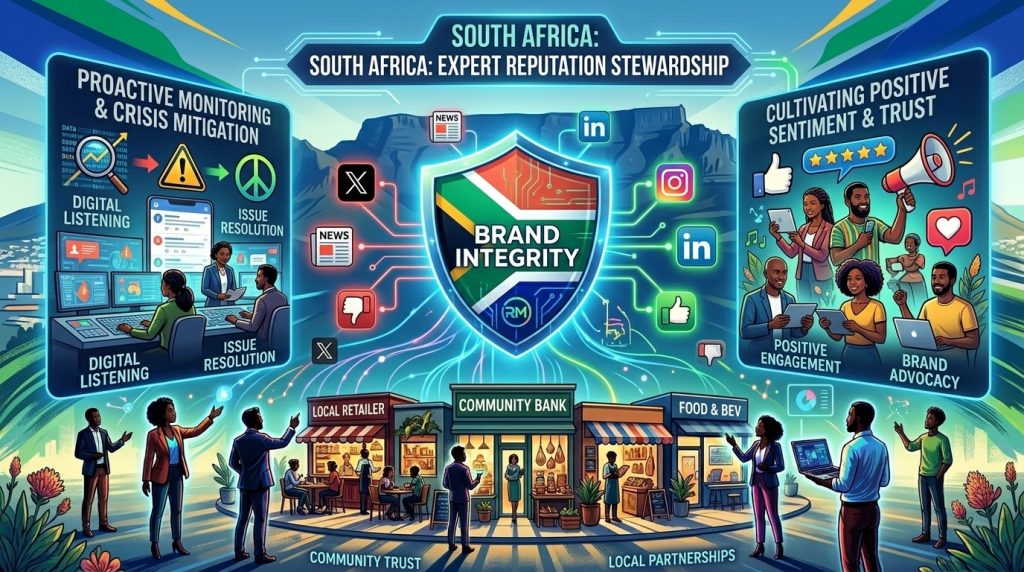
South Africa isn’t a one-size-fits-all market. Managing a brand’s reputation here comes with a distinct set of pressures that international reputation frameworks simply don’t account for. From navigating 11 official languages to operating through rolling blackouts, local brands must be more agile, more culturally aware, and more crisis-ready than their global counterparts.
Cultural Diversity and Community Expectations
South Africa’s demographic richness is one of its greatest strengths — and one of the most complex reputation variables a local brand must manage. What resonates as authentic and trustworthy in Cape Town’s Afrikaans-speaking communities may land completely differently in Johannesburg’s Soweto or Durban’s Indian Quarter. Brands that apply a single cultural lens to their messaging risk alienating large segments of their audience without realising it. Community expectations around respect, representation, and social responsibility run deep, and brands perceived as tone-deaf or exploitative face swift and public backlash.
The Speed of Social Media in South African Markets
South Africa has one of the most active social media populations on the continent. Platforms like Facebook, Twitter/X, Instagram, TikTok, and WhatsApp aren’t just communication tools — they are primary news channels, complaint forums, and brand courts of public opinion. A complaint posted at 9pm can be trending by midnight.
- Facebook remains the dominant platform for community-based brand discussions and local business reviews.
- Twitter/X is where brand controversies escalate fastest, often picked up by news outlets within hours.
- WhatsApp groups spread brand narratives — positive and negative — at a speed that’s nearly impossible to intercept once started.
- TikTok is rapidly growing among younger South African consumers, making video-based brand perception increasingly important.
- Instagram drives aspirational brand identity, particularly for lifestyle, fashion, and food businesses.
The real danger isn’t just the speed — it’s the permanence. A screenshot shared in a WhatsApp community group or a viral tweet lives on long after the original post is deleted. South African brands need real-time monitoring and a pre-built response framework, not a reactive scramble.
How Load Shedding and Service Delivery Issues Affect Brand Perception
Load shedding has become more than an inconvenience — it’s a brand reputation variable. When service delivery fails because of power outages, delayed communications, or system downtime, customers don’t always separate the infrastructure problem from the brand experience. Businesses that communicate proactively during outages — updating customers on delays, setting clear expectations, and showing empathy — consistently protect their reputation better than those that go silent. Silence during a service failure is interpreted as indifference, and indifference destroys loyalty fast.
The Role Brand South Africa Plays in Nation-Wide Reputation
Brand South Africa was established in August 2002 with a specific mandate: build a positive, compelling, and unified brand image for the country. At the time, mixed global messages about South Africa’s stability, safety, and economic potential were creating confusion in international markets. The organisation exists to develop and implement proactive, coordinated marketing and communications reputation management strategies that position South Africa as a competitive investment and tourism destination — both locally and globally.
How the Nation Brand Shapes Local Business Trust
The national brand acts as a credibility umbrella. When Brand South Africa successfully positions the country as a stable, innovative, and welcoming destination, local businesses benefit directly — particularly those in export, tourism, and professional services. A positive nation brand reduces the skepticism foreign partners and investors apply to local companies. Conversely, when national reputation takes a hit — through political instability, corruption headlines, or infrastructure failures — local brands absorb some of that reputational damage by association, even when they’ve done nothing wrong.
What Local Brands Can Learn From Brand South Africa’s Strategy
Brand South Africa’s approach is built around consistency, strategic communication, and long-term narrative control — principles that translate directly to individual business reputation management. Their model focuses on sending a unified message across all channels, targeting both domestic and international audiences simultaneously, and anchoring the brand identity in real strengths rather than aspirational fiction. Local brands that adopt this same discipline — consistent messaging, audience-specific communication, and evidence-backed credibility claims — build reputations that are far more resilient to attack.
How Online Reviews Control Your Brand’s Future
Online reviews are no longer just feedback — they are public trust signals that influence search rankings, purchasing decisions, and long-term brand equity. In South Africa’s growing e-commerce and local services market, the businesses with the strongest review profiles consistently outperform competitors with superior products but weaker digital reputations. Managing your reviews is not optional. It is one of the highest-leverage reputation activities available to any local brand.
Google Reviews and Local Search Visibility in South Africa
Google’s local search algorithm heavily weights review quantity, recency, and response rate when determining which businesses appear in the coveted “Local Pack” — the top three map results shown for location-based searches. A South African restaurant, law firm, or contractor with 200 reviews and a 4.6-star rating will consistently outrank a competitor with 12 reviews and a 4.9-star rating. Recency matters too — a steady flow of new reviews signals to Google that your business is active and trustworthy. Brands that set up and actively manage their Google Business Profile, respond to every review, and consistently encourage satisfied customers to leave feedback gain a compounding search visibility advantage over time.
Responding to Negative Reviews Without Making Things Worse
The worst thing you can do with a negative review is ignore it — the second worst thing is respond defensively. South African consumers who read your response to a complaint are evaluating how you handle pressure, not just whether the original complaint was fair. A response that dismisses the customer, argues with the facts, or gets personal signals to every future reader that your brand lacks accountability. Keep responses short, professional, and solution-focused. Acknowledge the experience, apologise where appropriate, and invite the conversation offline to resolve it properly.
How to Generate More Positive Reviews From Real Customers
Most satisfied customers don’t leave reviews — not because they don’t want to, but because nobody asks. The simplest reputation-building habit a South African business can develop is a consistent post-purchase or post-service review request. Timing is everything: ask when the positive experience is still fresh, ideally within 24 to 48 hours of the interaction.
Here are the most effective methods that work in the South African context:
- Send a WhatsApp follow-up message with a direct link to your Google review page — WhatsApp has the highest open rate of any digital channel in South Africa.
- Add a QR code at your till point, reception desk, or on your receipt that links directly to your review profile.
- Train frontline staff to verbally ask satisfied customers for a review at the natural close of a positive interaction.
- Include a review request in your post-purchase email sequence, keeping it brief and frictionless with a single click-through link.
- Never incentivise reviews with discounts or gifts — Google’s policies prohibit it and it undermines the authenticity of your profile.
Social Media Reputation Management for South African Brands
Social media is where South African brand reputations are made and broken in real time. The brands that manage their social presence with intention — monitoring conversations, responding quickly, and engaging authentically — consistently outperform those that treat social media as a one-way broadcasting channel. Your social profiles are public trust signals, and how you show up on them directly shapes how potential customers perceive your brand before they ever make contact.
Which Platforms Matter Most to South African Consumers
Platform priority should be driven by your target audience, not by global trends. For most South African local businesses, Facebook remains the highest-priority platform for community engagement and local brand discovery, particularly among consumers aged 25 to 54. Instagram is essential for any brand with a visual product or lifestyle positioning. LinkedIn is non-negotiable for B2B brands and professional services. TikTok is rapidly becoming the discovery engine for South African consumers under 30, and brands that dismiss it are ceding ground to more agile competitors. WhatsApp Business deserves special attention — it functions as both a customer service channel and a direct reputation management tool, allowing brands to resolve complaints privately before they escalate publicly.
How to Monitor What People Say About Your Brand Online
You cannot manage what you are not measuring. Set up a monitoring system that alerts you whenever your brand name, key products, or senior team members are mentioned online. Google Alerts is a free starting point — set up alerts for your brand name, common misspellings, and your key products or services. For deeper social listening, tools like Brandwatch, Mention, and Hootsuite provide real-time tracking across platforms. Locally, monitoring HelloPeter — South Africa’s largest consumer complaints platform — is essential for any brand serving the general public. A complaint on HelloPeter that goes unanswered is visible to thousands of prospective customers researching your brand.
Turning a Public Complaint Into a Trust-Building Moment
A public complaint, handled well, is one of the most powerful trust-building opportunities available to your brand. When a customer complains publicly and you respond with speed, empathy, and a clear resolution path, every person who reads that exchange sees a brand that takes accountability seriously. Research consistently shows that customers whose complaints are resolved quickly and effectively often become more loyal than customers who never had a problem at all. Respond publicly to acknowledge the issue, then move the detailed resolution to a private channel — a direct message, phone call, or email. Close the loop by following up publicly once the issue is resolved, where appropriate.
Building Local Trust Through Consistent Brand Messaging
Trust is built through repetition. When your brand consistently delivers the same message, tone, values, and visual identity across every touchpoint — from your Google Business Profile to your in-store signage to your WhatsApp replies — customers develop a reliable mental model of who you are. That consistency is what transforms a once-off buyer into a loyal advocate. Inconsistency, on the other hand, creates cognitive dissonance. When what a customer sees on your Instagram doesn’t match what they experience in your store, trust erodes silently.
Why Inconsistent Messaging Destroys Credibility Fast
Imagine a South African law firm that positions itself as approachable and community-focused on social media, but responds to online reviews with cold, legalistic language and no personal acknowledgment. The mismatch signals inauthenticity — and in the South African market, where community trust and personal relationships carry enormous weight, inauthenticity is a critical brand vulnerability. Consumers don’t always articulate why a brand feels “off,” but they act on it. They choose the competitor whose messaging feels coherent and genuine, even when the product or service is comparable. For more insights on the importance of online reputation, you can visit Cloudfusion’s blog.
Aligning Your Brand Voice Across All Local Touchpoints
Start with a simple brand voice document that defines your tone, your core values, and the three to five key messages you want every customer interaction to reinforce. This doesn’t need to be a corporate manifesto — a single page that your team can reference is enough to create meaningful consistency. Share it with everyone who communicates on behalf of your brand, from your social media manager to your receptionist to the person answering WhatsApp messages.
The touchpoints that most South African local brands neglect when it comes to voice alignment include:
- Google Business Profile descriptions and post updates
- Automated WhatsApp Business reply messages
- Invoice and quote cover letters
- Staff email signatures
- HelloPeter and Google review responses
- On-hold messages and voicemail greetings
Practical Steps to Protect Your Brand Reputation Right Now
Reputation protection is not a once-off project — it is an ongoing operational discipline. The brands that maintain strong reputations through market shifts, social media storms, and service failures are those that have built reputation management into their regular business rhythm, not those scrambling to respond after the damage is done.
The following five steps are sequenced deliberately. Start with the audit so you know exactly where your reputation stands today before taking any other action.
1. Audit Your Current Online Presence
Search your brand name on Google and document everything that appears on the first two pages of results. This is what your potential customers see. Your audit should cover the following areas:
- Your Google Business Profile — is it claimed, complete, and accurate?
- Your star rating and total review count across Google, Facebook, and HelloPeter
- Any news articles, blog mentions, or forum discussions referencing your brand
- Your social media profiles — are they active, consistent, and professionally presented?
- Your website — does it reflect your current brand positioning and load quickly on mobile?
- Image search results — are there any unflattering or outdated images associated with your brand?
Be brutally honest during this audit. You are looking at your brand through the eyes of a first-time customer with no prior loyalty or context. Every gap you identify is a reputation risk that a competitor could exploit.
Once your audit is complete, prioritise the gaps by potential impact. A missing or unclaimed Google Business Profile is a critical gap — fix it immediately. An outdated Facebook cover photo is a minor gap — schedule it and move on. The goal is a clear action list ranked by urgency, not a perfect brand overhaul done all at once.
2. Set Up Google Alerts and Social Listening Tools
Once you know your current reputation baseline, the next step is making sure you never get blindsided again. Set up Google Alerts for your brand name, your key products or services, your top team members’ names, and common misspellings of your brand. Alerts are free and deliver email notifications whenever new content matching your search terms appears online. For broader social monitoring, Mention and Hootsuite track conversations across social platforms in real time. South African brands should also set up a dedicated alert for their business name on HelloPeter — the platform is widely used by South African consumers to lodge formal complaints, and an unanswered HelloPeter complaint is a public trust liability that compounds the longer it sits unaddressed.
3. Create a Crisis Response Plan Before You Need One
Every South African brand, regardless of size, needs a basic crisis response plan documented and ready before a crisis happens. When a damaging post goes viral or a serious complaint surfaces publicly, the worst time to figure out your response process is in the moment. Panic, delayed responses, and inconsistent messaging all accelerate reputational damage rather than contain it.
Your crisis response plan doesn’t need to be a lengthy document. It needs to answer four critical questions clearly: Who is responsible for responding? What channels will you monitor and respond on? What is the approved tone and messaging framework? And at what point does an issue escalate to senior leadership or legal counsel? Having these decisions made in advance means your team responds within minutes with a calm, coordinated voice — which is exactly what South African consumers interpret as brand accountability and maturity.
4. Train Your Team to Be Brand Ambassadors
Your employees are your brand’s most powerful reputation asset — and its most overlooked vulnerability. Every staff member who interacts with a customer, posts on personal social media, or responds to a query is actively shaping your brand’s reputation whether they realise it or not. Investing in basic brand ambassador training pays outsized reputation dividends, particularly for South African businesses where word-of-mouth and community networks remain extraordinarily influential in purchasing decisions.
- Conduct a short brand induction for every new team member that covers your core values, tone of voice, and customer communication standards.
- Share real examples of both strong and poor customer interactions so staff understand the standard concretely, not just theoretically.
- Create a simple social media policy that sets clear expectations without being so restrictive that it stifles authentic employee advocacy.
- Empower frontline staff to resolve minor complaints on the spot rather than escalating everything — fast local resolution prevents public escalation.
- Recognise and reward team members who generate positive customer feedback — behaviour that gets reinforced gets repeated.
The goal is not robotic brand uniformity. South African consumers respond to warmth, authenticity, and genuine human connection. The goal is a team that understands the brand deeply enough to represent it well in any situation — planned or unexpected.
Pay particular attention to staff who manage your digital touchpoints. The person answering your WhatsApp Business messages, responding to Facebook comments, or handling HelloPeter complaints needs specific training on de-escalation, empathy-led communication, and when to take a conversation private. These interactions happen in full public view, and every response is a live demonstration of your brand’s character.
Revisit brand training at least twice a year, not just during onboarding. Markets shift, platforms change, and customer expectations evolve. A team that was well-aligned eighteen months ago may be operating on outdated assumptions today. Regular refreshers keep your entire brand communication ecosystem sharp and consistent.
5. Engage Consistently With Your Local Community
The brands South African consumers trust most are not the ones that shout the loudest — they are the ones that show up consistently, contribute meaningfully, and treat their community like a relationship worth investing in, not an audience to sell to.
Community engagement is one of the most underutilised reputation strategies available to local South African brands. It costs relatively little, builds goodwill that no advertising budget can replicate, and creates a network of genuine advocates who defend your brand organically when challenges arise. Whether it is sponsoring a local school event in Pretoria, supporting a community upliftment initiative in the Cape Flats, or simply engaging authentically in local Facebook community groups, consistent presence builds the kind of deep-rooted trust that transactional marketing never can. For more insights on building a trusted brand, explore Brand South Africa.
Set a minimum engagement standard for your team: respond to every direct message within a set timeframe, engage with community posts at least three times per week, and review your community feedback monthly to identify recurring themes. Consistency compounds. A brand that shows up reliably in its community for twelve months builds a reputation that takes competitors years to challenge.
Track your community engagement the same way you track sales. Monitor your follower growth, your average response time, your review rating trends, and the sentiment of comments over time. These metrics tell the real story of how your community perceives your brand — and they give you early warning signals when something is shifting before it becomes a visible crisis.
A Strong Local Reputation Is Your Most Valuable Business Asset in South Africa
In a market as competitive, culturally rich, and digitally active as South Africa’s, your brand reputation is not a soft marketing metric — it is a core business asset with direct impact on revenue, customer retention, and long-term growth. The brands that invest in building and protecting their reputation consistently outperform those that treat it as an afterthought. Start with the audit, build your monitoring systems, align your messaging, train your team, and engage your community with genuine intent. Every step you take today compounds into a reputation that becomes increasingly difficult for competitors to challenge and increasingly valuable to the customers who choose you.
FAQ’s Reputation Management for Local South African Brands
| Question | Quick Answer |
|---|---|
| What is reputation management for local South African brands? | The ongoing process of monitoring, shaping, and protecting how your brand is perceived online and in your local community. |
| How do I remove a negative Google review in South Africa? | You can flag reviews that violate Google’s policies, but you cannot remove legitimate reviews — your best strategy is a professional response. |
| How long does it take to rebuild a damaged brand reputation? | Typically six to eighteen months of consistent, positive action — depending on the severity of the damage and the consistency of the recovery effort. |
| Do small South African businesses need reputation management? | Yes — small businesses are often more vulnerable to reputational damage because a single negative incident represents a larger share of their total customer interactions. |
| What tools can South African brands use to monitor their online reputation? | Google Alerts, Mention, Hootsuite, Brandwatch, and HelloPeter monitoring are the most relevant tools for local South African brands. |
What is reputation management for local South African brands?
Reputation management for local South African brands is the active, ongoing process of monitoring, shaping, and protecting how your business is perceived — both online and within your physical community. It encompasses everything from how you respond to Google reviews and HelloPeter complaints, to how consistently your brand message is delivered across every customer touchpoint.
- Monitoring online mentions, reviews, and social media conversations about your brand
- Responding to feedback — positive and negative — in a timely and professional manner
- Building a consistent brand voice and message across all platforms and staff interactions
- Engaging authentically with your local community online and offline
- Preparing crisis response protocols before a reputational incident occurs
It is not a once-off marketing campaign. It is an operational discipline that requires consistent attention, clear internal processes, and a genuine commitment to the customer experience your brand delivers every single day.
How do I remove a negative Google review in South Africa?
You cannot remove a legitimate negative Google review, regardless of how unfair it may feel. What you can do is flag reviews that genuinely violate Google’s content policies — reviews that contain hate speech, are clearly fake, are posted by someone who was never your customer, or include personal information. Google will investigate flagged reviews, but removal is not guaranteed. Your most powerful tool is a professional, empathetic public response that demonstrates accountability and invites resolution. Prospective customers read your response to negative reviews just as carefully as they read the review itself — how you handle criticism publicly defines your brand character far more than the complaint ever could.
How long does it take to rebuild a damaged brand reputation?
Rebuilding a damaged brand reputation in South Africa typically takes between six and eighteen months of sustained, consistent positive action — but the timeline depends heavily on the severity of the original incident, how quickly and effectively it was addressed, and how consistently the recovery strategy is executed. Minor reputation dips caused by a handful of negative reviews can be reversed within two to three months through a focused review generation and engagement strategy. Serious crises — viral social media incidents, public service failures, or media coverage — require longer recovery timelines and often benefit from professional reputation management support to accelerate the rebuild and prevent further escalation.
Do small South African businesses need reputation management?
Small South African businesses arguably need reputation management more urgently than large corporates. A single viral complaint or a run of negative reviews has a proportionally far greater impact on a small business with a limited customer base than on a major brand with millions of touchpoints absorbing the blow. Small businesses also tend to rely more heavily on word-of-mouth and community referrals — both of which are directly driven by reputation. The good news is that effective reputation management for a small local business does not require a large budget. It requires consistent attention, fast response times, and genuine community engagement — all of which are within reach for any business willing to prioritise it.
What tools can South African brands use to monitor their online reputation?
The most accessible starting point for any South African brand is Google Alerts — free, easy to set up, and effective for tracking when your brand name appears in new online content. For social media monitoring, Hootsuite and Mention offer real-time tracking across multiple platforms from a single dashboard, with affordable entry-level pricing accessible to small and medium businesses. Brandwatch provides more advanced sentiment analysis and competitive benchmarking for brands ready to invest in deeper intelligence.
In the South African context specifically, HelloPeter monitoring is non-negotiable for any brand serving the general consumer market. HelloPeter is South Africa’s largest and most trusted consumer complaints platform, and it is one of the first places informed South African consumers check when evaluating a brand. An unmonitored HelloPeter profile with unanswered complaints is a significant and visible trust liability. Claiming your HelloPeter business profile and setting up response notifications takes less than an hour and removes one of the most common reputation blind spots for local brands.