

Why Bold AEO and SEO Are Complementary Strategies for 2026 Brands
You can dominate page one of Google and still be completely invisible to the buyer asking ChatGPT for a recommendation right now. In 2026, SEO establishes foundational web authority and drives bottom-of-funnel conversions, while AEO secures direct citations within AI platforms and voice search. Together, they form an essential dual strategy, wherby SEO earns eligibility to be crawled, and AEO ensures the brand is selected as the definitive answer by Large Language Models (LLMs).
Key Takeaways: Why AEO and SEO Are Complementary in 2026
- Ranking #1 on Google does not guarantee visibility in AI-driven search results — SEO and AEO require separate, deliberate strategies to capture both audiences.
- AEO (Answer Engine Optimisation) focuses on getting your content cited by AI platforms like ChatGPT, Perplexity, and Google AI Overviews, while SEO focuses on ranking in traditional search results.
- Both disciplines share a common foundation — authoritative content, technical performance, and E-E-A-T signals — but diverge significantly in execution.
- Early movers in AEO have a real competitive advantage, as AI search is still less saturated than traditional search results.
- Keep reading to discover the exact content tactics that improve visibility in both channels simultaneously — and why skipping one will cost you buyers in 2026.
That is the gap most digital marketing teams have not closed yet. SEO and AEO are not competing priorities — they are two distinct disciplines targeting the same buyer at different moments in the same search journey. Running only one means you are handing half your potential audience to competitors who figured this out earlier. For marketers looking to build a complete picture of modern search visibility, understanding how these two strategies interact is no longer optional — it is the baseline for staying competitive in 2026.
Your Brand Can Rank #1 on Google and Still Be Invisible to AI
Here is a scenario that is playing out across industries right now. A brand invests heavily in traditional SEO — technical audits, link building, keyword-optimised content — and earns the top organic position for a competitive term. Meanwhile, a buyer opens Perplexity or ChatGPT, asks the same question in conversational form, and receives an answer that does not mention that brand at all. The AI cites a competitor with a more structured, directly answerable piece of content sitting on page three of Google.
This is not a hypothetical. It reflects how AI search platforms select citations. They do not scrape the top-ranked pages — they pull from content that is clearly structured, authoritative, and easy to extract a direct answer from. Ranking signals and citation signals are genuinely different, and conflating the two is one of the most expensive mistakes a digital marketing team can make right now.
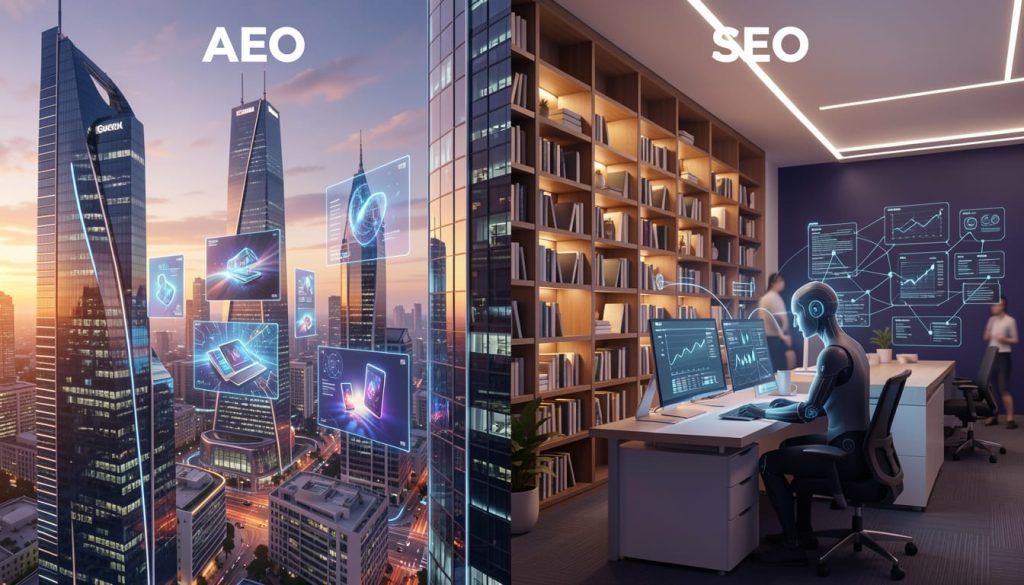
SEO vs AEO: What Each One Actually Does
Before building a combined strategy, it is worth being precise about what each discipline actually optimises for. They share vocabulary — “content quality,” “authority,” “relevance” — but apply those concepts in different ways, toward different outcomes.
SEO Is Built Around Rankings
Traditional SEO is the practice of improving a website’s visibility in search engine results pages (SERPs). Its primary currency is the ranked position — how high your page appears when a user types a query into Google or Bing. Success metrics typically include organic traffic volume, keyword rankings, click-through rates, and domain authority. The algorithm rewards pages that demonstrate topical relevance, earn backlinks from credible sources, load quickly, and satisfy user intent based on engagement signals like dwell time and bounce rate. For a comprehensive understanding of why both SEO and AEO are essential, check out this article on SEO and AEO in 2026.
AEO Is Built Around Citations
Answer Engine Optimisation (AEO) is the practice of structuring content so that AI-driven platforms — including Google AI Overviews, ChatGPT, Perplexity, and Claude — select it as the source of an answer. The goal is not a ranked position but a citation. AEO success looks like your brand’s content being quoted, summarised, or linked within an AI-generated response. The signals that drive this are fundamentally different: structured data, FAQ schema, direct and concise answer formatting, strong third-party brand presence, and content that reflects genuine expertise AI cannot replicate on its own.
Why the Same Content Can Succeed at One and Fail at the Other
A long-form pillar page built for SEO — comprehensive, internally linked, rich with keywords and supporting subheadings — may rank extremely well on Google while being largely unusable for an AI citation. The format is too dense. The answers are embedded too deep. The page was designed for a human reader navigating with intention, not an AI model extracting a concise, quotable response.
The reverse is also true. A tightly structured FAQ page with schema markup, direct answers under 50 words, and expert attribution may be cited repeatedly by AI platforms while sitting on page four of Google due to low backlink volume or thin word count. Both pages are doing their jobs — just different jobs. That is the core tension that a combined strategy resolves.
Where SEO and AEO Share Common Ground
Despite their differences, SEO and AEO are not opposites. There is a meaningful overlap zone where investment in one discipline actively supports the other. Understanding this overlap is what allows a lean content team to build both capabilities without doubling their workload.
High-Quality, Authoritative Content Matters for Both
Google’s own guidance on AI optimisation explicitly states the need to “create valuable, people-first content” — the same principle that has underpinned SEO best practice for years. E-E-A-T (Experience, Expertise, Authoritativeness, and Trustworthiness) is a framework Google developed for traditional search, but it has become equally central to AEO. AI platforms are trained to favour content from demonstrably credible sources, and that credibility is established through the same signals: expert authorship, factual accuracy, cited sources, and consistent topical depth across a domain.
This means that a well-executed content marketing programme — one built around genuine subject matter expertise — creates assets that serve both channels. The investment is not duplicated; it is leveraged across two distinct visibility surfaces.
Technical Performance and Mobile Optimisation Apply to Both
Page speed, mobile responsiveness, and clean site architecture are table-stakes for SEO. They are equally important for AEO because AI crawlers need to access and parse your content efficiently. A slow, poorly structured site that blocks crawlers or buries answers in JavaScript-rendered components is less likely to be indexed for citations regardless of how good the writing is. Core Web Vitals, canonical tags, and logical URL structures support both strategies simultaneously.
Where SEO and AEO Diverge in Execution
The shared foundation only gets you so far. Beyond authoritative content and technical hygiene, SEO and AEO require genuinely different tactical work. Treating them as interchangeable at this level is where most content strategies stall.
Backlinks and Domain Authority Drive SEO, Not AEO
In traditional SEO, backlinks remain one of the most powerful ranking signals. A page that earns links from high-authority domains climbs the rankings faster, and a domain with a strong overall link profile gives every page on it a competitive floor. Digital PR, guest posting, and link-building outreach campaigns exist almost entirely in service of this signal.
AEO operates differently. While a credible domain helps establish baseline trustworthiness, AI platforms do not select citations based on link graphs. A page with zero backlinks but a clear expert answer, proper schema markup, and direct formatting can be cited ahead of a heavily linked competitor page that buries its answer in long-form prose. This means link-building spend, while still valuable for SEO, does not automatically translate into AEO visibility gains.
Structured Data and FAQ Schema Are AEO-Specific Priorities
Schema markup — particularly FAQ schema, HowTo schema, and speakable schema — is one of the most direct levers available for AEO. It tells AI systems exactly where the questions are, exactly where the answers begin and end, and signals that the content was intentionally structured to be machine-readable. Google’s own developer documentation highlights structured data as a key input for AI-powered search features.
Most SEO-focused content workflows do not prioritise schema beyond basic article or product markup. Building AEO capability means auditing your highest-traffic pages for schema opportunities and making FAQ-structured content a default format for any piece targeting informational queries. This is a workflow change, not just a technical one.
Third-Party Credibility Signals Matter More in AEO
AI platforms build a picture of your brand from far more than your own website. Review platforms like G2, Capterra, and Trustpilot, mentions in industry publications, forum discussions on Reddit, and social media presence all contribute to how an AI model perceives your brand’s authority. A company with a strong website but minimal third-party footprint is at a structural disadvantage in AEO — the AI simply does not have enough corroborating signals to confidently cite it.
Conversational Query Formats Require a Different Content Approach
Users interact with AI search engines the way they speak, not the way they type into Google. Queries are longer, more contextual, and often framed as complete questions — “What is the best project management tool for a remote team of ten?” rather than “project management software remote teams.” Content built purely around short-tail keyword phrases will not match these conversational patterns. AEO content needs to anticipate natural language questions and answer them directly within the first two to three sentences of a response, without requiring the reader to scroll to find the point.
The Real Cost of Choosing One Over the Other
The instinct to prioritise one strategy over the other is understandable — resources are finite, and focus has real value. But the cost of that trade-off is more concrete than most marketing teams realise when they make it.
A brand that invests only in SEO will maintain its organic search presence but will steadily lose share of voice as more buyers begin — and sometimes complete — their research journey inside AI platforms. A brand that pivots entirely to AEO without maintaining its SEO foundation risks losing the organic traffic that funds the broader marketing operation while chasing citations that may not yet convert at scale. The risk is not abstract — it is compounding and directional.
Customers Use Both Channels in the Same Search Session
Modern buyers do not make a clean choice between Google and AI search. Research from multiple digital marketing studies shows that a single purchase decision often involves AI-assisted discovery, followed by traditional search to validate, followed by direct website visits to evaluate. A brand that is visible in only one of these stages is invisible during the others — and invisibility at any stage of that sequence creates an opening for a competitor to capture the conversion.
AI Search Is Still Less Crowded — Early Movers Have an Advantage
Traditional SEO is a mature, heavily contested space. Competitive keywords in most B2B and B2C categories have been fought over for years, and breaking into the top positions requires sustained investment, significant domain authority, and patience measured in months or quarters.
AEO is a different landscape. The number of brands actively building structured, citation-ready content for AI platforms is still relatively small. AI search results are not yet as saturated as Google’s first page, which means a well-executed AEO strategy implemented now can earn citation positions that will be significantly harder to displace once the space matures.
The analogy to early SEO in the mid-2000s is imperfect but instructive. The brands that invested in search optimisation before it became standard practice built domain authority and content archives that compounded over time. The window to be an early mover in AEO is measurably open right now — and it will not stay open indefinitely.
What a Combined AEO and SEO Strategy Looks Like in Practice
A unified strategy does not mean doing twice the work. It means making deliberate decisions at the content planning stage so that each asset you produce is built to perform across both channels. The five tactics below are the highest-leverage actions for teams building this dual capability.
1. Publish Original Research and First-Hand Insights AI Cannot Replicate
AI platforms are trained on existing data. They can summarise, synthesise, and explain — but they cannot generate original survey findings, proprietary customer data, or first-hand market observations that do not already exist in their training sets. Content built around original research creates a citation dependency: if an AI model wants to reference that data point, it has to cite your brand.
This does not require a dedicated research team. Even small-scale surveys of your existing customer base, aggregated data from your own platform, or structured expert commentary on emerging trends creates the kind of unique content that both AI platforms and traditional search algorithms reward. Original data earns backlinks for SEO and citations for AEO from the same single investment.
2. Leverage Subject Matter Experts for Q&A and Trend Content
One of the clearest AEO signals is demonstrable human expertise that an AI model could not credibly fabricate. Content that features named subject matter experts — with clear credentials, direct quotes, and specific insights drawn from real experience — performs consistently well across both AI citations and Google’s E-E-A-T evaluation. Building a content calendar that systematically captures expert perspectives through structured Q&A formats, bylined articles, and commentary pieces gives your content programme a quality ceiling that generic, AI-generated content simply cannot reach.
3. Update Existing Pages With Fresh Perspectives Regularly
Stale content is a liability in both SEO and AEO. Google’s ranking algorithm actively rewards freshness signals on pages targeting time-sensitive or competitive queries — and AI platforms are trained to favour content that reflects current information over outdated material. A systematic content refresh programme, where your highest-performing pages are updated quarterly with new data, updated examples, and current expert perspectives, extends the lifespan of existing assets while continuously improving their performance across both channels.
The most effective refresh strategy is not a cosmetic rewrite. It means adding genuinely new information — updated statistics, recent case examples, revised recommendations based on market changes — that gives both search algorithms and AI models a reason to re-evaluate the page. Even a single new data point or a direct expert quote added to an existing piece can shift its citation potential significantly.
4. Build Positive Brand Presence Across Review Platforms Like G2
AI models do not evaluate your brand solely from your own website. They build a composite picture from everything publicly available — and that includes review platforms, industry directories, forum mentions, and third-party publications. A brand with strong, consistent positive presence on platforms like G2, Capterra, Trustpilot, or even Reddit threads is far more likely to be cited confidently by an AI model than a brand whose only substantial footprint is its own domain.
This is an area where many SEO-focused teams have a genuine blind spot. Traditional SEO strategy rarely includes review platform management as a core tactic. For AEO, it is foundational. Actively encouraging customers to leave detailed, specific reviews — not just star ratings — creates third-party content that AI platforms can extract and reference. A proactive review generation programme is one of the fastest ways to build the off-site credibility signals that AEO depends on.
5. Use Structured Data to Make Content Directly Citable by AI
Implementing schema markup — particularly FAQ schema, HowTo schema, and Article schema with clear author attribution — is one of the most direct technical levers available for improving AEO performance. Structured data acts as a translation layer between your content and AI crawlers, explicitly marking where questions are asked, where answers begin, who wrote the content, and when it was last updated. Pages with properly implemented schema give AI models everything they need to extract a citation-ready answer without ambiguity. Audit your top informational pages first, add FAQ schema to any page that answers common industry questions, and ensure every published article carries author schema with verifiable credentials.
Both Strategies, One Content Foundation
The most efficient path to dual visibility is not two separate content programmes running in parallel — it is a single content foundation built with both channels in mind from the start. That means planning content around questions real buyers are asking, structuring every piece so its core answer is findable within the first two to three sentences, assigning named expert authors with clear credentials, implementing schema markup as a default rather than an afterthought, and maintaining a refresh cadence that keeps your best pages current. When each of those habits is embedded into the workflow, the same content asset that climbs Google’s rankings also earns citations in AI-generated responses.
The brands that will own search visibility in 2026 and beyond are not the ones that chose SEO over AEO or AEO over SEO — they are the ones that stopped treating the two as a trade-off and started treating them as a system. That shift in perspective is available to any marketing team right now, regardless of size or budget. The only real barrier is the assumption that the old playbook is still sufficient on its own.
Frequently Asked Questions About Why AEO and SEO Are Complementary
The questions below reflect what digital marketing professionals ask most consistently when they start building a combined AEO and SEO strategy. Each answer is kept direct and actionable.
What is the difference between SEO and AEO?
SEO (Search Engine Optimisation) and AEO (Answer Engine Optimisation) both aim to increase your brand’s visibility in search — but they target different platforms and optimise for different outcomes.
- SEO focuses on ranking your pages in traditional search engine results pages (SERPs) like Google and Bing, measured by position, organic traffic, and click-through rate.
- AEO focuses on getting your content cited by AI-driven answer platforms like ChatGPT, Perplexity, Google AI Overviews, and Claude, measured by citation frequency and brand mentions within AI responses.
- SEO rewards backlinks, keyword relevance, and engagement signals.
- AEO rewards structured formatting, direct answers, schema markup, and third-party credibility signals.
- Both reward authoritative, expert-led content and strong technical site performance.
The practical takeaway is that a page optimised purely for one will not automatically perform in the other. Both require deliberate, specific execution on top of a shared content quality foundation. For more insights on why you need both strategies, check out this article on SEO and AEO in 2026.
Can a page rank well on Google and also be cited by AI platforms?
Yes — and building pages that do both simultaneously is the goal of a combined AEO and SEO strategy. However, it requires intentional design rather than assuming that a high-ranking page will automatically earn AI citations.
Pages that consistently perform across both channels tend to share the following characteristics:
- A direct, concise answer to the primary query within the first paragraph
- FAQ schema markup that explicitly structures question-and-answer pairs
- Named expert authorship with verifiable credentials
- Original data, insights, or perspectives that AI models cannot independently generate
- Regular content updates that maintain freshness signals for both algorithms and AI training data
- Strong backlink profiles that reinforce domain authority for SEO while signalling credibility for AEO
The key design principle is to lead with the answer, then support it with depth — rather than the traditional SEO approach of building context before delivering the payoff.
Do I need a separate content strategy for AEO?
Not a separate strategy — but a deliberately expanded one. The most efficient approach is to audit your existing SEO content programme and identify the specific gaps that limit AEO performance: missing schema markup, answers buried too deep in long-form content, lack of expert attribution, and thin third-party brand presence. Closing those gaps within your existing workflow is more practical than building a parallel content operation, and it ensures that every new piece of content is built to serve both channels from day one.
Which AI platforms does AEO apply to?
AEO applies to any platform that generates answers from indexed or trained content rather than returning a list of ranked links. The primary platforms to optimise for in 2026 are Google AI Overviews, ChatGPT (including its Browse with Bing functionality), Perplexity AI, Microsoft Copilot, and Claude by Anthropic.
Each platform has slightly different weighting for the signals it uses to select citations — Perplexity, for example, places particularly strong emphasis on real-time web content and source transparency, while Google AI Overviews are more directly influenced by existing E-E-A-T signals from the traditional search index. However, the core AEO tactics — structured formatting, schema markup, direct answers, expert attribution, and strong third-party presence — improve performance across all of them.
Voice search platforms like Apple Siri and Amazon Alexa also operate on answer-engine principles, making AEO optimisation relevant for any brand targeting voice-assisted queries. As AI becomes embedded in more search surfaces, the addressable scope of AEO will continue to expand.
Is AEO more important than SEO in 2026?
Neither discipline is more important in absolute terms — they serve different buyer touchpoints in the same search journey, and deprioritising either one creates a measurable gap in your brand’s overall visibility. The more useful framing is that AEO is now equally important to SEO, rather than secondary to it, which represents a genuine shift from where the industry stood just two years ago.
What has changed is the urgency. Traditional SEO is a mature space with established competition and long feedback loops. AEO is earlier in its competitive lifecycle, which means the return on investment for brands building AEO capability now is disproportionately high relative to the effort required. The opportunity cost of waiting — while competitors establish citation authority across AI platforms — is real and compounding.
The most strategically sound position for any digital marketing team in 2026 is to maintain and protect existing SEO performance while systematically building AEO capability in parallel. That dual investment does not require a larger budget — it requires a smarter allocation of the content resources you already have. To explore how a structured approach to both SEO and AEO can be implemented for your brand, connect with a team that specialises in modern search visibility strategy.
