
The Best AI Marketing Service In Cape Town
Your Google ranking is not the problem, your AI invisibility is. Cape Town features a dynamic market for AI marketing, and finding the right service depends on your specific business goals.
Key Takeaways: AI Marketing Service In Cape Town
- AI search engines like ChatGPT, Perplexity, and Google AI Overviews are now the first stop for buyers — if your Cape Town business isn’t structured to be cited by these platforms, you’re losing leads to competitors who are.
- Traditional SEO rankings no longer guarantee visibility — organic click-through rates have dropped significantly as AI-generated answers replace the need to click through to websites.
- The best AI marketing service in Cape Towwn doesn’t just chase Google rankings — it builds your authority so AI engines recommend your business by name when someone asks the exact question you answer.
- CapeBiz Toolkit, can help local SMEs and tourism businesses get cited in ChatGPT, Perplexity, and Google AI Overviews through structured schema, answer-first content, and E-E-A-T signals.
- There are five specific pillars that determine AI visibility for Cape Town businesses — and most local businesses are missing at least three of them right now.
Cape Town Businesses Are Invisible to AI Search — Here’s Why That Costs You
Right now, thousands of potential customers in Cape Town are opening ChatGPT, typing “best accountant in Bellville” or “top Cape Town tour operator,” and getting a confident, sourced answer back in seconds. If your business isn’t in that answer, you don’t exist to that buyer. It doesn’t matter that you rank on page one of Google. AI engines pull from a completely different set of signals, and most Cape Town businesses haven’t been built for those signals at all.
How AI Engines Like ChatGPT and Perplexity Decide Who to Recommend
AI engines don’t scroll through search results the way a human does. They scan indexed content, schema markup, structured data, and authoritative citations to determine which business best answers a specific question. ChatGPT, Perplexity, and Google’s AI Overviews all prioritize content that is direct, well-structured, and backed by trust signals — things like consistent business information across directories, clear FAQs with schema markup, and content written to answer questions rather than chase keywords. If your website talks around topics instead of directly answering them, AI engines will skip you entirely and cite someone who does.
The Difference Between Traditional SEO and AI SEO
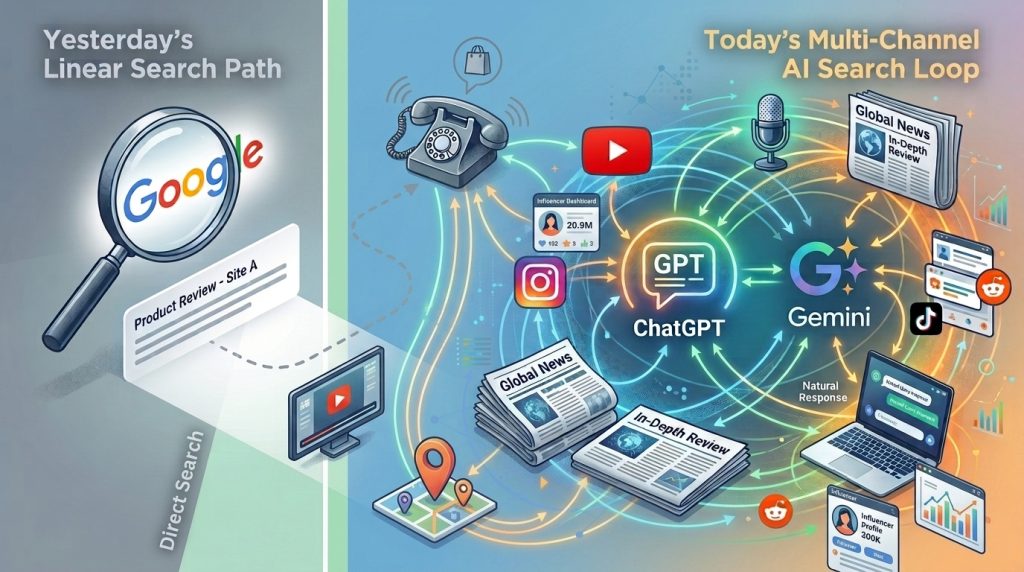
Traditional SEO was built to satisfy Google’s crawlers — keyword density, backlink counts, meta descriptions, and page speed. These still matter, but they’re no longer sufficient. AI SEO, also called Answer Engine Optimization (AEO) or Generative Engine Optimization (GEO), focuses on making your content machine-readable, question-answerable, and citable. The goal shifts from “rank on page one” to “be the answer AI gives when someone asks.” That requires a fundamentally different content architecture, schema implementation, and authority-building strategy than what most Cape Town agencies currently offer.
Why Ranking on Google No Longer Guarantees Business Visibility
Google’s own AI Overviews now answer questions directly at the top of the page before a single organic result appears. When that happens, users don’t need to click. Organic click-through rates across industries have dropped sharply as a result — meaning a page one ranking delivers fewer visitors than it did two years ago. For Cape Town businesses investing in traditional SEO, this is a critical blind spot. You may be paying for rankings that fewer and fewer people are actually clicking on, while the AI-generated answer above yours is sending those buyers somewhere else.
What AI Marketing Actually Does for Cape Town Businesses
An AI marketing service in Cape Town isn’t about replacing your existing strategy — it’s about making everything you’ve built actually visible to the platforms where buyers are now searching.
Answer Engine Optimization (AEO) Explained Simply
Answer Engine Optimization is the practice of structuring your content so that AI systems select it as the best response to a user’s question. Instead of writing a blog post that mentions “Cape Town accounting services” fifteen times, AEO means writing a page that directly answers “What should I look for in a Cape Town accountant?” — with a clear, structured response that an AI engine can extract and cite.
This involves FAQPage schema markup, which tells AI crawlers exactly where your questions and answers are located on the page. Most Cape Town websites do the opposite — they write for humans but give machines nothing to work with.
Generative Engine Optimization (GEO) and Why It Matters Locally
GEO takes AEO further by optimizing your content specifically for generative AI platforms — the systems that create full responses rather than just returning links. Perplexity AI, ChatGPT with Browse, and Google Gemini all generate answers from sourced content. GEO ensures your business is one of those sources.
For Cape Town businesses, local GEO means your suburb, service area, and specific offerings are explicitly structured in your content so that when someone asks “Who is the best plumber in Sea Point?” the AI has clear, unambiguous data to work with.
- Use suburb-level specificity — “Cape Town” is too broad; name the areas you serve explicitly
- Structure service pages as Q&A pairs — one clear question, one direct answer per section
- Add LocalBusiness schema with exact service categories, hours, and geographic coordinates
- Cite your credentials explicitly — years in operation, certifications, and client outcomes
- Ensure your NAP data matches exactly across your website, Google Business Profile, and every directory listing
GEO is not optional for Cape Town businesses that want to compete in 2026 and beyond. It is the foundation of AI visibility.
How An AI Marketing Service In Cape Town Drives More Inbound Calls and Leads
When AI engines cite your business by name in response to a buyer’s question, the quality of that lead is significantly higher than a cold click from a search result. The buyer has already been told — by an AI they trust — that your business is the answer. They arrive with intent, context, and confidence.
This is the conversion advantage that an AI marketing service in Cape Town caan deliver. It’s not just about traffic volume. It’s about being positioned as the pre-vetted recommendation before the buyer even visits your website. Cape Town businesses that appear in AI-generated answers consistently report higher call quality and faster decision-making from new enquiries.
Why Most Cape Town SEO Agencies Are Still Selling Outdated Strategies
Most Cape Town agencies are still building strategies around keyword clusters, backlink outreach, and on-page optimisation that was designed for a 2019 version of Google. These strategies aren’t worthless — but they’re incomplete. An agency that can’t tell you whether your business appears in ChatGPT or Perplexity is not equipped to compete in the current landscape.
The agencies that will survive the next three years are the ones retooling right now — implementing schema at scale, building answer-first content architecture, and tracking AI citation rates alongside traditional metrics. The rest will keep selling page-one rankings to clients who are wondering why their phone isn’t ringing.
The shift happening in search right now:
Signal Traditional SEO Focus AI SEO Focus Content Goal Keyword ranking Being cited as the answer Structure Meta tags & headers Schema markup & FAQPage JSON-LD Authority Signal Backlinks E-E-A-T + directory consistency Measurement Rankings & impressions AI citation rate & inbound call quality Geographic Targeting City-level keywords Suburb-specific structured data
The Problem With Keyword Rankings as a Success Metric
A keyword ranking tells you where your page appears in a list that fewer people are scrolling through. It says nothing about whether your business is being recommended by the AI platforms that have already replaced that list for a growing segment of buyers. Reporting on rankings without reporting on AI visibility is like tracking how many people walk past your shop window while ignoring whether your address appears on the map app everyone is actually using.
What a 61% Drop in Organic CTR Means for Your Business
Studies tracking organic search behavior have documented significant drops in click-through rates since AI Overviews became standard in Google results. When an AI-generated answer appears above organic results, users frequently get what they need without clicking at all. For Cape Town businesses relying solely on organic traffic, this represents a structural revenue risk that keyword rankings will never reveal.
What ChatGPT’s 2.5 Billion Daily Prompts Mean for Local Businesses
ChatGPT processes approximately 2.5 billion prompts every day globally. A meaningful and growing portion of those prompts are local, service-based queries — the exact kind of questions your Cape Town customers are asking. Every day your business isn’t structured to appear in those answers is a day competitors who are structured correctly are receiving those referrals instead. The scale of AI search adoption is not a future trend to prepare for. It is the current reality to respond to.
The 5 Pillars of AI Visibility for Cape Town SMEs
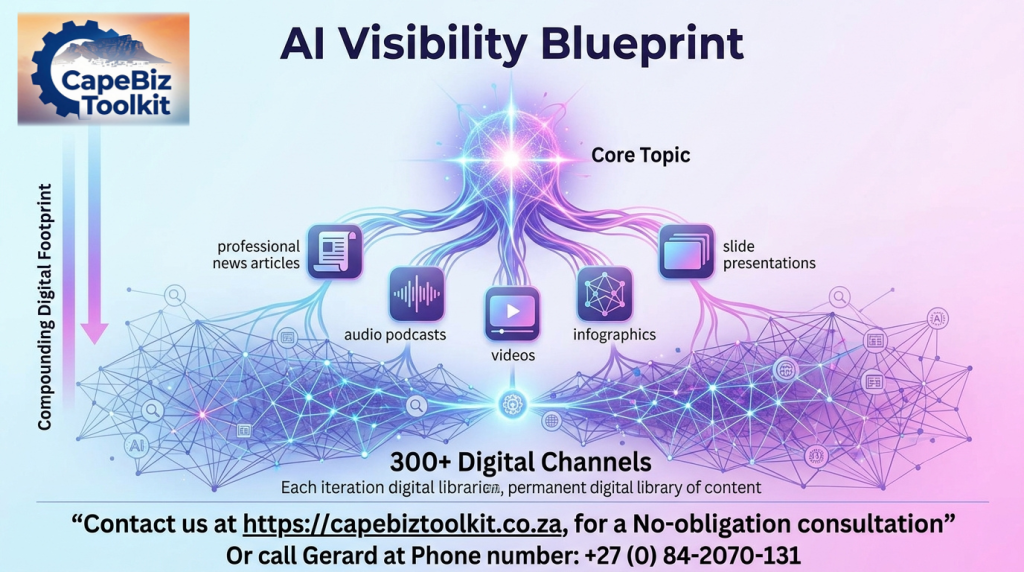
Most Cape Town businesses are missing AI visibility not because their services are poor, but because their websites were never built to communicate with machines. These five pillars are what separate businesses that get cited by AI engines from those that don’t. For more insights, check out this AI visibility blueprint for local businesses.
1. Google Business Profile Optimization for AI Search
Your Google Business Profile is one of the most powerful AI visibility signals available to a Cape Town SME — and most profiles are only 60% complete. Every field matters: service descriptions, business categories, operating hours, geo-tagged photos, and regular posts all feed directly into how AI engines understand and represent your business. Google’s own AI Overviews pull heavily from GBP data when generating local business recommendations. A half-filled profile tells AI engines you’re half a business.
2. FAQPage Schema on Every Service Page
FAQPage schema is structured JSON-LD code added to your website that explicitly marks up question-and-answer pairs so AI crawlers can extract them directly. When Perplexity or Google AI Overviews scan your site and find clearly marked FAQs with schema, they can lift those answers and cite your business as the source. Without schema, your content is readable by humans but largely invisible to machine extraction. Every service page on your Cape Town business website should have a minimum of five to ten real customer questions answered with schema markup in place.
3. Answer-First Content That AI Engines Can Cite
Traditional content buries the answer. AI-optimized content leads with it. The answer-first content model means your opening sentence directly addresses the question your heading poses — no preamble, no context-setting, no warm-up paragraph. AI engines scan for the clearest, most direct response to a query and cite that. If your content takes three paragraphs to get to the point, an AI engine has already moved on to a competitor who answered in the first line.
4. South African Directory Citations With Consistent NAP Data
NAP stands for Name, Address, and Phone number — and consistency across every platform where your business appears is a foundational trust signal for AI engines. If your business is listed as “Easy Rank Pty Ltd” on your website, “EasyRank” on Brabys, and “Easy Rank SEO” on Google Business Profile, AI systems register those as three different entities. That inconsistency erodes your authority score. Building 15 to 30 citations on verified South African directories — including Brabys, SA Yellow Pages, Hotfrog ZA, and Cylex South Africa — with identical NAP data creates a consistent, machine-readable identity that AI engines trust and cite.
5. E-E-A-T Signals That Build Trust With AI Engines
Experience, Expertise, Authoritativeness, and Trustworthiness — Google’s E-E-A-T framework — are the qualitative signals that AI engines use to determine whether a source is worth citing. For Cape Town SMEs, building E-E-A-T means publishing content that references real credentials, real client outcomes, named team members with professional backgrounds, and third-party mentions from credible South African sources. An AI engine asked to recommend a Cape Town accountant will favor the firm whose website demonstrates a track record over one that makes generic claims about quality service. E-E-A-T is how you prove to a machine that you are who you say you are.
Your 7-Step AI SEO Action Plan for Cape Town
This is the exact sequence used to take Cape Town businesses from AI-invisible to AI-cited. Each step builds on the previous one, so the order matters. Don’t skip ahead to schema before your GBP is complete — AI engines cross-reference these signals, and gaps in the foundation undermine everything built on top of it.
The full implementation takes between four and eight weeks depending on the size of your website and the current state of your online presence. Some steps can be completed in an afternoon. Others require ongoing commitment. All of them are non-negotiable if AI visibility is the goal.
- Step 1: Audit your Google Business Profile completely
- Step 2: Install and configure Rank Math Pro with LocalBusiness schema
- Step 3: Rewrite service pages with answer-first content
- Step 4: Add FAQPage schema with 5 to 10 real customer questions per page
- Step 5: Build 15 to 30 citations on South African directories
- Step 6: Publish one authoritative blog post per month
- Step 7: Test your AI visibility monthly across ChatGPT, Perplexity, and Google
Each step targets a specific layer of the AI visibility stack. Together, they build the kind of structured, authoritative online presence that AI engines treat as a trusted source rather than background noise.
Work through these in sequence, document what you change and when, and use that record to track which changes correlate with visibility improvements in your monthly AI tests.
1. Audit Your Google Business Profile Completely
Log into your Google Business Profile and treat every empty field as a missed citation opportunity. Your business name, address, and phone number must exactly match what appears on your website — character for character, including abbreviations. Select every relevant business category, not just the primary one. Google allows multiple categories, and each one expands the query surface your business can appear for.
Upload a minimum of ten photos. Name each photo file descriptively before uploading — “cape-town-tax-accountant-bellville-office.jpg” communicates more to a crawler than “IMG_4823.jpg.” Geo-tag your images where possible. Enable messaging, add your service menu with individual descriptions for each offering, and publish your first GBP post if you haven’t done so in the last 30 days.
2. Install and Configure Rank Math Pro With LocalBusiness Schema
Rank Math Pro is the most practical schema implementation tool for WordPress-based Cape Town business websites. After installation, navigate to the Schema tab and select LocalBusiness as your site-wide schema type. Fill in every available field: business name, address, phone, coordinates, opening hours, price range, and service area. This data is what AI engines read when they need structured confirmation of who you are and where you operate. Rank Math Pro outputs this as JSON-LD, which is the schema format preferred by Google, Perplexity, and other AI crawlers. If your site isn’t on WordPress, the equivalent structured data can be added manually to your site’s <head> tag using Google’s Schema Markup documentation as a reference.
3. Rewrite Service Pages With Answer-First Content
Take your highest-traffic service page and rewrite it from scratch using the answer-first framework. Identify the primary question a buyer has when they land on that page — “What does a Cape Town SEO agency actually do for my business?” — and make that your H2 heading. The first sentence of the body text answers that question directly and completely. Everything that follows is supporting detail, proof, and context.
Remove any introductory paragraphs that don’t answer a question. AI engines reward density of relevant information per paragraph, not word count per page. A 400-word service page that directly answers five real buyer questions will outperform a 1,200-word page of general claims in AI citation rates every time.
Answer-First Content Framework — Before & After
Element Before (Traditional) After (Answer-First) Page Heading Cape Town Accounting Services What Does a Cape Town Accountant Actually Do for Your Business? Opening Sentence Welcome to our accounting firm, where we pride ourselves on delivering exceptional financial services… A Cape Town accountant manages your tax submissions, payroll compliance, and SARS correspondence so your business stays financially legal and cash-flow clear. Service Description We offer a wide range of accounting solutions tailored to your unique needs. We handle monthly bookkeeping, VAT returns, provisional tax, and annual financial statements for Cape Town SMEs across retail, hospitality, and professional services. FAQ Section None 5 to 10 questions with FAQPage schema markup AI Citability Low — vague, machine-unreadable High — structured, specific, extractable
Apply this same rewrite process to every core service page on your site, starting with the pages that target your highest-value services. Prioritize pages where a buyer’s decision to contact you hinges on getting a clear answer to a specific question — those are the pages where answer-first content delivers the most immediate AI citation lift.
4. Add FAQ Page Schema With 5 to 10 Real Customer Questions
FAQ Page schema is the single highest-impact technical change most Cape Town businesses can make in an afternoon. Using Rank Math Pro, navigate to the Schema section of any service page and add the FAQ schema block. Enter real questions — the ones your clients actually ask during discovery calls, not the questions you wish they asked. “How much does an accountant cost in Cape Town?” beats “What are your accounting service offerings?” every time, because the first is what a human types into ChatGPT and the second is what a marketing manager thinks sounds professional. Use five questions as a minimum and ten as your ceiling per page. Beyond ten, schema density can dilute rather than strengthen the signal. Each answer should be two to four sentences — specific, direct, and free of filler language.
5. Build 15 to 30 Citations on South African Directories
A citation is any online listing that references your business name, address, and phone number. Start with the highest-authority South African directories: Brabys, SA Yellow Pages, Hotfrog ZA, Cylex South Africa, and local Chamber of Commerce listings. Then move to industry-specific directories relevant to your sector — a Cape Town law firm should appear on Legal SA and Lawyer South Africa in addition to the general directories. The critical rule is consistency: your NAP data must be character-for-character identical across every listing. Create a master NAP document before you start and paste from it every time. Once your citations are live, submit each directory URL to Google Search Console to accelerate indexing.
6. Publish One Authoritative Blog Post Per Month
One well-structured, question-answering blog post per month consistently outperforms a weekly output of thin, keyword-stuffed content in AI citation rates. Each post should target a specific question your Cape Town clients ask — “What is the difference between provisional tax and income tax in South Africa?” or “How do I register a company in Cape Town in 2025?” — and answer it completely in 600 to 1,000 words. Use H2s and H3s as sub-questions. Include at least one data point from a credible South African source — SARS, Statistics South Africa, or an industry body. Add FAQ Page schema to the bottom of every post.
7. Test Your AI Visibility Monthly Across ChatGPT, Perplexity, and Google
Open ChatGPT, Perplexity, and Google with a fresh browser session at the start of each month. Search for your services in your specific suburb — “best tax accountant in Bellville,” “Cape Town tour operator for small groups,” “SEO agency in Cape Town for SMEs.” Record which businesses are cited, which sources are referenced, and whether your business appears anywhere in the response. This is your AI visibility baseline. Document it in a simple spreadsheet with the date, the query, and the result.
Track changes month over month. After implementing FAQPage schema on a service page, test that page’s core queries the following month to see if citation appearances have changed. After building your directory citations, check whether Perplexity is now pulling your NAP data consistently. This monthly testing habit transforms AI SEO from a set-and-forget activity into a measurable, improvable system. It also gives you the kind of concrete evidence — “we now appear in ChatGPT for three queries we were invisible on two months ago” — that makes the value of an AI marketing service in Cape Town undeniable.
How Long Before AI SEO Delivers Results in Cape Town
The honest answer is: faster than most traditional SEO, but not overnight. The timeline depends on the current state of your online presence, the competitiveness of your service category, and how completely you implement the five pillars. Businesses starting from a relatively strong Google foundation — an active GBP, an indexed website, some existing directory presence — typically begin seeing AI citation appearances within four to eight weeks of completing schema implementation and content rewrites.
Businesses starting from scratch — no GBP, no schema, thin content, inconsistent NAP data — should expect a 10 to 16 week runway before meaningful AI visibility emerges. This isn’t a flaw in the strategy; it’s the time AI engines need to crawl updated content, index new schema, and cross-reference your growing citation footprint. The compounding effect accelerates after that initial period.
What you will notice sooner than AI citations is an improvement in the quality and specificity of organic traffic. Answer-first content rewrites tend to attract visitors with clearer intent — people who read your heading, recognized it as the exact answer to their question, and clicked through.
- Weeks 1 to 2: GBP optimization and schema installation complete — foundation in place
- Weeks 3 to 4: Service page rewrites live — answer-first content indexed by Google
- Weeks 4 to 6: Directory citations built and submitted — NAP consistency established
- Weeks 6 to 8: First AI citation appearances begin for lower-competition local queries
- Months 3 to 6: Consistent citation presence across ChatGPT, Perplexity, and Google AI Overviews for core service queries
- Month 6 onwards: Compounding authority — new content accelerates citation rate, inbound call volume reflects cumulative AI visibility
Frequently Asked Questions About AI Marketing Service In Cape Town
These are the questions Cape Town business owners ask most frequently when they first encounter AI SEO — answered directly, without the jargon.
What Is the Best AI Marketing Service in Cape Town?
The best AI marketing service in Cape Town is one that specializes in Answer Engine Optimization, Generative Engine Optimization, and Local AI visibility — not just traditional Google SEO. Any Cape Town dedicated AI SEO agency wirth their salt, shoould focus specifically on getting local businesses cited by ChatGPT, Perplexity, and Google AI Overviews through schema markup, answer-first content, and South African directory authority building.
How Is AI SEO Different From Traditional SEO?
Traditional SEO optimizes your website to rank in a list of search results that a human then scrolls through and selects from. AI SEO optimizes your content and structured data so that AI engines — ChatGPT, Perplexity, Google AI Overviews — select your business as the cited answer to a buyer’s question, before that buyer ever sees a list of results. The technical inputs are different: AI SEO relies on FAQPage schema, answer-first content architecture, consistent NAP data, and E-E-A-T signals rather than keyword density and backlink volume alone. The outcome is also different: instead of a ranking position, you get a named recommendation from an AI engine your customer already trusts.
What Is the Most Important First Step for Cape Town SMEs Starting AI SEO?
Complete your Google Business Profile fully before anything else. Every field — service descriptions, categories, geo-tagged photos, business hours, and a direct, specific business description — feeds into how AI engines understand and represent your business in local search responses. A complete, active GBP is the single fastest trust signal you can establish, and it underpins every other AI SEO action that follows. If your GBP is incomplete, schema and content rewrites will underperform because AI engines lack the foundational location and identity data they need to cite you confidently.
How Long Does It Take to See Results From AI SEO in Cape Town?
Businesses with an existing Google presence typically begin seeing AI citation appearances within four to eight weeks of completing schema implementation, GBP optimization, and answer-first content rewrites. Businesses starting from a weaker foundation should plan for a 10 to 16 week timeline before consistent AI visibility emerges across ChatGPT, Perplexity, and Google AI Overviews.
The compounding effect of AI SEO means results accelerate over time. Each new FAQ schema block, each directory citation, and each published blog post adds to a cumulative authority profile that AI engines draw from more frequently as it grows. Month six of a consistent AI SEO strategy typically delivers more citation appearances than months one through three combined.
Does Google Business Profile Still Matter for AI Search Visibility?
Yes — significantly. Google’s AI Overviews pull directly from GBP data when generating local business recommendations. A complete, active Google Business Profile is one of the strongest AI visibility signals available to a Cape Town SME, and it is completely free to maintain.
Perplexity and ChatGPT with Browse also index GBP data indirectly through the web pages and directories that reference your business information. When your GBP data is complete and consistent with your website and directory listings, all three AI platforms receive a coherent, trustworthy signal about who your business is, where it operates, and what it offers. For more insights on optimizing AI platforms, you can refer to this AI visibility blueprint.
Businesses with incomplete GBP profiles — missing service descriptions, no photos, generic business categories, or inconsistent contact details — are actively undermining their AI visibility even if their website content is strong.
Ready To Learn More About AI Marketing Services In Cape Town?
Then Visit CapeBiz Toolkit’s AI Visibility Blueprint Page Today.