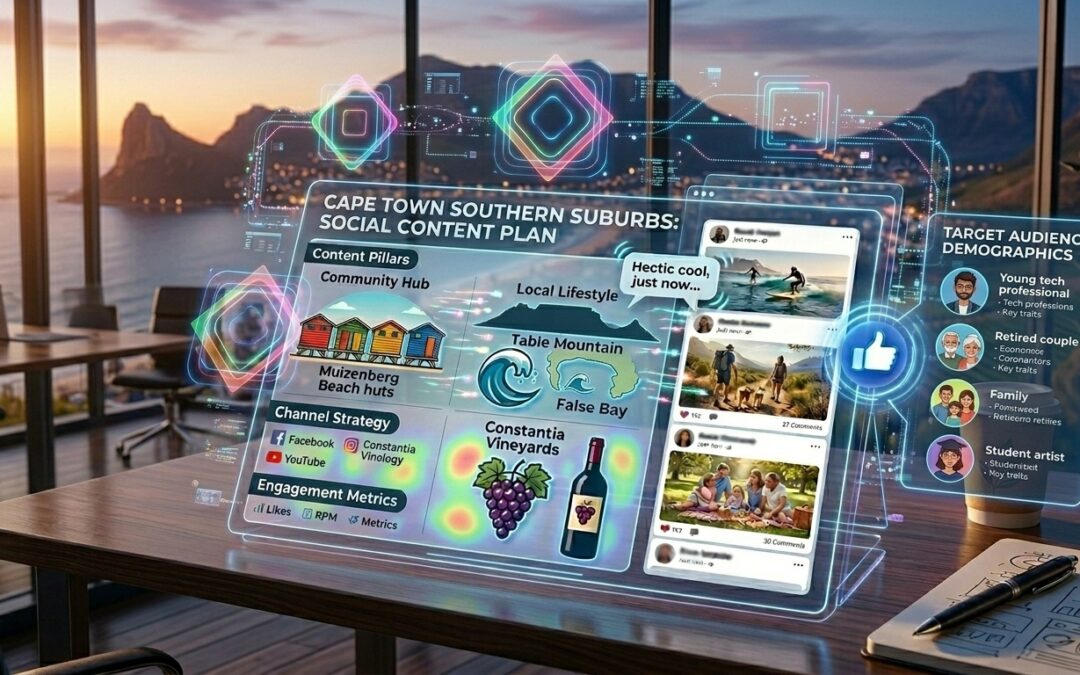
A Compelling Social Media Plan for The Southern Suburbs
A successful social media plan for the Southern Suburbs of Cape Town requires a localized, community-focused approach that balances authenticity with consistent, high-quality visuals. Target audiences in areas like Constantia, Claremont, Rondebosch, and Newlands value community, lifestyle, and reliability.
Key Takeaways: Social Media Plan for The Southern Suburbs
- South Africa has over 26 million active social media users, and Cape Town’s Southern Suburbs represent one of the most digitally engaged local audiences in the country.
- WhatsApp is not just a messaging app in Cape Town — it is a core business communication and marketing tool that most local businesses are underusing.
- Choosing the wrong platform for your business type is one of the biggest mistakes Southern Suburbs businesses make with social media.
- Hyper-local content referencing recognizable landmarks, events, and community culture consistently outperforms generic content for Cape Town audiences.
- CapeBiz Toolkit provides local Cape Town businesses with practical digital marketing tools designed specifically for the Southern Suburbs market — find out how it fits into your strategy below.
Most social media advice is written for businesses in London or New York — and it shows the moment you try to apply it in Claremont or Constantia.
The Southern Suburbs of Cape Town have a character all their own. From the leafy residential streets of Rondebosch and Newlands to the busy retail corridors of Claremont and the upmarket estate feel of Constantia, this part of the city attracts a specific kind of consumer — educated, community-oriented, and increasingly digital. A social media plan built for this audience needs to reflect that reality, not just recycle global best practices.
For local businesses looking to cut through the noise, CapeBiz Toolkit offers a locally grounded resource built around what actually works in Cape Town’s unique market. Rather than guessing which strategy to follow, Southern Suburbs businesses can work from a foundation designed for this exact environment.
Southern Suburbs Businesses Need a Different Social Media Approach
A coffee shop in Sea Point and a law firm in Claremont are not competing for the same audience, on the same platform, with the same content — and yet most generic social media guides treat them identically. The Southern Suburbs reward specificity. Residents here are not passive scrollers; they are active community members who engage with content that feels local, relevant, and real. Discover more about smart digital marketing strategies tailored for Cape Town businesses.
Why Generic Social Media Advice Fails Local Businesses
Global social media guides are optimized for scale. They assume large budgets, broad audiences, and the kind of brand recognition that takes years to build. For a physiotherapy practice in Kenilworth or a boutique retail store in Cavendish, that advice creates more confusion than clarity. The tactics that drive results in a Southern Suburbs context are grounded in community trust, local visibility, and platform choices that match how this specific audience actually spends its time online.
The mismatch gets worse when businesses blindly copy competitor strategies from other markets. What works for a Johannesburg e-commerce brand does not automatically translate to a family-run restaurant in Wynberg. Southern Suburbs consumers respond to authenticity and local relevance, which means your social media plan needs to be built around your neighborhood, not someone else’s.
The Southern Suburbs Audience: Who You Are Actually Talking To
Understanding your audience is the foundation of any effective social media plan. In the Southern Suburbs, that audience skews toward professionals, families, and young adults with disposable income and strong community ties. They shop locally when they can, they trust word-of-mouth recommendations, and they engage with businesses that show genuine involvement in their neighborhoods.
Key characteristics of the Southern Suburbs social media audience include:
- Higher-than-average household income compared to other Cape Town regions
- Strong preference for locally owned and operated businesses
- Active participation in community Facebook groups and WhatsApp neighborhood chats
- High engagement with visual content tied to recognizable local landmarks and culture
- Significant LinkedIn usage among the professional and corporate demographic
- Growing TikTok adoption among the 18–30 age bracket in suburbs like Observatory and Rondebosch
Knowing this shapes every decision in your social media plan — from which platforms you prioritize to what time you post and what language you use in your captions.
South Africa Has 26 Million Active Social Media Users — Here Is Your Share
South Africa’s social media penetration sits at around 79%, with over 26 million active users nationally as of early 2025. Cape Town and its surrounding suburbs account for a significant slice of that number, and the Southern Suburbs in particular have high smartphone ownership and consistent data access — two factors that directly influence how reachable your audience is online. This is not a market you can afford to be absent from.
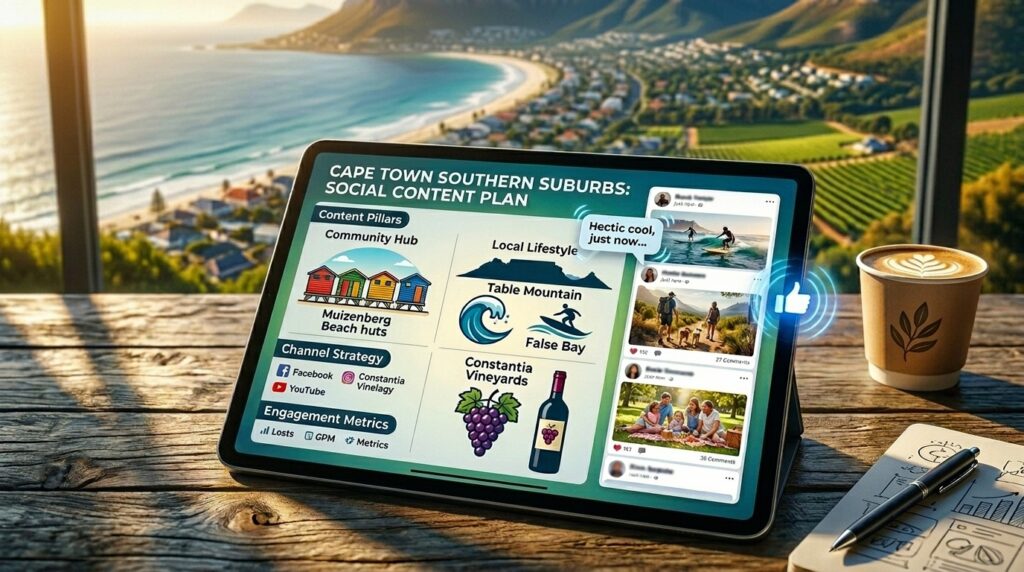
The Right Platforms for Southern Suburbs Businesses
Platform selection is where most local businesses go wrong. The temptation is to be everywhere at once, but spreading yourself thin across five platforms with mediocre content is far less effective than dominating two or three with a clear, consistent strategy. Here is what the data and local behavior actually tell us about each platform.
Facebook Still Dominates With 26.7 Million South African Users
Facebook remains the broadest reach platform in South Africa, with approximately 26.7 million users nationally as of early 2025. For Southern Suburbs businesses, this means Facebook is almost always worth maintaining — especially for community-focused content, local event promotion, and targeted paid advertising. Its Groups feature is particularly powerful in this market, where neighborhood-specific groups see high daily activity.
Instagram Works Best for Visual and Lifestyle Businesses
If your business is built around aesthetics, experience, or lifestyle — think restaurants, interior designers, fitness studios, fashion boutiques, or event spaces — Instagram is non-negotiable. The Southern Suburbs audience on Instagram is highly engaged with aspirational but attainable local content. A well-shot flat white on a Newlands café table or a before-and-after kitchen renovation in Constantia performs exceptionally well because it is both visually compelling and geographically familiar.
Reels continue to drive the highest organic reach on the platform. Short, location-tagged videos showing your space, your team, or your product in a recognizable Southern Suburbs setting will consistently outperform static posts in 2025.
LinkedIn Is the Platform for B2B and Professional Services
The Southern Suburbs are home to a dense concentration of professionals — attorneys, accountants, consultants, engineers, and corporate service providers. For businesses targeting this demographic, LinkedIn is not optional. It is where decision-makers spend time during business hours, and consistent thought leadership content positions your brand as the credible, knowledgeable option when a referral conversation comes up.
A financial advisory firm in Claremont publishing weekly commentary on South African tax changes or property market trends will build a following of exactly the people most likely to become clients. The content does not need to be flashy — it needs to be accurate, useful, and consistent.
WhatsApp Is How Capetonians Actually Communicate
In South Africa, and especially in Cape Town, WhatsApp is the default communication layer for everyday life. It is how residents get neighborhood news, coordinate school pickups, and increasingly, how they engage with local businesses. WhatsApp Business allows you to set up a professional profile, automate responses, create product catalogues, and use broadcast lists to send updates directly to opted-in customers — with open rates that dwarf any email campaign.
For Southern Suburbs businesses, WhatsApp is often the highest-converting channel in the entire marketing mix. A quick message about a weekend special or a stock arrival lands differently when it arrives in the same app someone uses to chat with family.
When TikTok Makes Sense for a Southern Suburbs Business
TikTok is not for every business in the Southern Suburbs, but dismissing it entirely is a mistake if your target audience includes anyone under 35. Suburbs like Observatory, Rondebosch, and Claremont have younger, digitally active demographics where TikTok has strong penetration. If your brand has personality, a behind-the-scenes story to tell, or a product that lends itself to demonstration, TikTok can deliver organic reach that paid campaigns on other platforms cannot match at the same budget level.
How to Build Your Content Strategy Around the Southern Suburbs
A content strategy is not a posting schedule — it is a deliberate plan for what you say, how you say it, and why it matters to the specific people you are trying to reach. In the Southern Suburbs, the most effective content strategies share one common trait: they are unmistakably local.
Generic stock photography and copy-paste captions are immediately recognizable as disconnected from the community. Residents here know their suburbs, and they notice when a brand makes the effort to reflect that back at them. Use imagery that features real Cape Town backdrops — Table Mountain from the Southern Suburbs perspective, the Constantia Winelands, UCT’s upper campus, the Liesbeek River corridor. These are not just aesthetic choices; they are trust signals.
Your content mix should balance three things: content that educates, content that entertains or connects emotionally, and content that converts. Too much of the latter and your audience will disengage. Too little and your social media activity becomes a cost with no return. Most Southern Suburbs businesses benefit from a rough split of 50% value-driven content, 30% community and brand personality, and 20% direct promotional content.
Effective content types for Southern Suburbs businesses include:
- Location-tagged Instagram Reels and Stories featuring recognizable local settings
- Behind-the-scenes content showing your team, process, or workspace
- Community shout-outs, local event coverage, and neighborhood news commentary
- Customer testimonials and user-generated content from local clients
- Educational posts that answer common questions your customers actually ask
- Seasonal content tied to Cape Town’s unique weather patterns and local events calendar
- Collaborations with complementary Southern Suburbs businesses or local micro-influencers
Use Hyper-Local Visuals and References That Residents Recognize
The Southern Suburbs have a visual identity that is instantly recognizable to anyone who lives there — and completely invisible to anyone who does not. That gap is your opportunity. When your content features the Constantia Valley vineyards, the oak-lined streets of Newlands, or the mountain backdrop visible from Rondebosch, residents do not just recognize the location — they feel something. That emotional connection is the foundation of engagement, and it cannot be faked with a generic stock photo of a smiling woman holding a coffee cup.
Local references extend beyond visuals. Mentioning the Cavendish Square refurbishment, referencing load-shedding schedules in content timing, or tying a campaign to the Cape Town Cycle Tour creates immediate relevance. Your audience self-selects when they see content that speaks directly to their lived experience. A home security company in Kenilworth that posts about neighborhood watch updates will earn more trust than one running generic crime-prevention content lifted from a Johannesburg template.
Practically speaking, invest in a small library of original photography taken in and around your suburb. It does not require a professional shoot every month — a smartphone with good lighting and a recognizable local backdrop is enough to make your content feel authentic and rooted in the community you serve.
The Content Mix That Keeps Followers Engaged Without Burning Out
Consistency beats frequency every time. A Southern Suburbs business that posts three times a week with focused, relevant content will outperform one that posts daily with filler. The goal is to build a rhythm your audience can anticipate, not to flood their feeds with content that does not earn its place.
Burnout is real for small business owners managing their own social media. The solution is batching — setting aside one afternoon every two weeks to create and schedule content in bulk. Use Meta Business Suite to schedule Facebook and Instagram posts in advance, and plan your WhatsApp broadcasts around your natural business rhythm, such as Monday morning specials or Friday afternoon weekend promotions.
A simple but effective weekly content structure for a Southern Suburbs business might look like this:
- Monday: Educational or value-driven post relevant to your industry
- Wednesday: Behind-the-scenes, team spotlight, or community connection content
- Friday: Promotional content, weekend special, or product/service highlight
- Ongoing: Instagram Stories three to five times per week with casual, real-time local content
- Monthly: One longer-form piece such as a Reel, a blog share, or a LinkedIn article for professional audiences
WhatsApp Business: Your Most Powerful Local Marketing Tool
No other platform gives you the direct access to a warm, opted-in audience that WhatsApp Business does. Email open rates for small businesses typically hover around 20 to 30 percent. WhatsApp messages routinely see open rates above 90 percent. In the Southern Suburbs, where community communication already flows through WhatsApp neighborhood groups and school chats, your business showing up in that same environment carries significant weight.
WhatsApp Business is a free app available on Android and iOS, and it is entirely separate from your personal WhatsApp account. It transforms what would otherwise be a basic messaging exchange into a structured business communication channel — complete with automated replies, a searchable product catalogue, and detailed business profile information that builds credibility before a single conversation takes place.
The businesses seeing the best results with WhatsApp Business in Cape Town are not using it as a broadcast spam channel. They are using it as a relationship tool — sending timely, relevant messages that feel personal even when they reach a large list. A Constantia wine retailer sending a curated weekend selection to 200 opted-in customers on a Friday afternoon is not marketing in the traditional sense. It is service.
WhatsApp Business vs Regular WhatsApp — What Actually Changes
| Feature | Regular WhatsApp | WhatsApp Business |
| Business Profile | ✗ Not available | ✓ Address, hours, website, description |
| Automated Replies | ✗ Not available | ✓ Away messages, greeting messages |
| Product Catalogue | ✗ Not available | ✓ Up to 500 products with images and pricing |
| Broadcast Lists | ✓ Limited | ✓ Organised with labels and segmentation |
| Quick Replies | ✗ Not available | ✓ Saved responses for frequent questions |
| Message Labels | ✗ Not available | ✓ Organise chats by New Customer, Paid, Pending |
How to Set Up WhatsApp Business for a Local Customer Base
Download WhatsApp Business from the Google Play Store or Apple App Store and register with your business phone number — ideally a dedicated business line, though your existing number works if necessary. Complete your business profile in full: add your physical address in the Southern Suburbs, your trading hours, your website URL, and a clear business description that includes what you do and where you are based. This profile appears to every customer who messages you, and a complete profile immediately establishes legitimacy.
From there, set up your automated greeting message — the message a customer receives when they contact you for the first time — and your away message for outside business hours. These two automations alone eliminate the friction of unanswered messages and set expectations professionally. Label your incoming contacts immediately using WhatsApp Business’s built-in label system so that New Customers, Returning Clients, and Pending Orders are always organized and easy to follow up.
Using Broadcast Lists to Reach Existing Customers Directly
A broadcast list in WhatsApp Business sends a single message to multiple contacts simultaneously, but each recipient receives it as an individual message — not a group chat. This is critical because it preserves the personal feel of a direct message while allowing you to reach your entire customer base at once. The only requirement is that each recipient must have your number saved in their phone, which is an easy ask when you are actively building a local customer relationship.
Segment your broadcast lists by customer type from day one. A Claremont clothing boutique, for example, might maintain separate lists for wholesale buyers, regular retail customers, and VIP loyalty members — each receiving different content at different frequencies. A monthly new arrivals update goes to everyone; an exclusive early-access sale invitation goes only to the VIP list. This kind of segmentation keeps your content relevant and your unsubscribe rate low.
WhatsApp Catalogue Features for Product-Based Businesses
WhatsApp Business allows you to create a product catalogue of up to 500 items, each with an image, name, price, description, and link. For a Southern Suburbs retailer, florist, or food business, this turns WhatsApp into a lightweight e-commerce channel where customers can browse your offering and send enquiries directly from the catalogue view — without ever leaving the app. Update your catalogue regularly, tie it to your current stock, and share individual catalogue items in conversations or broadcasts to drive direct sales without any additional platform investment.
Community Engagement Is the Southern Suburbs Advantage
The Southern Suburbs have something that no paid advertising budget can manufacture: genuine community density. Residents here are connected to each other — through schools, sports clubs, neighborhood associations, and the informal networks that form in any established residential area. For a local business, tapping into that network authentically is worth more than any boosted post. Community engagement is not a social media tactic; it is the foundation of local brand equity, and in the Southern Suburbs, it compounds over time.
Local Facebook Groups Where Your Customers Already Spend Time
There are dozens of active Facebook Groups serving the Southern Suburbs specifically — neighborhood watch groups for Rondebosch and Newlands, buy-and-sell groups covering Claremont and Kenilworth, parenting and school groups tied to the area’s many well-regarded schools, and general community discussion groups where residents share recommendations and warnings alike. These groups collectively represent a highly targeted, highly engaged audience that is already in the mindset of discovering and evaluating local businesses. Joining the right three or four groups and participating consistently will do more for your local brand awareness than a month of unfocused paid ads.
How to Contribute Without Coming Across as Spam
The fastest way to get banned from a local Facebook Group — and damage your reputation in the process — is to join and immediately start posting promotional content. Group members have seen it before and they will flag it immediately. The approach that works is contribution first, promotion almost never. Answer questions in your area of expertise, share genuinely useful local information, and let your business profile do the quiet work of signaling who you are and what you offer. When a group member asks for a recommendation in your category, a short, honest response with no sales pitch will earn you far more than a promotional post ever could.
Paid Social Advertising Targeted at the Southern Suburbs
Organic content builds relationships over time, but paid social advertising is what accelerates local visibility when you need results faster. The good news for Southern Suburbs businesses is that the geo-targeting capabilities on Facebook and Instagram are precise enough to make even a modest budget work hard — you are not paying to reach all of Cape Town, just the suburbs where your customers actually live and shop.
How to Geo-Target Ads to Specific Suburbs Like Claremont, Rondebosch and Constantia
In Meta Ads Manager, you can target by specific location using a pin-drop radius as small as one kilometer. For the Southern Suburbs, this means you can run a campaign that reaches only users physically located in or regularly present in Claremont, Rondebosch, Constantia, Kenilworth, Newlands, or whichever combination of suburbs is most relevant to your business. You can layer this geographic targeting with demographic filters — age, income bracket, household type — to narrow your audience even further and reduce wasted spend.
A practical example: a pediatric dentist in Claremont running a new patient campaign can target parents aged 28 to 45 within a three-kilometer radius of their practice, on both Facebook and Instagram simultaneously, with a creative that references the local area by name. That level of specificity was previously only available to large brands with agency budgets. Today, it is accessible from R150 per day or less.
Budgeting for Paid Social When You Are a Small Business
Most Southern Suburbs small businesses do not need large ad budgets to see meaningful results — they need focused ones. A scattered R5,000 monthly budget spread across multiple campaigns with no clear objective will consistently underperform a tightly focused R1,500 campaign built around one specific goal, one well-defined audience, and one compelling creative.
Start with a single campaign objective that maps directly to a business outcome. For a new business, that might be awareness — reaching as many relevant local users as possible within your suburb. For an established business, it might be conversions — driving bookings, enquiries, or direct sales through a landing page or WhatsApp link. Match your budget to your objective and resist the urge to run multiple campaigns simultaneously until you have data to guide those decisions.
A realistic monthly paid social budget structure for a Southern Suburbs small business might look like this:
- R500 to R1,000/month: Awareness campaign targeting your core suburb with reach or engagement objective
- R1,000 to R2,500/month: Lead generation or conversion campaign with geo-targeted audience and WhatsApp CTA
- R2,500 to R5,000/month: Multi-campaign approach covering awareness, retargeting existing page visitors, and seasonal promotions
- Above R5,000/month: Full-funnel strategy including lookalike audiences, A/B creative testing, and cross-platform placements across Facebook, Instagram and Messenger
Which Ad Formats Perform Best for Local Cape Town Audiences?
Ad Format Performance Guide for Southern Suburbs Businesses
| Ad Format | Best For | Typical Objective | Local Example |
| Single Image Ad | Brand awareness, offers | Reach, Traffic | Weekend special at a Claremont restaurant |
| Carousel Ad | Product ranges, services | Engagement, Conversions | Constantia property listings or menu items |
| Video / Reel Ad | Storytelling, demos | Awareness, Engagement | Behind-the-scenes at a Newlands fitness studio |
| Lead Generation Ad | Bookings, enquiries | Lead Generation | Kenilworth medical practice new patient form |
| WhatsApp Click-to-Chat Ad | Direct conversations | Messages | Rondebosch tutor or home services business |
| Stories Ad | Flash sales, urgency | Traffic, Conversions | Limited availability event tickets or product drops |
For most Southern Suburbs small businesses, the WhatsApp Click-to-Chat ad format deserves special attention. It places a direct “Message Us on WhatsApp” button inside a Facebook or Instagram ad, and when a user taps it, a WhatsApp conversation opens instantly — no website visit, no form, no friction. Given that WhatsApp is already the default communication channel for most Capetonians, this format converts at a significantly higher rate than ads driving traffic to a landing page, particularly for service-based businesses where a personal conversation is part of the sales process.
Video and Reel ads continue to outperform static formats on both Facebook and Instagram in terms of organic reach, and that advantage carries into paid placements too. A 15 to 30 second vertical video filmed on a smartphone — showing your space, your product, or a quick tip relevant to your industry — placed as a Reels ad with Southern Suburbs geo-targeting will consistently deliver lower cost-per-result than a polished static image. The Southern Suburbs audience is not looking for glossy corporate production; they are looking for authenticity and local relevance.
Carousel ads work exceptionally well for businesses with multiple offerings to showcase — a Constantia interior designer showing five recent project transformations, a Claremont florist displaying different bouquet options for an upcoming occasion, or a Southern Suburbs estate agent cycling through new listings. Each card in the carousel is independently swipeable and linkable, which means you can direct different audience segments to different pages from a single ad placement.
Measuring What Actually Matters for Your Social Media Plan
Most business owners who feel like their social media is not working are actually measuring the wrong things. Follower counts and post likes are visible and emotionally satisfying, but they are not business outcomes. A Rondebosch accounting firm with 400 highly engaged local followers generating consistent enquiries is performing better than one with 4,000 followers and no conversions. The metrics worth tracking are the ones that connect directly to revenue, leads, or meaningful audience growth — everything else is vanity.
The discipline of measurement is also what separates businesses that improve over time from those that repeat the same strategies indefinitely and wonder why results plateau. When you track performance consistently, patterns emerge. You discover that your Wednesday posts generate three times the engagement of your Monday ones, or that video content drives ten times the link clicks of static images. Those insights are what allow you to refine your strategy continuously rather than guessing what to do next month.
The Metrics That Tell You If Your Plan Is Working
Focus your measurement on a small number of metrics that directly reflect your business goals. For awareness, track reach and impressions — how many unique users saw your content and how often. For engagement, track comments, shares, and saves rather than likes alone, since saves and shares signal that your content was genuinely useful or compelling. For conversion-focused activity, track link clicks, WhatsApp message initiations, form completions, and ultimately, the number of enquiries or sales that originated from social media. If you are running paid ads, monitor your cost-per-result and your return on ad spend (ROAS) weekly, not monthly — catching an underperforming campaign early saves budget that can be redirected to what is working.
Free Tools You Can Use to Track Performance Right Now
You do not need to invest in expensive analytics software to measure your social media performance effectively. The native analytics tools built into each platform are comprehensive enough for most Southern Suburbs small businesses, and they are completely free.
Here is what each free tool gives you access to:
- Meta Business Suite Insights: Covers Facebook and Instagram in one dashboard — reach, engagement, follower demographics, post performance, and ad results all in one place
- Instagram Professional Dashboard: Reel plays, profile visits, account reach, and audience location data that shows whether you are actually reaching Southern Suburbs users
- LinkedIn Analytics: Post impressions, follower growth, and demographic breakdowns including job title and industry — essential for B2B businesses in the Southern Suburbs
- WhatsApp Business Statistics: Message delivery rates, read rates, and response times that tell you how effectively your broadcasts are landing
- Google Analytics 4 (with UTM links): Tracks social media referral traffic to your website, showing which platform is actually driving visitors who convert
- TikTok Analytics: Video views, watch time, follower growth, and audience demographics including geographic location data
Monthly Social Media Performance Review — What to Check and When
| Review Frequency | What to Check | Why It Matters |
| Weekly | Post reach, engagement rate, ad cost-per-result | Catch underperforming content or campaigns early |
| Fortnightly | Follower growth, WhatsApp message open rates | Track audience building momentum |
| Monthly | Top performing content, platform comparison, leads generated | Inform next month’s content and budget decisions |
| Quarterly | Overall social media ROI, strategy alignment, platform audit | Assess whether your platform mix still matches your audience |
Set a recurring calendar reminder for your weekly and monthly reviews so measurement becomes a habit rather than an afterthought. Even 20 minutes a week looking at your Meta Business Suite dashboard will reveal patterns that improve your results over time without any additional spend.
Your Southern Suburbs Social Media Plan Starts Today
A social media plan for the Cape Town Southern Suburbs is not complicated — but it does require intentionality. Choose the platforms your specific audience actually uses, build content that reflects the local culture and community they are proud to be part of, use WhatsApp Business as the direct-line communication tool it is, engage authentically in the community spaces where your customers already spend time, and measure the metrics that connect back to real business outcomes. Start with one platform done well, build a consistent rhythm, and layer in paid advertising once your organic foundation is in place.
The Southern Suburbs reward businesses that show up consistently, speak authentically, and contribute genuinely to the community — and social media, done right, is simply the digital extension of that relationship. Your next customer is already scrolling. The question is whether they are going to find you.
FAQ’s About A Social Media Plan for The Southern Suburbs
These are the questions Southern Suburbs business owners ask most often when building their first social media plan. The answers below are based on what actually works in the Cape Town market — not global averages or generic best practices.
- Which platform should a local Cape Town business start with?
- How often do you actually need to post to see results?
- Is paid social advertising worth it on a small budget?
- What is the real difference between WhatsApp and WhatsApp Business?
- How do you make sure your ads only reach Southern Suburbs customers?
Which social media platform works best for small businesses in the Cape Town Southern Suburbs?
It depends entirely on your business type and your target audience. For most consumer-facing businesses — restaurants, retailers, beauty and wellness, home services — Instagram and Facebook together form the most effective foundation. Instagram drives discovery and brand personality through visual content, while Facebook supports community engagement, event promotion, and broader reach across the full adult demographic.
For professional services businesses targeting the Southern Suburbs corporate and entrepreneurial community — attorneys, consultants, financial advisors, HR firms — LinkedIn should sit alongside Facebook as a primary channel. WhatsApp Business is essential for almost every Southern Suburbs business regardless of category, since it functions as your highest-converting direct communication channel once relationships are established.
TikTok is worth considering if your audience skews under 35 or if your business has strong visual or entertainment potential. Start with the one platform that best matches your primary audience, build consistency there first, and only expand once you have a reliable content rhythm in place. Being active on two platforms well is always more valuable than being present on five poorly.
How often should a Southern Suburbs business post on social media?
For most Southern Suburbs small businesses, three to four main feed posts per week on Instagram and Facebook, combined with daily or near-daily Stories, is the sweet spot between consistency and sustainability. On LinkedIn, two to three posts per week is sufficient for most professional services businesses. WhatsApp broadcasts should align with your natural business rhythm — typically one to two per week maximum, tied to genuine news, offers, or value rather than a rigid schedule. Consistency over a long period always outperforms a burst of daily posts followed by silence.
Is paid advertising on social media worth it for a local Cape Town business?
Yes — but only when it is focused. The geo-targeting capabilities available through Meta Ads Manager allow a Southern Suburbs business to reach users specifically within their target suburb for as little as R150 per day. The key is to start with a single, clear campaign objective and a tightly defined audience rather than running multiple broad campaigns simultaneously. A focused R1,500 monthly campaign built around one specific business goal will consistently outperform an unfocused R5,000 budget spread across too many objectives. Once you have data showing what works, you scale what is performing and cut what is not.
How does WhatsApp Business differ from a regular WhatsApp account for marketing?
WhatsApp Business is a separate application that adds a structured business communication layer on top of standard WhatsApp messaging. While a regular WhatsApp account is essentially a personal messaging tool, WhatsApp Business provides a formal business profile with your address, operating hours, website, and description — all visible to customers before they even send a message.
The operational differences that matter most for marketing are automated messaging, the product catalogue, and broadcast list management. Automated greeting and away messages mean your business responds professionally even outside trading hours. The catalogue feature allows product-based businesses to showcase up to 500 items with images, pricing, and descriptions — effectively a lightweight store within the app. Broadcast lists allow you to send personalised-feeling messages to your entire opted-in customer base simultaneously, with open rates that consistently exceed 90 percent.
The practical impact for a Southern Suburbs business is significant. A Constantia wine estate using WhatsApp Business to send Friday afternoon tasting notes and weekend availability to 300 opted-in customers will generate more same-day conversions than a Facebook post reaching the same audience. The message arrives in a personal, trusted space — and it gets read.
Regular WhatsApp vs WhatsApp Business — Feature Comparison
| Capability | Regular WhatsApp | WhatsApp Business |
| Business Profile (hours, address, website) | ✗ | ✓ |
| Automated Greeting Message | ✗ | ✓ |
| Away Message Automation | ✗ | ✓ |
| Product Catalogue (up to 500 items) | ✗ | ✓ |
| Broadcast Lists with Label Segmentation | Basic only | ✓ Full segmentation |
| Quick Reply Templates | ✗ | ✓ |
| Chat Labels (New Customer, Paid, Pending) | ✗ | ✓ |
| Message Statistics and Read Rates | ✗ | ✓ |
How do I target only Southern Suburbs customers with Facebook or Instagram ads?
In Meta Ads Manager, navigate to the Audience section when setting up your campaign and select the Locations targeting option. Choose “People living in or recently in this location” and then drop a pin directly on your target suburb — Claremont, Rondebosch, Constantia, Kenilworth, Newlands, or whichever area you want to reach. Set the radius as small as one kilometer to keep your targeting hyper-local, or expand to three to five kilometers if your business draws from a wider catchment area.
You can refine this geographic targeting further by layering in demographic filters such as age range, parental status, or household income bracket — all available within the Meta Ads Manager audience builder. For example, a high-end kitchen renovation company in Constantia might target homeowners aged 35 to 60 within a five-kilometer radius of Constantia, filtered by an interest in home improvement and interior design. That combination of geography, demographics, and interest targeting narrows your audience to the people most likely to convert.
If you already have an existing customer database — even just a list of phone numbers or email addresses from previous clients — upload it to Meta as a Custom Audience. Meta will match those contacts to Facebook and Instagram profiles and allow you to run ads specifically to people who have already done business with you. From there, you can create a Lookalike Audience based on that existing customer list, which instructs Meta to find new users in the Southern Suburbs who share similar characteristics to your best customers.