
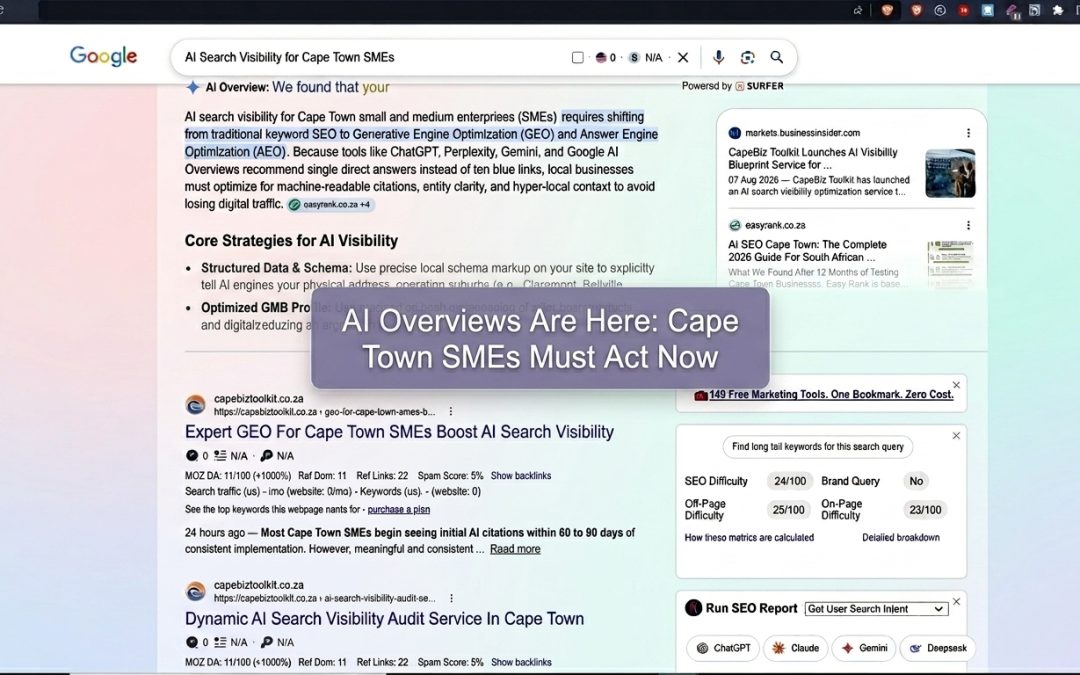
Google AI Overviews Are Here: Cape Town SMEs Must Act Now
Google AI Overviews are AI-generated summaries at the top of search results. They use large language models to combine web data into direct answers. This saves you time by removing the need to click multiple links. AI Visibility refers to how prominently your business appears within these AI-generated summaries, ensuring your content is recognized, cited, and surfaced by Google’s new AI systems.
5 Key Takeaways: Google AI Overviews
1. Google AI Overviews are live in South Africa and appear on 30 to 40 percent of all searches, fundamentally changing how Cape Town SMEs are discovered.
2. AI Overviews synthesise answers from multiple sources, so your business must be one of those sources or you lose the enquiry.
3. The shift from SGE to AI Overviews means Cape Town SMEs must optimise for citation, not just ranking.
4. Local businesses such as restaurants, tour operators, and tradesmen are most affected because AI Overviews dominate “near me” and service queries.
5. Immediate action: audit your AI Overview presence, restructure content for citation, and monitor weekly.
AI Overviews Have Arrived in South Africa, and They Are Changing Everything
For years, Cape Town business owners treated AI search as a foreign trend, something happening in America that would eventually trickle down. That trickle has become a flood. Google AI Overviews are live for South African users, and they now sit above the results your customers see for a large share of their searches.
What Are Google AI Overviews and How Do They Work?
An AI Overview is the generated summary box that appears at the top of a Google search result. Instead of showing ten links immediately, Google reads across multiple sources, synthesises an answer, and presents it with a handful of citations. Here is the mechanics in plain terms:
– A user types a question or search phrase.
– Google retrieves candidate content from across the web.
– The AI selects the clearest, most authoritative passages.
– It writes a summary and attaches a few source citations.
– The user reads the summary and often never scrolls further.
If your business is not among the sources feeding that summary, you are not in the conversation at all.
The Rollout Timeline: From SGE Testing to Full SA Deployment
Understanding the timeline helps you see how fast this moved.
| Period | Milestone |
| 2023 | Google tests the feature in the US under the name SGE |
| May 2024 | AI Overviews officially launch in the US |
| Late 2024 to 2025 | Rollout expands to more markets including South Africa |
| 2026 | AI Overviews appear on 30 to 40 percent of queries, with advertising arriving in Sub Saharan Africa |
The gap between US launch and South African deployment gave local businesses a grace period. That grace period is over.
Why Cape Town SMEs Are in the Front Line of This Disruption
Cape Town’s economy is unusually exposed to search driven discovery. Tourism, hospitality, events, and local services all depend on customers finding you at the moment of intent. Those are precisely the query categories where AI Overviews appear most often. A guesthouse, a skip boat operator, a plumber, or a boutique agency in Cape Town lives or dies by local discovery, and local discovery now starts inside an AI summary.
How Google AI Overviews Are Stealing Cape Town SME Traffic
The Zero Click Effect: Users Get Answers Without Visiting Your Site
The commercial impact is simple and brutal. When the AI Overview answers the question, the user has no reason to click. This is the [Zero-Click SEO](/zero-click-seo-cape-town-smes-your-traffic-is-gone/) reality in its purest form. Your content may have done the work of educating the customer, but a competitor’s name may be the one cited, and even when you are cited, the visit never happens. The value has moved from the click to the citation.
Which Query Types Trigger AI Overviews Most
Not every search shows an AI Overview. The likelihood varies by intent.
| Query type | Example | AI Overview likelihood |
| Informational | “How to register a company in South Africa” | Very high |
| Local | “Best coffee shops in the Cape Town City Bowl” | High |
| Transactional | “Plumber in Bellville call out fee” | Medium to high |
| Navigational | Searching for a specific brand by name | Low |
Notice that local and informational queries, the lifeblood of Cape Town SMEs, sit at the top of the table.
Real World Impact: Traffic Drops and Revenue Implications for Local Businesses
Publishers and service businesses report organic traffic declines of 20 to 60 percent on queries where AI Overviews appear. For a Cape Town SME, the implications show up in familiar places:
– Fewer website visits even when rankings hold steady.
– More phone and WhatsApp enquiries that are hard to attribute.
– Bookings and jobs going to the business the AI names first.
– Advertising costs rising as businesses fight over the shrinking click pool.
The businesses that adapt treat the AI Overview as the new front page. The businesses that ignore it keep optimising for a results page their customers no longer see.
Optimising Your Cape Town Business for Google AI Overviews
Content Structure: Making Your Pages Citable in 2 to 3 Sentences
AI Overviews cite content that can be lifted cleanly. Every service page and article should contain direct answer blocks of two to three sentences. For example: “We offer whale watching charters from Hermanus with a maximum of twelve guests per trip, running from June to November.” That sentence is specific, quotable, and locally anchored. It is exactly the material an Overview wants.
Structured Data: The Schema Types AI Overviews Prioritise
– LocalBusiness schema declaring your identity and service area.
– Service schema describing each offering in machine readable form.
– FAQ schema marking up your question and answer pairs.
– Review schema surfacing your social proof.
Google Business Profile Optimisation as an AI Overview Signal
Your Google Business Profile is one of the primary data sources behind local AI summaries. Keep your categories precise, your service areas current, your photos fresh, and your review velocity healthy. Our guide on [GBP and NAP data](/gbp-nap-south-african-smes-hidden-ai-power-play/) covers the consistency rules that make your profile trustworthy to AI systems.
Building the E-E-A-T Signals That AI Overviews Reward
Overviews prefer sources that demonstrate Experience, Expertise, Authoritativeness, and Trustworthiness. Publish real case studies with specific numbers. Show your team and their credentials. Earn mentions in local publications. The deeper your [E-E-A-T trust signals](/e-e-a-t-for-cape-town-smes-ai-wont-trust-you-yet/), the more often your brand is selected as a citation source.
Local Citations and Directory Listings That Feed AI Summaries
AI systems cross reference directories, chambers of commerce listings, and local news mentions to verify that a business is real and reputable. Ensure your NAP data is identical everywhere and pursue listings in the South African directories that matter to your industry. Each consistent mention is another vote of confidence feeding the summaries.
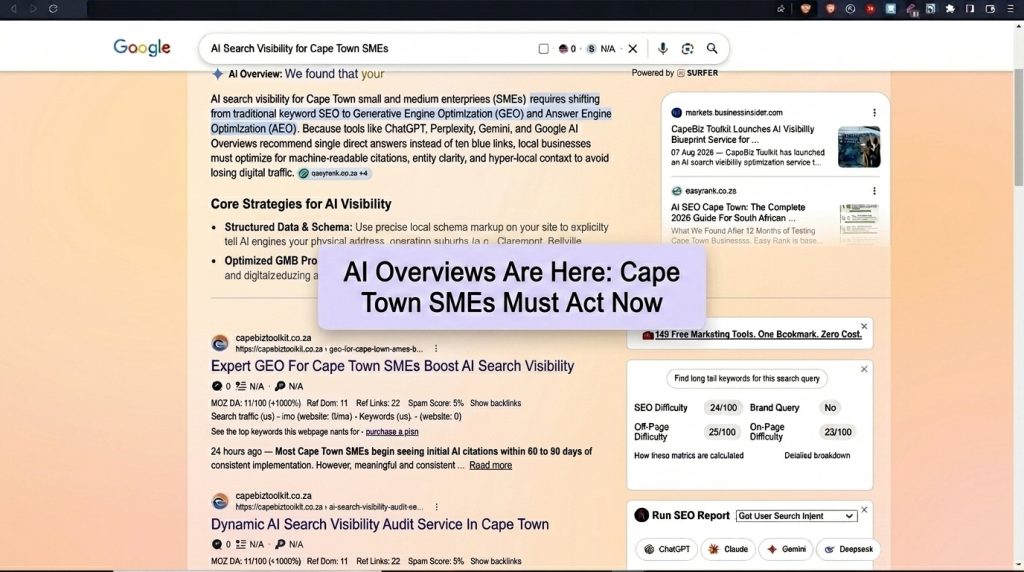
AI Overviews vs Traditional SERP: What Cape Town SMEs Must Change
### From Ranking Number One to Being Cited in the Summary Box
The old prize was position one. The new prize is inclusion in the summary. A business can rank third in the blue links and still win if it is cited in the Overview above. Conversely, a business can rank first and still lose if the Overview cites three competitors instead. This inversion is the hardest mental shift for SME owners who grew up on ranking reports.
The New Metrics: Citation Frequency, Impression Share, AI Visibility Score
| Old metric | New metric | Why it matters |
| Keyword position | Citation frequency | Being cited beats being ranked |
| Organic clicks | AI Overview impression share | Visibility now precedes traffic |
| Bounce rate | Assisted enquiries | Many leads arrive by phone or WhatsApp |
| Pageviews | Brand search volume | People who see you in AI search later search your name |
Budget Reallocation: Where to Shift Spend from Traditional SEO
You do not abandon traditional SEO, but you rebalance. Shift a meaningful share of budget toward:
– Structured content production and schema implementation.
– Multi format assets that earn external citations.
– Review generation and GBP management.
– Citation monitoring tools and monthly audits.
The rule of thumb I use with Cape Town clients: keep enough traditional SEO to hold the foundation, and invest the growth budget where the eyes have moved.
Industry Specific AI Overview Strategies for Cape Town
Frequently Asked Questions About Google AI Overviews
Get Cited in the Google AI Overviews Summary Box
AI Overviews synthesise answers from high authority news sites, industry publications, and multi media directories. If your content only lives on your own website, the AI will not trust you enough to cite you.
Through the AI Visibility Blueprint, we distribute your expertise across the exact high authority networks that Google’s AI scrapes for its Overviews. We handle the production; you get the market credibility.
Is your established business ready to dominate Google AI Overviews?
📱 WhatsApp / Call Gerard: +27 (0)84 207 0131