

Expert Startup Business Coaching In Cape Town
Entrepreneurship growth demands startup business coaching in Cape Town, which provides strategic guidance, mentorship, and operational support to help founders scale, refine business models, and secure funding. Key specialists focus on technology, SaaS, and digital innovation, offering services like business strategy, executive coaching, and team alignment for sustainable growth,
Key Takeaways: Startup Business Coaching In Cape Town
- Cape Town’s unique business ecosystem requires specialized coaching that addresses local market dynamics and regulatory challenges specific to South African entrepreneurs.
- Working with a Cape Town business coach can reduce startup failure rates by up to 70% through tailored strategy development and accountability systems.
- CapeBiz Toolkit offers comprehensive startup consulting services that help new businesses navigate the complexities of launching in Cape Town’s competitive landscape.
- The most effective business coaches combine local knowledge with industry expertise to create customized growth roadmaps for Cape Town entrepreneurs.
- Successful coaching relationships typically deliver ROI within 3-6 months through improved decision-making, strategic networking, and elimination of costly startup mistakes.
The entrepreneurial landscape in Cape Town is booming, with innovative startups emerging across industries from tech to tourism. Yet despite this vibrant ecosystem, many new businesses struggle to gain traction in their crucial early stages. CapeBiz Toolkit has been at the forefront of helping these emerging ventures transform challenges into stepping stones for success through specialized startup coaching tailored to Cape Town’s unique business environment.
Why Cape Town Startups Need Specialized Coaching
Cape Town’s business landscape presents a fascinating contradiction. While it’s one of Africa’s most developed startup hubs with world-class infrastructure, it also operates within South Africa’s complex regulatory environment and unique market dynamics. This creates both extraordinary opportunities and significant hurdles for new entrepreneurs.
The Unique Challenges of the Cape Town Business Ecosystem
Starting a business anywhere requires courage, but Cape Town entrepreneurs face particular challenges that make specialized coaching invaluable. The city’s economy operates at the intersection of first-world expectations and developing market realities. New business owners must navigate fluctuating exchange rates, frequent power disruptions, and a customer base with vastly different purchasing behaviors across economic segments. A business coach with deep local expertise can help founders develop contingency plans and resilient business models specifically designed to thrive despite these challenges.
Local Market Dynamics That Affect New Businesses
Cape Town’s market has distinctive characteristics that directly impact how startups should position themselves. The city experiences dramatic seasonal fluctuations due to tourism patterns, which affects cash flow for many businesses. Additionally, Cape Town’s geographical layout creates micro-markets with significantly different customer profiles—from the affluent Atlantic Seaboard to developing townships. Understanding these nuances requires local market intelligence that generalized business advice simply can’t provide. Experienced Cape Town business coaches bring valuable insights into which marketing approaches work in specific neighborhoods and how to adjust business models to accommodate local consumer behavior.
How Proper Coaching Reduces Failure Rates
The statistics are sobering: approximately 70% of South African startups fail within their first two years. However, businesses that engage with professional coaching show dramatically improved survival rates. This isn’t coincidental. A skilled business coach helps entrepreneurs avoid common pitfalls specific to the Cape Town market, such as underestimating seasonal fluctuations, misunderstanding local purchasing patterns, or failing to properly navigate municipal regulations. By providing structured guidance and accountability, coaches ensure that founders make data-driven decisions rather than operating on assumptions. This methodical approach transforms guesswork into strategy and significantly increases the odds of building a sustainable business.
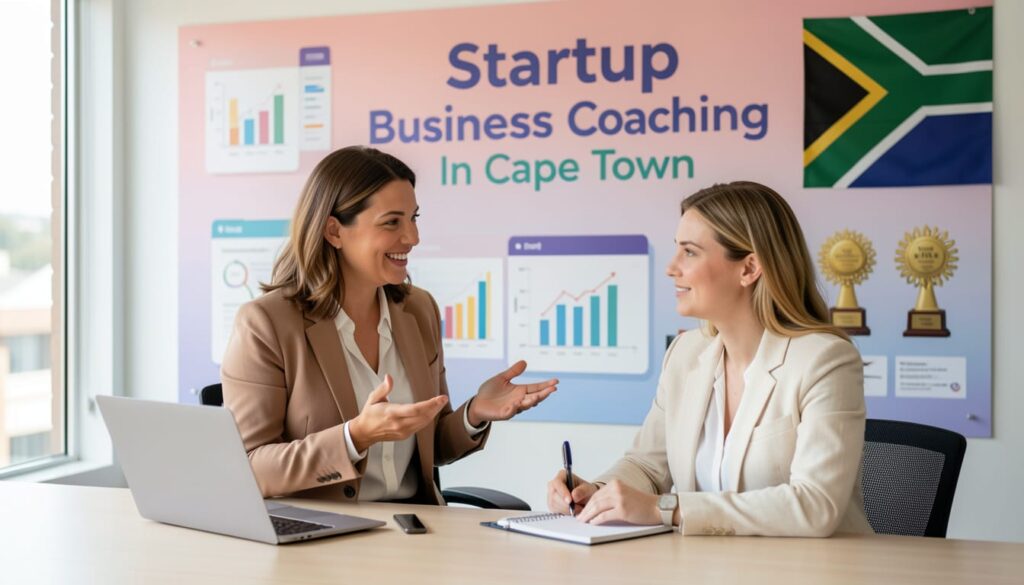
Top 5 Benefits of Working With a Cape Town Business Coach
When entrepreneurs partner with coaches who truly understand Cape Town’s business environment, the impact goes far beyond general business advice. The right coach becomes a strategic asset who can dramatically accelerate growth and prevent costly missteps.
1. Localized Strategy Development
Generic business strategies rarely translate effectively to Cape Town’s unique market conditions. Local business coaches help entrepreneurs develop plans that account for Cape Town-specific factors like seasonal tourism fluctuations, neighborhood demographics, and local competitive landscapes. They understand which business models have historically succeeded in different parts of the city and why certain approaches that work elsewhere might fail here. Through collaborative strategy sessions, coaches help founders craft plans that leverage local opportunities while mitigating region-specific risks. This localized approach ensures that limited startup resources are directed toward tactics with the highest probability of success in Cape Town’s particular business environment.
2. Access to Cape Town’s Business Networks
One of the most valuable assets an established business coach brings is their extensive network of connections throughout Cape Town’s business community. These relationships, built over years of operating in the local ecosystem, open doors that would otherwise remain closed to new entrepreneurs. From introductions to potential investors in the V&A Waterfront business district to connections with suppliers in Woodstock’s manufacturing hub, coaches can facilitate meetings that might take months or years to arrange independently.
Beyond simple introductions, skilled coaches understand the nuanced relationships between different business communities in Cape Town. They can guide founders on navigating the city’s business culture, including unwritten rules around business etiquette that vary between the corporate environment in the CBD and the more relaxed approach in creative districts like Observatory. This cultural intelligence prevents damaging missteps and accelerates relationship-building in a city where who you know often matters as much as what you know.
3. Guidance Through Local Regulations and Compliance
South Africa’s regulatory landscape is notoriously complex, with Cape Town adding municipal requirements that create additional layers of compliance. From business registration with CIPC to obtaining specific permits from the City of Cape Town, the paperwork alone can overwhelm new entrepreneurs. A local business coach provides clarity through this regulatory maze, helping founders understand which regulations apply to their specific business type and location.
More importantly, experienced coaches have developed relationships with key regulatory departments and understand how to navigate bureaucratic processes efficiently. They can advise on timing (certain applications move faster at specific times of year) and preparation (which supporting documents will expedite approval). This insider knowledge can save months of delays and prevent the costly mistakes that occur when businesses operate without proper permissions.
4. Market-Specific Growth Planning
Scaling a business in Cape Town requires understanding the city’s unique growth patterns and limitations. A knowledgeable coach helps entrepreneurs develop expansion plans that account for local constraints like limited industrial space, neighborhood-specific zoning restrictions, and the logistics challenges created by Cape Town’s geography and traffic patterns.
Successful coaches bring practical experience in how Cape Town businesses can overcome typical growth plateaus, whether that’s the transition from Southern Suburbs to CBD operations or the leap from local to national distribution. They help founders anticipate obstacles before they become problems, creating contingency plans for common challenges like seasonal cash flow fluctuations or staff transportation during tourism high season. This forward-looking guidance ensures growth happens sustainably rather than through unsupported rapid expansion that often leads to collapse.
5. Accountability and Performance Tracking
Perhaps the most underrated benefit of business coaching is the structured accountability it provides. Cape Town’s laid-back culture, while wonderful for quality of life, can sometimes create a relaxed approach to business deadlines and milestones. Professional coaches counter this by establishing clear performance metrics and regular check-ins tailored to the pace of Cape Town business.
Effective coaches implement tracking systems that measure both quantitative metrics (revenue, customer acquisition costs, conversion rates) and qualitative indicators relevant to Cape Town businesses (seasonal variations, neighborhood performance differences). This data-driven approach ensures entrepreneurs make decisions based on actual performance rather than assumptions, dramatically improving business outcomes while reducing costly errors.
What to Look For in a Cape Town Startup Coach
Finding the right business coach in Cape Town requires looking beyond impressive websites and charismatic personalities. The most effective coaches combine specific attributes that make them particularly valuable for Cape Town entrepreneurs. When evaluating potential coaches, consider these crucial factors that will determine whether they can truly accelerate your business growth.
Experience With Local Business Success Stories
The most telling indicator of a coach’s potential value is their track record with businesses similar to yours in the Cape Town market. Look for coaches who have demonstrable experience helping companies in your size range and industry overcome challenges specific to the local environment. Ask potential coaches for case studies or examples of how they’ve helped Cape Town businesses navigate common hurdles like seasonal fluctuations, load shedding impacts, or neighborhood-specific market entry.
Be wary of coaches who only reference international success stories or who can’t provide concrete examples of their impact on local businesses. The strategies that work in London or New York often require significant adaptation for Cape Town’s unique business ecosystem. A coach with a history of local successes brings practical knowledge that no amount of theoretical expertise can replace.
Industry-Specific Knowledge
While general business principles apply across sectors, each industry in Cape Town has unique dynamics that significantly impact strategic decisions. A coach with experience in your specific sector brings invaluable insights into local supply chains, competitive landscapes, and customer expectations. For example, a food business in Bree Street faces dramatically different operational challenges than a tech startup in Woodstock or a tourism venture in Camps Bay.
The most valuable coaches combine broad business expertise with deep knowledge of your industry’s specific mechanisms in Cape Town. They understand seasonal patterns, pricing norms, typical profit margins, and growth limitations for your sector in this particular market. This specialized knowledge allows them to provide advice that’s immediately applicable rather than requiring extensive translation to your context.
Coaching Style and Compatibility
Finding Your Perfect Coach Match in Cape Town
Different entrepreneurs respond to different coaching approaches. Some thrive with direct, challenging coaches who push boundaries, while others need supportive guides who build confidence through incremental wins. The most successful coaching relationships occur when the coach’s natural style aligns with your learning preferences and personality.
Beyond methodology, consider the practical aspects of working together. Does the coach understand the realities of your specific Cape Town location? A coach who grasps the unique challenges of operating in Observatory versus Claremont can provide more relevant advice. Similarly, a coach who appreciates the rhythms of your industry—knowing when tourism businesses need intensive support before high season versus when manufacturing operations typically plan expansion—will provide guidance when you most need it.
The chemistry between entrepreneur and coach significantly impacts results. Schedule initial consultations with potential coaches to assess not just their knowledge but whether their communication style resonates with you. The most brilliant coach won’t help if their approach triggers resistance rather than receptivity. Trust your instincts about whether this is someone who truly understands your vision for your Cape Town business.
Remember that effective coaching requires vulnerability and openness to feedback. Choose someone you feel comfortable sharing challenges with and whose input you respect enough to implement, even when it means changing course. The right coach challenges your thinking while respecting your ultimate decision-making authority as the business owner.
The Cape Town Startup Coaching Process
Understanding how business coaching actually works removes much of the mystery and hesitation entrepreneurs often feel. While methodologies vary between coaches, most effective Cape Town coaching relationships follow a structured process designed to create measurable progress over time.
The journey typically begins with comprehensive discovery and progresses through increasingly specific action plans as your coach gains deeper insight into your business and market positioning. Let’s explore what you can expect during each phase of a productive coaching engagement.
Initial Business Assessment
Every effective coaching relationship begins with a thorough assessment of your current business reality. Experienced Cape Town coaches typically start with a comprehensive evaluation covering everything from financial performance to team dynamics, market positioning to operational efficiency. This process often involves reviewing your business documentation, interviewing key team members, and analyzing your competitive landscape within Cape Town’s market.
The assessment phase isn’t just about identifying weaknesses—it’s equally focused on uncovering hidden strengths and untapped opportunities specific to your position within Cape Town’s business ecosystem. Perhaps your Woodstock location offers manufacturing partnerships you haven’t explored, or your Sea Point clientele has network connections that could open expansion opportunities. A skilled coach helps you see these possibilities through fresh eyes.
Most importantly, this initial assessment establishes your baseline metrics. By documenting where your business stands today across key performance indicators, your coach creates the foundation for measuring progress throughout your work together. This data-driven approach ensures you can objectively evaluate the return on your coaching investment.
Creating Your Tailored Growth Roadmap
Once your coach thoroughly understands your business, they’ll collaborate with you to develop a customized growth plan that addresses your specific challenges and opportunities within Cape Town’s market. Unlike generic business plans, these roadmaps incorporate local market intelligence about neighborhood demographics, seasonal patterns, and Cape Town-specific consumer behavior.
Effective coaches prioritize initiatives based on potential impact and implementation difficulty, ensuring you focus on high-leverage actions first. The roadmap typically includes specific milestones, detailed action steps, and clear timelines designed around Cape Town’s business cycles. For example, tourism-adjacent businesses might focus on different priorities during high season versus the quieter winter months.
The most valuable growth plans balance immediate wins with longer-term strategic initiatives. Your coach should identify quick victories to build momentum while also laying groundwork for sustainable competitive advantage. This balanced approach ensures you see tangible results quickly while also building toward significant transformation.
Implementation Support and Course Correction
Creating a strategy is just the beginning. The real value of coaching emerges during the implementation phase, when your coach helps you execute your growth plan despite the inevitable obstacles. Regular coaching sessions provide accountability and troubleshooting support as you navigate the practical challenges of growth in Cape Town’s dynamic environment.
Effective coaches serve as sounding boards for critical decisions, offering perspective informed by their experience with similar situations in Cape Town’s business landscape. They help you anticipate local market responses to your initiatives and adapt your approach based on real-time feedback from customers and competitors.
The most valuable coaching relationships include flexible support between scheduled sessions, recognizing that business challenges don’t always arise on a convenient timeline. Look for coaches who offer email support or brief check-in calls when you’re facing urgent decisions that can’t wait until your next formal meeting.
Measuring Progress and ROI
Serious business coaches track concrete results throughout your engagement, regularly comparing current performance against your baseline metrics. This data-driven approach ensures your coaching investment delivers measurable returns through increased revenue, improved margins, operational efficiencies, or other key performance indicators specific to your business goals.
Beyond quantitative metrics, comprehensive evaluation includes qualitative improvements like enhanced decision-making confidence, stronger team leadership, and more effective strategic thinking. These softer benefits often translate into significant long-term value as they positively impact countless future business decisions.
The most effective coaches gradually transfer their knowledge throughout your work together, helping you develop the skills and perspectives to continue your growth trajectory independently. This educational component creates lasting value that extends far beyond your formal coaching relationship.
Common Coaching Programs Available in Cape Town
Cape Town’s business coaching landscape offers various engagement models to suit different business needs, budgets and learning preferences. Understanding these options helps you select the approach that aligns with your specific situation and goals.
One-on-One Executive Coaching
The most intensive and customized coaching format involves regular private sessions between you and your coach, typically meeting weekly or bi-weekly at your business location or a neutral space. This personalized approach allows for deep exploration of your specific challenges and opportunities within Cape Town’s business environment. Your coach serves as a dedicated thinking partner, helping you navigate decisions while holding you accountable to your strategic priorities.
One-on-one coaching particularly benefits businesses facing complex challenges or significant transition points—such as expanding from a single Cape Town location to multiple sites, pivoting your business model, or preparing for investment. The confidential nature of these sessions creates a safe space to discuss sensitive issues like team dynamics, partnership challenges, or financial concerns that might be difficult to address in group settings.
While this coaching format typically represents the highest investment, it also offers the most tailored guidance and flexible support. Many Cape Town coaches offer tiered packages ranging from intensive weekly engagement to monthly strategy sessions supplemented with email support. Consider your business complexity and personal learning style when evaluating whether this high-touch approach justifies its premium price point.
Group Coaching Programs
For entrepreneurs seeking both guidance and peer connection, group coaching programs bring together small cohorts of Cape Town business owners facing similar challenges. Typically meeting monthly or bi-weekly, these structured programs combine coach-led teaching with facilitated discussion and accountability mechanisms. The shared learning environment allows participants to benefit not only from their coach’s expertise but also from the diverse perspectives and experiences of fellow entrepreneurs.
Many Cape Town accelerators, business schools, and entrepreneurship organizations offer these cohort-based programs focused on specific business stages or industries. The group format creates built-in networking opportunities while significantly reducing the per-participant cost compared to one-on-one coaching. This makes quality guidance accessible at earlier business stages when investment capacity might be limited.
The most effective group programs balance curriculum-based learning with adequate individualized attention, often supplementing group sessions with limited one-on-one coaching. Look for cohorts intentionally composed of non-competing businesses at similar growth stages operating within Cape Town’s market—this composition maximizes relevant peer learning while minimizing competitive concerns.
Industry-Specific Coaching Initiatives
Several Cape Town business support organizations have developed specialized coaching programs for key local industries including technology, tourism, food and beverage, creative services, and manufacturing. These sector-specific programs provide guidance tailored to the unique challenges and opportunities within Cape Town’s version of these industries, often delivered by coaches with deep experience in the relevant sector.
Industry-specific coaching brings together market intelligence, regulatory knowledge, and best practices directly applicable to your business category. For example, tourism-focused programs might address Cape Town’s distinct seasonality patterns and international visitor expectations, while tech startup coaching might focus on connecting with the city’s growing investor community and talent acquisition in a competitive developer market.
These specialized programs often include valuable extras beyond core coaching, such as introductions to industry-specific suppliers, potential clients, and strategic partners. Many incorporate site visits to successful Cape Town businesses within your sector, allowing you to observe effective practices firsthand while building relationships with established operators.
- Tech-focused initiatives like Silicon Cape connect startups with experienced mentors
- Tourism Enterprise Partnership provides specialized coaching for hospitality businesses
- Craft & Design Institute offers sector-specific support for creative entrepreneurs
- Food Forward accelerator programs for culinary and food production businesses
Government-Supported Entrepreneurship Programs
Both the Western Cape Government and City of Cape Town operate subsidized business development programs that include coaching components. These initiatives aim to stimulate economic growth and job creation by supporting promising local businesses, often with particular focus on previously disadvantaged entrepreneurs. Programs like the Small Enterprise Development Agency (SEDA) and the Department of Trade and Industry’s support schemes offer affordable access to business guidance alongside potential grant funding or incentive access.
How to Get Maximum Value From Your Business Coach
The return on your coaching investment depends significantly on how you approach the relationship. Even the most skilled Cape Town business coach can’t create transformation without your active participation and implementation. By understanding how to effectively engage with your coach, you can dramatically increase the value you receive.
Successful coaching clients approach the relationship as a collaborative partnership rather than a passive learning experience. They take ownership of outcomes while leveraging their coach’s expertise as a catalyst for accelerated growth. The following strategies will help you extract maximum value from your coaching investment.
Setting Clear Goals Before Your First Session
Before meeting with potential coaches, define specific, measurable objectives you want to achieve through the coaching relationship. Vague aspirations like “grow my business” provide insufficient direction—instead, identify concrete targets such as “increase monthly revenue to R100,000 by expanding into the Southern Suburbs market” or “develop systems that allow me to reduce my working hours from 70 to 45 per week while maintaining current profit levels.”
Take time to distinguish between symptoms and root causes in your business challenges. A surface-level goal like “get more customers” might mask deeper issues with your value proposition, pricing strategy, or operational capacity. Thoughtful pre-work helps you communicate your true needs to potential coaches and evaluate whether their expertise aligns with your specific goals.
Consider both short-term priorities and longer-term aspirations when defining your coaching objectives. While immediate pain points might drive your initial decision to seek coaching, the most valuable engagements address both urgent issues and fundamental improvements that create sustainable competitive advantage in Cape Town’s market.
Goal-Setting Framework for Cape Town Entrepreneurs
Immediate Wins (1-3 months): What specific metrics need rapid improvement?
Medium-Term Growth (3-12 months): Which capabilities or market positions must you develop?
Long-Term Vision (1-3 years): How will your business uniquely serve the Cape Town market?
Share these defined goals with prospective coaches during your initial consultations. Their response—including how they might refine or challenge your objectives based on their Cape Town market knowledge—provides valuable insight into their coaching approach and business acumen. The most effective coaches help sharpen your goals while respecting your vision rather than imposing their predetermined solutions.
Being Open to Challenging Feedback
- Recognize that discomfort often precedes breakthrough growth
- Separate your identity from your business decisions
- Ask clarifying questions rather than defending current approaches
- Consider feedback as data rather than criticism
A coach’s outside perspective allows them to identify blind spots and limiting patterns that may be invisible to you as the business owner. Their observations might challenge your assumptions about Cape Town’s market dynamics or highlight inconsistencies between your stated goals and actual behaviors. While this feedback can feel uncomfortable, it often catalyzes the most significant improvements.
Effective coaching relationships require psychological safety—you must feel secure enough to be vulnerable about your challenges and receptive to alternative perspectives. This doesn’t mean uncritically accepting every suggestion, but rather approaching feedback with curiosity before evaluation. Ask questions to fully understand your coach’s reasoning, especially when their guidance contradicts your initial instincts about Cape Town’s market.
Remember that resistance to feedback often indicates areas where growth is most needed. When you feel defensive about a particular topic, consider whether that reaction might signal an important opportunity for development. The most valuable coaching often occurs precisely in these uncomfortable spaces where established patterns are disrupted to create new possibilities.
Implementing Recommendations Between Sessions
The actual value of coaching emerges not during your sessions but in the implementation work you do between meetings. Commit to taking specific, measurable actions based on each coaching conversation, treating these commitments as non-negotiable priorities despite the inevitable daily demands of running your Cape Town business. The most successful coaching clients create protected time for implementation immediately after each session, before urgent matters can crowd out important growth work.
Start Your Coaching Journey Today
Cape Town’s competitive business landscape doesn’t wait for hesitant entrepreneurs. Every day without strategic guidance represents missed opportunities and potential missteps that could impact your business trajectory. Whether you’re launching a new venture or seeking to scale an established operation, the right coaching relationship can dramatically accelerate your progress toward sustainable success in this unique market.
Begin by researching coaches with demonstrated expertise in your specific industry within Cape Town’s business ecosystem. Schedule initial consultations with your top candidates, approaching these conversations as mutual interviews where both parties assess the potential for productive collaboration. Ask pointed questions about their experience with challenges similar to yours and request concrete examples of how they’ve helped comparable Cape Town businesses achieve measurable results.
CapeBiz Toolkit offers specialized startup consulting and business coaching designed specifically for Cape Town entrepreneurs who want to launch confidently, grow strategically, and overcome the unique challenges of our local business environment. Our proven methodology combines practical tools, local market intelligence, and personalized guidance to help you build a thriving business in Cape Town’s dynamic market.
Frequently Asked Questions About Startup Business Coaching In Cape Town
As entrepreneurs consider business coaching, certain questions consistently arise about the process, investment, and expected outcomes. These straightforward answers address the most common inquiries from Cape Town business owners considering professional guidance.
Understanding these fundamental aspects of business coaching helps you approach potential coaching relationships with realistic expectations and clear evaluation criteria. While individual experiences vary based on your specific business situation and chosen coach, these general insights provide a useful framework for decision-making.
Remember that coaching represents an investment in both your business’s future and your personal development as an entrepreneur. The returns typically extend far beyond the specific challenges that initially prompt you to seek guidance, creating lasting improvements in how you approach business leadership in Cape Town’s unique market context.
- What qualifications should I look for in a Cape Town business coach?
- Is coaching appropriate for my current business stage?
- How is business coaching different from consulting?
- Should I choose a coach with experience in my specific industry?
These questions reflect common concerns entrepreneurs have when considering this significant investment in their business development. The following detailed responses address the most frequent inquiries we receive from Cape Town business owners exploring coaching options.
How much does startup business coaching typically cost in Cape Town?
Business coaching in Cape Town generally ranges from R1,500-R4,500 per session for one-on-one coaching, with most coaches requiring a minimum 3-6 month commitment. Group programs typically cost R3,000-R8,000 per month, while intensive mastermind groups or high-level executive coaching may reach R15,000-R25,000 monthly. Many coaches offer tiered packages with varying levels of access and support, allowing entrepreneurs to select an option aligned with both their needs and budget. Some coaches also provide sliding scale rates for early-stage startups with demonstrated potential but limited resources.
How long should I expect to work with a business coach before seeing results?
While timeframes vary based on your specific goals and implementation speed, most Cape Town entrepreneurs report noticing meaningful improvements within the first 4-8 weeks of coaching. Initial results typically appear in areas requiring primarily behavioral changes or strategic adjustments, while outcomes dependent on market response (such as revenue growth from new initiatives) may take 3-6 months to fully materialize. The most significant transformations often emerge after 6-12 months of consistent coaching and implementation, as fundamental improvements in your business model, team performance, and market positioning create compound effects. Coaches focused on sustainable results will establish clear expectations and measurable milestones appropriate to your specific business goals and Cape Town market conditions.
Can a business coach help me secure funding for my Cape Town startup?
While coaches don’t directly provide funding, experienced Cape Town business coaches can significantly improve your funding readiness and connection to potential investors. They help refine your business model, financial projections, and pitch presentation to meet local investor expectations. Many established coaches maintain relationships with angel investors, venture capital firms, and alternative funding sources specific to the Western Cape ecosystem. They can provide strategic introductions once your business demonstrates the traction and preparation necessary for successful funding conversations. Additionally, coaches can help you identify and apply for government grants, incentive programs, and competition opportunities specifically available to Cape Town entrepreneurs in your sector.
What’s the difference between a business coach and a mentor?
Business coaches provide structured, fee-based professional guidance with clear objectives, accountability mechanisms, and defined timeframes. They employ specific methodologies to address your business challenges while maintaining professional boundaries. Mentors typically offer informal, relationship-based guidance drawn from their personal experience, often without monetary compensation or formal measurement frameworks. Both relationships can be valuable, but coaching generally provides more systematic development with defined deliverables and return-on-investment expectations. Many Cape Town entrepreneurs benefit from simultaneously maintaining both types of relationships—a professional coach for structured growth and accountability alongside mentors who provide industry-specific wisdom and network connections.
Comparing Professional Support Options
Aspect Business Coach Mentor Consultant Primary Focus Developing your capabilities Sharing personal wisdom Solving specific problems Payment Fee-based professional service Typically unpaid relationship Project or retainer fees Approach Questions and guidance Advice and stories Analysis and recommendations Timeframe Medium to long-term relationship Often ongoing without defined end Usually project-based
Each support type serves different needs at various business stages. Many successful Cape Town entrepreneurs utilize all three at different points in their journey or simultaneously for complementary perspectives. The key is understanding which type of guidance best addresses your current priorities.
You might engage a coach for structured development of your leadership capabilities, connect with mentors who have successfully navigated Cape Town’s specific market challenges, and hire consultants to solve technical problems requiring specialized expertise. This multi-faceted support network provides comprehensive guidance while addressing different aspects of your business growth.
Is online coaching as effective as in-person coaching for Cape Town startups?
Virtual coaching can be equally effective as in-person sessions when structured properly, with many Cape Town entrepreneurs actually reporting benefits from the online format. Digital platforms enable more frequent, focused interactions without travel time, increasing coaching consistency while reducing logistics challenges in Cape Town’s congested traffic environment. The key success factor isn’t delivery method but rather the coach’s expertise, your implementation commitment, and the accountability systems established.
That said, certain coaching objectives may benefit from occasional in-person interaction, particularly for observational coaching where your coach assesses team dynamics, operational workflows, or customer experience at your physical location. The most effective coaching relationships often combine virtual sessions for regular check-ins with strategic in-person meetings for deeper work and direct observation. Many Cape Town coaches now offer hybrid models that provide this balance while maximizing convenience and engagement.
