
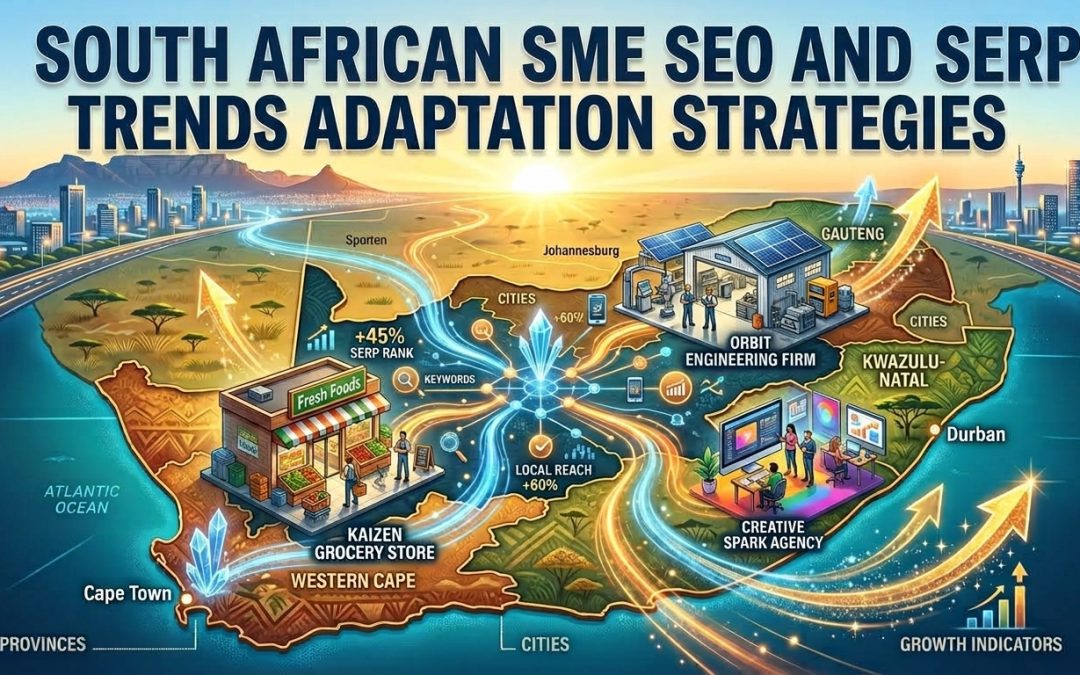
South African SME SEO And SERP Trends Adaptation Strategies
South African SMEs are fighting for online visibility in a search landscape that looks almost nothing like it did three years ago — and most are using outdated playbooks. The rules have shifted fast. Google’s interface has changed dramatically.
Key Takeaways: South African SME SEO And SERP Trends Adaptation
- Zero-click searches and AI-generated overviews are reducing website traffic — South African SMEs need to adapt their SEO strategies beyond traditional keyword rankings to stay visible.
- Local SEO is the single biggest opportunity for South African SMEs in 2025 and 2026, with Google Business Profiles and local listing platforms like HelloPeter becoming critical discovery tools.
- AI tools like ChatGPT and Meta AI are changing how South Africans search — and your content needs to be structured to appear in these new search environments, not just on Google.
- Social media platforms including TikTok, Instagram, and Facebook Marketplace now function as search engines — optimising in-platform content for local keywords is no longer optional.
- The new SEO success metrics go beyond page rankings — engagement rates, dwell time, and multi-touch attribution are what actually tell you whether your strategy is working.
AI tools are intercepting searches before users even reach a website, and platforms like TikTok and Instagram have become legitimate search engines for younger South African consumers. For SMEs operating on tight budgets and leaner teams, missing these shifts doesn’t just mean lower rankings — it means lost revenue. Africa In Touch, a digital marketing resource focused on South African business growth, highlights that understanding these 2025 digital marketing trends is now essential for any SME looking to compete.
South African SMEs Are Losing Ground Online — Here’s Why
The core problem isn’t that South African SMEs are doing SEO badly. It’s that the game itself has changed, and many businesses haven’t been told the new rules yet. Organic search traffic, once the most reliable free marketing channel for small businesses, is being disrupted by structural changes inside Google’s own results pages.
Zero-Click Searches Are Eating Into Organic Traffic
A zero-click search happens when Google answers a user’s question directly on the results page — through a featured snippet, knowledge panel, or AI overview — so the user never clicks through to any website. This is now the default experience for a growing percentage of searches. For South African SMEs who have invested in SEO to drive website traffic, this is a direct threat to that strategy.
The practical impact is measurable. Businesses that once relied on informational content to generate top-of-funnel traffic are seeing that content answer questions for users without earning a single visit. The solution is not to abandon content — it’s to restructure it so that your brand name appears inside those featured answers, building awareness even without the click.
AI-Generated Overviews Are Reducing Website Click-Throughs
Google’s AI Overviews — the AI-generated summaries that now appear at the very top of many search results — have accelerated the zero-click problem. When a South African consumer searches “best accounting software for small businesses in South Africa,” they may receive a fully formed AI-written answer before they ever see a single organic result. SMEs that are not cited as sources inside these overviews are effectively invisible for that query.
Traditional SEO Metrics No Longer Tell The Full Story
Tracking keyword rankings and monthly organic sessions made sense when search was simpler. Today, a business can rank position one for a keyword and still see declining traffic because AI overviews and featured snippets sit above it. South African SMEs need to expand what they measure — including brand search volume, direct traffic, engagement rates, and conversion paths — to get an accurate picture of their actual search visibility.
AI Is Changing How South Africans Search
The rise of AI-powered search tools is not a future trend. It is happening right now across South Africa’s connected population, and it is reshaping the entire top of the customer journey. From Google’s own AI features to standalone tools like ChatGPT and Meta AI, South African consumers are increasingly getting answers from AI before they ever visit a brand’s website.
How Google’s AI Overviews Work And Why They Matter For SMEs
Google’s AI Overviews use large language models to synthesise answers from multiple indexed sources. When someone searches a question-based query, Google’s AI reads content from across the web, summarises it, and presents that summary at the top of the page — with small citations to source websites. Getting cited in these overviews requires your content to be authoritative, well-structured, and directly answer the specific questions your target customers are asking.
What Gets You Cited In Google AI Overviews:
- Content that directly and clearly answers a specific question in the first paragraph
- Pages with strong E-E-A-T signals (Experience, Expertise, Authoritativeness, Trustworthiness)
- Structured content using proper heading hierarchies (H2, H3) and schema markup
- Websites with consistent backlinks from credible South African or industry-relevant sources
- Content that uses natural, conversational language matching how people actually ask questions
For South African SMEs, this means the old approach of stuffing a page with keywords and hoping for a top-ten ranking is finished. The new priority is writing content that genuinely and specifically answers questions your local customers are typing — or speaking — into search.
South Africans Are Using ChatGPT and Meta AI To Search
Beyond Google, South African consumers are increasingly turning to ChatGPT, Meta AI (integrated into WhatsApp and Facebook), and other AI assistants to research products, compare services, and make purchasing decisions. This represents an entirely new search channel that most SME SEO strategies do not account for at all.
These AI tools pull information from across the web, including your website, your reviews, your social media presence, and third-party mentions of your business. An SME with a thin website, poor reviews, and minimal online presence will simply not appear as a trusted recommendation when a South African consumer asks Meta AI, through WhatsApp, which local electrician or accountant to use.
What SMEs Must Do To Stay Visible In AI-Driven Search Results
Staying visible across AI-driven search environments requires a content and authority strategy, not just a keywords strategy. South African SMEs should focus on building a consistent, credible digital footprint across multiple platforms simultaneously — because AI tools draw from all of them.
Local SEO Is The Biggest Opportunity For South African SMEs
While the broader SEO landscape is getting more competitive and complex, local SEO remains the most accessible and highest-return channel available to South African SMEs right now. Local search intent — people searching for a product or service near them — is exploding, and Google’s local results still heavily favour businesses with complete, active, well-reviewed local profiles over large national brands.
Why Google Business Profiles Are Non-Negotiable In 2026
A Google Business Profile (GBP) is the single most important free SEO asset a South African SME can own. When someone searches “plumber in Sandton” or “bakery near me in Cape Town,” Google’s local pack — the map results that appear at the top of the page — is driven almost entirely by GBP data. An incomplete or unclaimed profile means your business simply does not appear in those results, regardless of how good your website is.
Optimising your GBP goes well beyond filling in your address and phone number. You need to actively manage it like a marketing channel — posting weekly updates, responding to every review within 24 hours, uploading fresh photos regularly, and keeping your business hours accurately updated. Google rewards active profiles with higher local pack placement, which directly translates to more calls, more foot traffic, and more website visits from high-intent local customers.
HelloPeter and Business Directory South Africa As Discovery Platforms
HelloPeter has evolved from a complaints platform into one of South Africa’s most trusted business discovery and review sites. South African consumers actively search HelloPeter before making purchasing decisions — particularly for service-based businesses like insurance providers, telecommunications companies, banks, and home services. An SME with a strong HelloPeter rating and recent positive reviews gains credibility that no paid ad can replicate. Claiming your HelloPeter profile, responding professionally to both positive and negative reviews, and actively encouraging satisfied customers to leave feedback is a legitimate local SEO tactic that most SMEs overlook entirely.
How To Optimise For Local Packs And Map Results
Getting into Google’s local pack — the three business listings that appear with a map above organic results — requires a specific optimisation approach that is separate from standard website SEO. The three primary ranking factors Google uses for local pack placement are relevance, distance, and prominence. You can’t control distance, but you have full control over relevance and prominence.
Prominence is built through the volume and quality of your reviews, the number of credible local citations (mentions of your business name, address, and phone number across directories and websites), and the authority of your Google Business Profile. Relevance is driven by how precisely your GBP categories, description, and posts match what a user is searching for.
Local Pack Optimisation Checklist For South African SMEs:
Action Priority Frequency Claim and fully complete Google Business Profile Critical Once, then maintain Select the most specific primary GBP category Critical Review quarterly Post updates, offers, or events to GBP High Weekly Respond to all Google reviews High Within 24 hours Build citations on SA directories (HelloPeter, Business Directory SA, Yellow Pages SA) High Once, then audit bi-annually Add geo-tagged photos to GBP Medium Monthly Embed Google Map on website contact page Medium Once
Consistency of your business name, address, and phone number — referred to as NAP consistency — across every platform where your business is listed is foundational. A single inconsistency between your GBP listing and your website can suppress your local rankings. Audit every directory listing your business appears on and correct any discrepancies before investing time in any other local SEO tactic.
Voice Search And Multilingual SEO In South Africa
South Africa’s unique linguistic landscape — with 11 official languages and a population that code-switches fluidly between languages in everyday conversation — creates both a challenge and a significant opportunity for SMEs willing to adapt their content strategy. Voice search adoption is accelerating as smartphone penetration grows and data costs decrease, making conversational, question-based content more important than ever for South African SMEs.
- Voice searches are three times longer than typed searches — they mirror natural spoken questions rather than shortened keyword phrases.
- Most voice search results are pulled from featured snippets — meaning structured, question-answering content is the gateway to voice visibility.
- South African voice searches frequently include location modifiers — phrases like “near me,” city names, and neighbourhood names appear constantly in local voice queries.
- isiZulu, Afrikaans, and Sesotho are among the most commonly spoken home languages in South Africa — representing untapped SEO audiences for SMEs who create content in these languages.
- Google’s voice recognition has improved dramatically for South African English accents — making voice search a viable and growing channel for the country’s largest language demographic.
The practical implication for SMEs is that your content strategy needs to include pages or sections that directly answer the specific questions your customers are asking out loud. Think about the questions your staff answer on the phone every single day — those are your voice search keywords.
Creating an FAQ section on your website that mirrors the natural language questions your customers ask is one of the fastest, lowest-cost ways to capture both voice search traffic and featured snippet placements simultaneously. Each FAQ answer should be concise, direct, and under 50 words where possible — the format Google’s AI prefers for spoken responses.
Why Conversational, Question-Based Keywords Drive More Traffic
Long-tail, conversational keywords — the kind that sound like a real question a real person would ask — consistently outperform short, generic keywords for South African SMEs on tight budgets. The reason is simple: competition for broad keywords like “accountant South Africa” is dominated by large firms and aggregator platforms. But “how much does an accountant cost for a small business in Johannesburg” is a query that a local SME can realistically rank for, and the user asking it is much closer to making a purchasing decision.
These longer queries also align directly with how AI Overviews and voice search results are generated. When your content answers a specific, conversational question clearly and completely, it becomes a candidate for multiple types of search visibility — traditional organic rankings, featured snippets, AI overview citations, and voice search responses — all from a single well-written page.
Keyword Type Comparison For South African SMEs:
Keyword Type Example Competition Conversion Intent Voice/AI Visibility Short-tail (broad) “accountant South Africa” Very High Low Low Mid-tail “small business accountant Cape Town” Medium Medium Medium Long-tail (conversational) “how much does a small business accountant cost in Cape Town” Low Very High High
For most South African SMEs, the sweet spot is building a library of long-tail, locally specific content pieces that each target one precise question or problem. Over time, this library compounds — each piece driving small but highly targeted traffic that converts at a far higher rate than broad keyword traffic ever would. For more insights, check out digital marketing trends that every South African SME should know.
How To Target South Africa’s Multilingual Audiences With SEO
Multilingual SEO for South African SMEs does not need to mean translating your entire website into 11 languages overnight. A practical starting point is identifying the one or two languages most spoken by your specific target customer base, then creating dedicated landing pages or blog content in those languages targeting high-intent local queries. Using the hreflang HTML attribute correctly tells Google which language version of a page to serve to which user — a technical step that is often missed but critical for multilingual SEO to work properly.
Social Media Has Become A Search Engine
South African consumers — particularly those under 35 — are increasingly bypassing Google entirely and searching for products, services, restaurants, and recommendations directly inside social media platforms. This behavioural shift means that for many SMEs, your Instagram profile, TikTok page, or Facebook business listing is now a search result, and it needs to be optimised accordingly.
How TikTok, Instagram, and Facebook Marketplace Function As Search Tools
TikTok’s in-app search function is now used by a significant portion of its users as a primary discovery tool — particularly for food, fashion, beauty, home services, and entertainment. Instagram’s search and Explore features surface content based on keywords in captions, hashtags, and profile descriptions, functioning similarly to a visual search engine. Facebook Marketplace, meanwhile, is one of the most actively used local commerce platforms in South Africa, with users searching for products and services by location in a way that closely mirrors local Google searches. An SME that treats these platforms purely as social channels and ignores their search functionality is leaving significant organic discovery potential on the table.
Optimising In-Platform Content For Local South African Keywords
Optimising social media content for search within these platforms requires applying basic SEO thinking to in-platform content creation. Your profile bio, post captions, video descriptions, and even spoken words in video content (TikTok indexes audio) should include the specific keywords and location terms your target South African customers are searching for.
The approach differs slightly by platform, but the underlying principle is consistent — use the language your customers use, be specific about location, and structure your content to answer a question or solve a problem rather than simply promote a product. South African users searching TikTok for “best hair salon Durban” or Instagram for “affordable wedding photographer Pretoria” are high-intent searchers, and geo-specific, keyword-rich content is what surfaces in those results.
- TikTok: Include target keywords in your video caption, on-screen text, and spoken dialogue — TikTok’s algorithm indexes all three for search.
- Instagram: Write keyword-rich captions (not just hashtags), use location tags on every post, and optimise your profile bio with your primary service and city.
- Facebook: Keep your Facebook Business Page’s “About” section fully completed with specific service keywords and your precise service area.
- Facebook Marketplace: List your products or services with detailed, keyword-rich descriptions that include neighbourhood and city names relevant to your South African customer base.
- YouTube: Write detailed video descriptions (minimum 200 words) with local keywords, and always include a location-specific title where relevant.
Consistency across all platforms is what compounds results over time. An SME that applies keyword-aware content creation across TikTok, Instagram, and Facebook simultaneously builds multi-platform search visibility that no single-channel competitor can easily replicate.
How Structured Data Improves Content Discoverability Across Platforms
Structured data — specifically schema markup added to your website’s HTML — tells search engines exactly what your content is about in a language they can process instantly. For South African SMEs, implementing LocalBusiness schema, FAQPage schema, and Product schema on relevant pages can significantly increase the chances of appearing in rich results, knowledge panels, and AI overview citations. It also signals to third-party AI tools that your website is a well-organised, trustworthy source of information — which is increasingly important as AI-driven search tools decide which businesses to recommend.
The New SEO Metrics South African SMEs Should Track
The metrics that defined SEO success five years ago — keyword ranking position and total organic sessions — are now incomplete indicators at best and actively misleading at worst. A South African SME can rank number one for a keyword that drives zero qualified traffic, while simultaneously generating significant revenue from search visibility that never appears in a traditional ranking report. The shift is toward measuring actual business outcomes, not search engine positions.
Engagement Metrics That Replace Rankings As Success Indicators
Google’s own ranking systems have moved heavily toward engagement signals as quality indicators. Dwell time (how long a visitor stays on your page), scroll depth (how far down the page they read), bounce rate in context (did they leave satisfied or frustrated?), and pages-per-session all feed into how Google evaluates whether your content is genuinely useful. For South African SMEs, this means content quality — specifically, content that genuinely answers what a South African customer needs to know — is now a direct ranking factor, not just a user experience nicety.
Brand search volume is another underused but powerful metric for SMEs to track. When people search directly for your business name, it signals to Google that your brand has real-world recognition and trust — which boosts your overall domain authority and helps all your other pages rank better. Growing your brand search volume through consistent local visibility, word-of-mouth, and social media presence creates an SEO flywheel that paid keyword optimisation alone cannot replicate.
Multi-Touch Attribution Models For The Full Customer Journey
Most South African SMEs attribute a sale to whichever marketing channel the customer last interacted with before converting — a model called last-click attribution. The problem is that this dramatically undervalues every touchpoint that built awareness and consideration along the way. A customer might discover your business through a TikTok video, research you on Google, read your HelloPeter reviews, and then convert through a direct website visit. Last-click attribution gives 100% of the credit to direct traffic and zero credit to TikTok, Google, or HelloPeter — leading to budget decisions that gut the channels that actually started the journey.
Multimedia Search Is Expanding Fast
Text-based content is no longer the only format that earns search visibility. Google now surfaces images, videos, short-form clips, and audio content directly inside search results, and South African consumers are engaging with these formats at growing rates as data costs decrease and smartphone quality improves. For SMEs, this represents a genuine opportunity to appear in search results without competing purely on domain authority or backlink volume — two areas where large brands have a structural advantage.
The shift toward multimedia search means that a well-optimised YouTube video, a keyword-rich TikTok clip, or a properly tagged product image can now appear in Google’s main results page alongside traditional web pages. South African SMEs that produce even modest amounts of video or visual content — and optimise it correctly — can achieve search visibility that their website alone would never reach.
Why Video Content Is Now A Core SEO Asset
Google prioritises video content for queries where a visual demonstration is more useful than written text — how-to questions, product reviews, tutorials, and local business showcases all trigger video results prominently. For a South African SME, this creates a direct path to page-one visibility. A plumbing company in Johannesburg that posts a YouTube video titled “How To Fix A Leaking Geyser In South Africa” with a properly written description, accurate tags, and a clear thumbnail can realistically appear in Google’s video carousel for that search — competing directly with major home improvement brands that have far larger SEO budgets.
Video content also supports your broader SEO strategy in ways that extend beyond direct search visibility. Pages that embed relevant video content see higher dwell times, which signals quality to Google’s ranking systems. Video content shared across social platforms generates backlinks and brand mentions organically. And YouTube itself — owned by Google — is the second-largest search engine in the world, making it a standalone discovery channel that South African SMEs are dramatically underusing.
How Short-Form Video From TikTok and YouTube Appears In Google Results
Google has been actively integrating short-form video content into its search results pages, with TikTok videos and YouTube Shorts now appearing in dedicated short-form video carousels for relevant queries. For South African SMEs, this means a 60-second TikTok video explaining your service, showcasing a product, or answering a common customer question can appear directly inside Google search results — reaching users who never open TikTok at all. The optimisation requirement is straightforward: your video title, description, and spoken content should include the specific search terms your South African customers are using, and your account should be linked consistently to your other digital properties so Google can confirm the source.
Your 2026 South African SME SEO Strategy Starts Here
The South African SMEs that will win in search over the next 12 to 24 months are not necessarily the ones with the biggest budgets — they are the ones that understand where the landscape is shifting and act on it before their competitors do. The core strategic shift required is moving from a single-channel, keyword-ranking mindset to a multi-platform, authority-building approach that accounts for AI search, local discovery, social search, and multimedia visibility simultaneously.
Start with the foundations: claim and fully optimise your Google Business Profile, audit your NAP consistency across every directory your business appears on, and build a content strategy around the specific questions your South African customers are actually asking. These actions cost nothing but time and deliver compounding returns that paid advertising cannot replicate. From there, layer in video content, multilingual pages where relevant, and structured data markup — each addition expanding your search footprint across more platforms and more query types.
The businesses that treat SEO as a one-time website task will continue to lose ground. The ones that treat search visibility as an ongoing, multi-channel business function — feeding it consistently with quality content, active profile management, and real customer engagement — will build a durable competitive advantage in South Africa’s increasingly digital marketplace. The strategy is not complicated. The commitment to executing it consistently is where most SMEs either win or fall behind.
FAQ’s About South African SME SEO And SERP Trends Adaptation
These are the questions South African SME owners ask most frequently when they start taking their search visibility seriously — answered directly and practically.
What Is The Most Important SEO Priority For South African SMEs In 2026?
Local SEO — specifically a fully optimised and actively managed Google Business Profile — is the highest-return SEO priority for most South African SMEs in 2026. It is free, it directly targets high-intent local customers, and it is the primary driver of the local pack results that appear above all organic website listings for location-based searches.
Beyond local SEO, the second most important priority is structured content that answers specific customer questions — because this is what earns visibility in Google’s AI Overviews, voice search results, and featured snippets simultaneously. These two priorities together address the majority of how South African consumers are finding and choosing local businesses right now.
2026 SEO Priority Ranking For South African SMEs:
Priority Action Cost Time To Results 1 Google Business Profile optimisation Free 2 to 6 weeks 2 Question-based content (FAQ pages, blog posts) Low 4 to 12 weeks 3 Local citation building (HelloPeter, Business Directory SA) Free to low 4 to 8 weeks 4 Short-form video content (TikTok, YouTube Shorts) Low 4 to 16 weeks 5 Schema markup implementation Low (developer cost) 2 to 8 weeks
The sequence matters. Investing in schema markup or video content before your Google Business Profile is complete is building on an unstable foundation. Fix local visibility first, then expand outward into content, multimedia, and technical optimisation.
Every rand and every hour a South African SME invests in SEO should be mapped to one of these five priority areas before any other tactic is considered. Chasing trending SEO tactics without nailing these fundamentals is one of the most common and costly mistakes small businesses make.
How Do Zero-Click Searches Affect South African SME Website Traffic?
Zero-click searches reduce the volume of users who click through to your website from a search result — because Google answers their question directly on the results page. For South African SMEs that rely heavily on blog content or informational pages to drive top-of-funnel website traffic, this is a real and measurable reduction in organic visits. However, the solution is not to stop producing content — it is to reframe the goal of that content.
When your business is cited inside a featured snippet or AI Overview, your brand name appears in front of a user even without a click. Over time, repeated brand exposure at the top of relevant search results builds the kind of name recognition that drives direct searches, referrals, and word-of-mouth — which are ultimately higher-quality traffic sources than first-click organic visits anyway. South African SMEs should track brand search volume growth as the leading indicator that their zero-click visibility is translating into real business awareness.
Is Google Still The Most Important Search Platform For South African SMEs?
Yes — Google remains the dominant search platform in South Africa by a significant margin, and it should remain the primary focus of any SME’s search visibility strategy. However, “Google only” is no longer a complete strategy, because a growing share of search behaviour — particularly among younger South African consumers — is happening on platforms that Google does not control.
- Google — Still the primary search platform; optimise your website, GBP, and content here first.
- YouTube — The second-largest search engine globally; essential for video content discoverability.
- TikTok — Rapidly growing as a search tool among South Africans under 35, especially for lifestyle, food, and service queries.
- Facebook & Facebook Marketplace — Major local commerce discovery platform across all South African age groups.
- Instagram — Search-driven discovery for visual industries including fashion, food, beauty, and events.
- HelloPeter — A uniquely South African trust and discovery platform that influences high-consideration purchase decisions.
- ChatGPT & Meta AI — Emerging AI search tools that are beginning to influence product and service discovery, particularly for tech-savvy South African consumers.
The practical approach is to anchor your strategy in Google optimisation and then extend it systematically to the platforms where your specific target customers are most active. A B2B South African SME may find LinkedIn search more valuable than TikTok. A restaurant in Cape Town may find TikTok and Instagram more impactful than schema markup. Platform priority should follow customer behaviour, not industry trend reports.
What has fundamentally changed is that visibility on Google alone no longer guarantees the level of market reach it once did. South African consumers are researching, comparing, and discovering businesses across a wider range of platforms than at any previous point — which means SMEs need a presence strategy, not just an SEO strategy.
The good news is that the core principles of good SEO — clear, accurate, helpful content; consistent and trustworthy business information; genuine customer engagement — transfer directly to every platform on this list. An SME that executes these fundamentals well across multiple platforms builds compounding visibility that is genuinely difficult for competitors to replicate quickly.
How Can South African SMEs Optimise For Voice Search?
Voice Search Optimisation Framework For South African SMEs:
Element What To Do Example Question-based content Write content that directly answers spoken questions “What is the cost of a solar installation in Cape Town?” Featured snippet targeting Format answers in 40 to 50 word paragraphs below a question heading H3: “How much does solar cost in South Africa?” followed by a concise direct answer Local modifiers Include city, suburb, and “near me” language in content “solar installers in Durban” and “solar companies near Umhlanga” Page speed Ensure mobile page load time is under 3 seconds Use Google PageSpeed Insights to identify and fix speed issues Conversational keyword research Use tools like AnswerThePublic or Google’s “People Also Ask” for question keywords Search your primary service keyword and capture every PAA question Google surfaces
Voice search optimisation is not a separate discipline from general SEO — it is what good SEO looks like when applied to how people actually speak. The fundamentals are consistent: answer specific questions clearly, load your pages fast, and structure your content so Google can extract a clean, spoken answer from it without confusion.
What Local Listing Platforms Should South African SMEs Focus On Besides Google?
Beyond Google Business Profile, South African SMEs should prioritise three key local listing platforms: HelloPeter, Business Directory South Africa, and Yellow Pages South Africa. Each serves a different function in the local discovery journey, and together they create a citation network that strengthens your overall local SEO authority while putting your business in front of consumers at different stages of their decision-making process.
HelloPeter is the most uniquely valuable of the three because South African consumers actively use it as a trust verification tool before committing to a service provider — particularly for higher-value or ongoing service relationships. A strong HelloPeter profile with recent, positive reviews can be the deciding factor that converts a consumer who found you on Google into an actual customer. Responding to reviews — both positive and negative — on HelloPeter signals professionalism and accountability, two qualities that South African consumers weight heavily when choosing between competing businesses.
Business Directory South Africa and Yellow Pages South Africa function primarily as citation sources — their value is in reinforcing the accuracy of your business information across the web, which strengthens your Google local pack rankings. List your business on both, ensure your NAP information is identical to what appears on your Google Business Profile, and then prioritise maintaining your GBP and HelloPeter presence as your ongoing active management focus. These directory listings do not require frequent updates once they are accurate — but getting them right from the start is a foundational step in any South African SME local SEO strategy.
Occupy The New SERP Real Estate
The modern SERP is crowded with multimedia carousels, news features, and AI summaries. A standard text blog will not survive this new layout.
With the AI Visibility Blueprint, we transform your core topics into the exact media formats (video, audio, infographics) that dominate the 2026 SERP, distributing them across a global publishing network.
If you have a solid product and are ready to invest in long-term growth, let’s talk.
📱 WhatsApp / Call Gerard: +27 (0)84 207 0131