
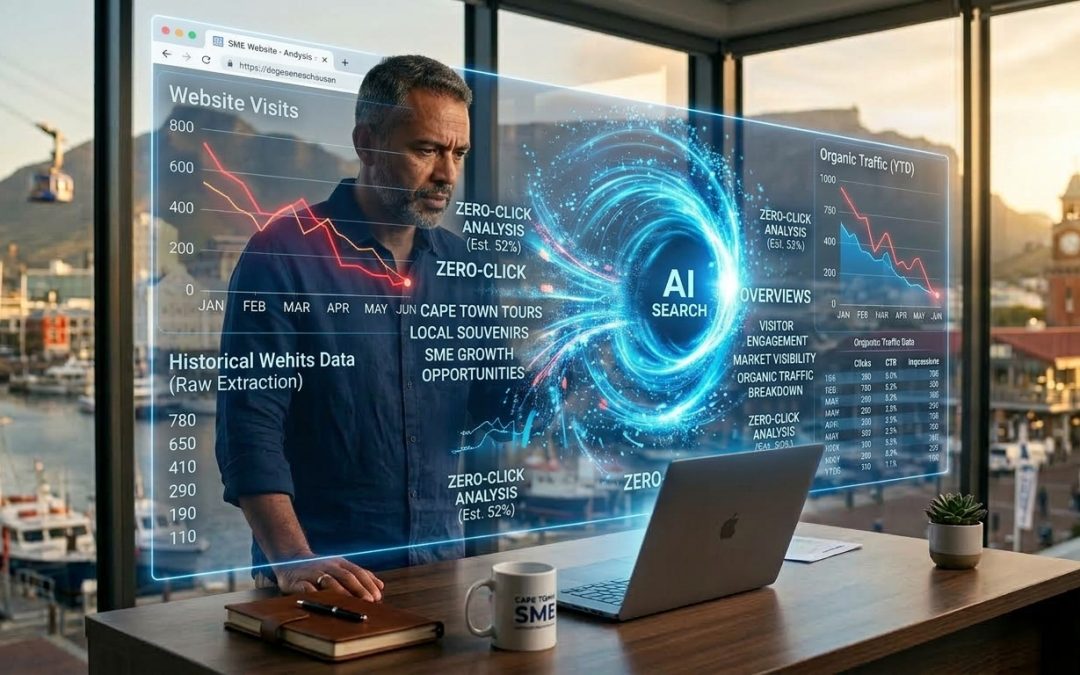
Hidden Zero-Click SEO Impact: Cape Town SMEs Traffic Loss & Solutions
Google is answering your customers’ questions before they ever reach your website — and for most Cape Town SMEs, that’s already costing them traffic they haven’t even noticed yet. This shift isn’t a glitch or a temporary algorithm update. It’s a structural change in how search engines deliver information, driven by AI Overviews, featured snippets, knowledge panels, and People Also Ask boxes that have been quietly absorbing clicks for years.
Key Takeaways: Zero-Click SEO at a Glance
- Over 60% of Google searches now end without a single click — and that number is rising fast as AI Overviews expand across more query types.
- Cape Town SMEs relying purely on organic website traffic are already feeling the squeeze, with impressions climbing while actual sessions quietly drop.
- Zero-click doesn’t mean zero opportunity — businesses that become the source AI cites are building a powerful new form of brand visibility.
- Your current analytics dashboard is only showing you part of the picture — phone calls, walk-ins, and branded searches driven by zero-click exposure are largely invisible to standard reporting.
- There are five proven strategies Cape Town SMEs can implement right now to not just survive zero-click search, but turn it into a competitive edge — and we cover all of them below.
The arrival of AI-powered search has pushed online visibility and brand discovery to a tipping point. Understanding what zero-click search means for your business — and what to do about it — is now one of the most important digital marketing decisions a Cape Town SME can make in 2026 and beyoond.
The Zero-Click Crisis: Why Cape Town SMEs Are Losing Website Traffic
The term “zero-click search” sounds technical, but the problem it describes is straightforward: fewer people are clicking through to websites, even when those websites rank well. For SMEs that built their lead generation around organic search traffic, this is a direct hit to the bottom line.
What Is a Zero-Click Search and Why Is It Exploding?
A zero-click search happens when a user types a query into Google and gets the answer they need directly on the search results page — without clicking any link. Google surfaces the answer through a featured snippet, an AI Overview, a knowledge panel, a map result, or a People Also Ask box. The user gets what they came for. Your website gets nothing.
This behaviour isn’t new, but it has accelerated sharply. Featured snippets and knowledge panels have been pulling clicks away from organic results for over a decade. What’s changed is the scale. AI Overviews — Google’s generative AI summaries that appear at the top of the SERP — now synthesise answers from multiple sources into a single, confident response. Users don’t need to visit any of those sources. They already have the answer.
The Data: How Much Traffic Are Cape Town SMEs Actually Losing?
The numbers are hard to ignore. Research from SparkToro and Datos found that approximately 60% of Google searches end without a click — and that figure applies even without an AI Overview present. When AI Overviews are factored in, the zero-click rate climbs higher. For informational queries — the kind local service businesses often rank for — click-through rates have dropped significantly as SERP features expand to fill more of the page.
For Cape Town SMEs, the local dimension makes this even more acute. Queries like “best accountant in Cape Town,” “plumber near me,” or “Cape Town hair salon hours” are precisely the types of searches that trigger map packs, business panels, and AI-generated summaries. These are high-intent, conversion-ready searches — and increasingly, they resolve on the SERP without a website visit. For more insights on this trend, read about the zero-click search impact.
| Search Type | SERP Feature Triggered | Zero-Click Risk Level |
|---|---|---|
| Business hours / location | Google Business Profile / Map Pack | Very High |
| How-to / informational | AI Overview / Featured Snippet | Very High |
| Local service queries | Map Pack / Local Pack | High |
| Product comparisons | Shopping Panel / People Also Ask | Medium-High |
| Branded searches | Knowledge Panel / Brand SERP | Medium |
| Transactional / buy intent | Paid Ads / Shopping Results | Medium-Low |
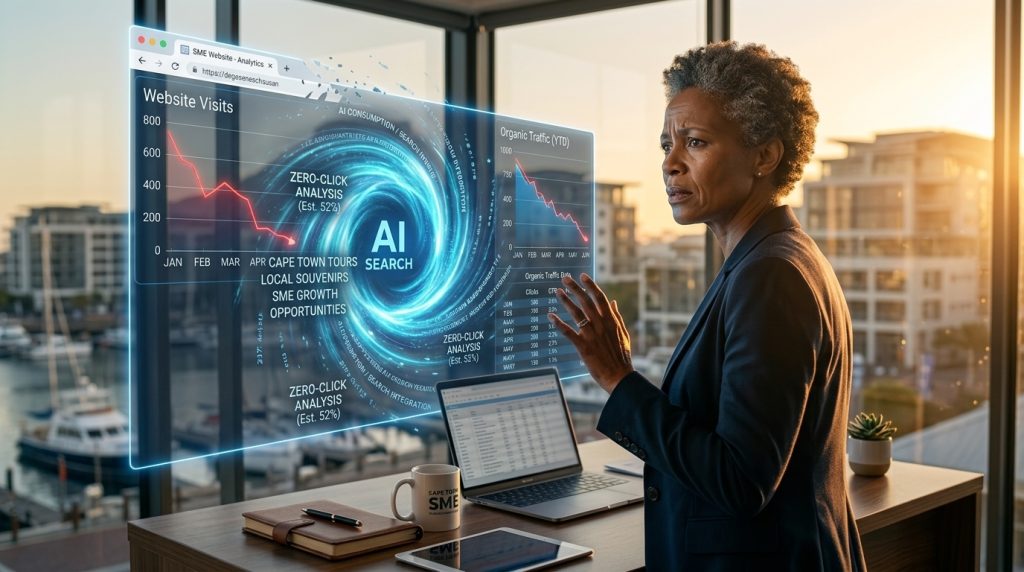
What makes this data particularly challenging for SMEs is that Google Search Console will still show impressions — your pages are being seen — but clicks simply don’t follow. It creates a misleading picture where rankings look healthy but traffic tells a different story.
The Psychology of Zero-Click: Why Users Trust AI Summaries Over Links
There’s a human behaviour element at play here that no algorithm update is going to reverse. When Google presents a clean, confident AI-generated summary at the top of a results page, users trust it. It looks authoritative. It answers the question directly. Clicking through to a website — with its loading time, pop-ups, and navigation — adds friction that most users simply won’t bother with when the answer is already in front of them.
This is especially true on mobile, where the majority of local searches happen. A Cape Town resident searching for “open restaurants near me” on their phone gets a map pack with ratings, hours, and directions — all without leaving Google. The psychology is simple: Google has trained users to expect instant answers, and it has delivered on that promise so consistently that clicking a blue link now feels like extra work.
How AI Overviews and Featured Snippets Create the Zero-Click Problem
Understanding exactly which SERP features are driving zero-click behaviour helps Cape Town SMEs identify where their traffic is disappearing — and more importantly, where it can be recovered or redirected.
The Anatomy of a Zero-Click SERP in 2026 and Beyond
Open Google and search for almost any informational or local query right now. What you’ll see above the traditional blue links is a layered stack of SERP features. At the very top sits the AI Overview — a generated paragraph or bulleted summary pulling from multiple web sources. Below that, you might see a featured snippet, a People Also Ask accordion, a map pack, and sponsored results — all before a single organic link appears. By the time a user scrolls to the traditional results, many have already found what they need.
For Cape Town SMEs, this means the page-one ranking your business worked hard to achieve may now sit below the fold on mobile — below features that didn’t exist two years ago. Ranking first is no longer enough. Visibility has a new definition, and it’s measured in SERP features, not just positions.
Which Cape Town SME Queries Are Most Affected (Local, Informational, Transactional)
Not all queries are equally affected by zero-click behaviour. Informational queries — “how to fix a leaky tap,” “what documents do I need to register a business in South Africa” — are the highest-risk category. These are almost always resolved by an AI Overview or featured snippet. If your blog content targets these queries to drive top-of-funnel traffic, that traffic is shrinking.
Local queries are the second major risk zone for Cape Town businesses specifically. Map pack results for searches like “Cape Town web designer” or “Woodstock coffee shop” satisfy most user needs without a website visit. Transactional queries — where someone is ready to buy — carry the lowest zero-click risk, because Google still recognises that purchase completion requires visiting a website or calling a business directly. This is where smart SMEs should be focusing their conversion-oriented content.
The Compounding Effect: AI Mode + AI Overviews + Zero-Click = Traffic Collapse
The real danger isn’t any single SERP feature — it’s the combination. AI Overviews launched at scale. Google’s AI Mode is expanding. Featured snippets and People Also Ask boxes have been present for years. When all three operate simultaneously on the same query, the organic click-through rate for that keyword can drop close to zero. This compounding effect is what’s turning a manageable traffic dip into a structural collapse for businesses that haven’t adapted their strategy.
Why Impressions Rise While Clicks Fall
This is the metric paradox that confuses most SME owners when they look at their Google Search Console data. Impressions count every time your page URL appears anywhere in a search result — including as a citation inside an AI Overview that a user never clicks. So your impression count rises because Google is referencing your content inside its AI-generated answers, while your click count falls because users read the summary and move on. Your rankings look fine. Your content is being used. But your website traffic is declining.
This disconnect is one of the clearest signals that the old way of measuring SEO success — sessions, pageviews, and click-through rate as primary KPIs — is no longer sufficient for understanding your true search visibility in 2026.
Rethinking Success Metrics in a Zero-Click World
If clicks are no longer a reliable proxy for search visibility, Cape Town SMEs need a measurement framework that reflects how modern search actually works — one that captures brand influence, citation presence, and offline conversion activity that traditional analytics were never built to track.
From Sessions and Pageviews to Citation Frequency and Brand Recall
The metrics that defined SEO success for the past fifteen years were built for a world where clicks were the primary currency of search visibility. Sessions, pageviews, bounce rate, and organic click-through rate all assume that a user visiting your website is the goal. In a zero-click environment, that assumption breaks down. Your business can be influencing hundreds of purchase decisions every week through AI Overviews and featured snippets — and your analytics dashboard will show you almost none of it.
- Citation frequency: How often your brand, content, or business details appear inside AI-generated answers and featured snippets — with or without a click.
- Brand recall lift: Whether users who encounter your brand in a zero-click result are more likely to search for you by name later — measurable through branded search volume trends.
- Assisted conversions: Sales, enquiries, or leads where a zero-click touchpoint appeared earlier in the customer journey, visible in GA4 through multi-channel attribution.
- Direct traffic growth: Users who bypass Google entirely after a previous zero-click brand encounter, typing your URL directly or using a saved bookmark.
- Offline conversion signals: Phone calls tracked through Google Business Profile, walk-in mentions captured through customer surveys, and WhatsApp enquiries tied to search activity.
Shifting to these metrics doesn’t mean abandoning traditional reporting — it means layering a new measurement framework on top of what you already have. The businesses that will thrive in a zero-click search environment are those that start building this picture now, before their competitors realise the old dashboard is lying to them.
Brand recall is particularly powerful for Cape Town SMEs operating in tight-knit local communities. When a Claremont resident sees your business cited in an AI Overview answering a question about local services, they may not click — but they remember the name. That recognition drives a branded search days later, a direct visit to your website, or a walk past your shopfront with intent to enter. None of that shows up as organic traffic from the original search, but it is absolutely a result of your zero-click visibility.
The New KPIs: AI Impression Share, Citation Rate, and Assisted Conversions
Practically speaking, tracking your AI Overview citation rate requires manual monitoring right now — Google Search Console does not yet surface a dedicated AI citation report. The most reliable approach is to run regular incognito searches for your target keywords and note when your brand or content appears inside an AI-generated summary. Pair this with Google Search Console’s impression data for those same queries, and you begin to build a citation frequency baseline. For assisted conversions, GA4’s path exploration report and multi-channel funnel data give you the clearest view of how zero-click touchpoints contribute to eventual website conversions.
How to Track Revenue from Zero-Click Visibility (Phone Calls, Walk-Ins, Direct Traffic)
Google Business Profile is your most actionable tracking tool for zero-click revenue attribution. The platform reports call clicks, direction requests, website clicks, and message interactions directly — all of which can be triggered by a map pack result that resolves without a website visit. If your GBP shows 200 direction requests in a month but your website analytics shows minimal local traffic, that gap represents zero-click value that was previously invisible to your reporting.
For walk-in attribution, the simplest and most underused method is training your front-of-house staff or intake process to ask one question: “How did you hear about us?” Customers who answer “I Googled it” without specifying a website visit are frequently zero-click conversions — they found your details on the SERP, made a decision, and came in. Combining GBP insights, phone tracking software like CallRail, and basic customer intake questions gives Cape Town SMEs a far more complete picture of zero-click revenue than any analytics platform alone.
Why Your Current Analytics Dashboard Is Showing You Less Than Half the Picture
Google Analytics 4 tracks sessions that originate from a click. It cannot track a user who read your business name in an AI Overview, closed their phone, and walked into your store twenty minutes later. It cannot track the person who saw your brand cited in a featured snippet, remembered your name, and called you directly three days later. These conversion paths are real, they are increasing in frequency as zero-click rates rise, and they are completely invisible to standard GA4 organic traffic reporting.
The practical implication for Cape Town SMEs is this: if your organic traffic is declining but your leads, calls, and sales remain stable or are growing, zero-click visibility is likely filling the gap your analytics can’t see. Don’t let a drop in sessions trigger a panic-driven strategy overhaul before you’ve interrogated all the data sources available to you — including GBP insights, direct traffic trends, branded search volume, and offline conversion signals.
Zero-Click Survival Strategies for Cape Town SMEs
Surviving zero-click search isn’t about fighting Google’s direction — it’s about repositioning your business to win visibility inside the new search landscape rather than chasing clicks that the SERP no longer produces. These five strategies are sequenced from highest-impact content changes to longer-term brand-building moves that compound over time.
Strategy 1: Become the Source AI Cites (Content Architecture Shift)
Google’s AI Overviews pull from sources that demonstrate clear expertise, structured information, and direct answers to specific questions. To become a cited source, your content needs to shift from broad, keyword-stuffed articles to tightly structured, question-and-answer formatted pages that give Google’s AI exactly what it needs to generate a reliable summary. This means leading every section with a direct answer to the section’s question, using clear subheadings, including specific data points and locally relevant examples, and structuring content with schema markup so Google can parse it efficiently. For a Cape Town SME, this might mean rewriting your services page from a general description into a structured FAQ that answers the exact questions your customers type into Google — complete with location-specific context that signals local relevance to AI systems.
Strategy 2: Optimise for “Click-Through” Moments Within Zero-Click SERPs
Not every element of a zero-click SERP kills the click — some create it. People Also Ask boxes, for example, often drive secondary clicks when a user expands one question and sees a related question they hadn’t considered. If your content answers both the primary and related questions comprehensively, you increase the chance of capturing that secondary click. Similarly, AI Overviews frequently include a “More” or source citation link that curious users do follow. Being the cited source — even in a summary that resolves most of the query — keeps you in the running for the minority of users who want to go deeper.
Title tags and meta descriptions still matter in this context, but their job has changed. Instead of selling the click purely on keyword relevance, they now need to signal what additional value exists beyond what the AI summary provided. A meta description that reads “Including 2026 pricing, Cape Town-specific regulations, and a free checklist” gives a user who already read the AI Overview a concrete reason to click through to your page for the details the summary couldn’t include.
Strategy 3: Build Direct Channels (Email, WhatsApp, Social) to Reduce Google Dependence
The most resilient Cape Town SMEs in a zero-click world are those that convert Google-discovered visitors into owned-channel subscribers before the zero-click rate climbs high enough to cut off new discovery entirely. Every website visitor represents an opportunity to capture an email address, a WhatsApp opt-in, or a social media follow — converting a one-time Google-driven visit into a direct relationship that doesn’t depend on future search visibility. Tools like WhatsApp Business API, Mailchimp, and even a simple Google Forms lead magnet can anchor this strategy without significant budget.
For Cape Town SMEs specifically, WhatsApp is a particularly high-value channel. South Africa has one of the highest WhatsApp adoption rates globally, and local customers are comfortable using it for business enquiries, appointment bookings, and customer service. A business that converts even 10% of its monthly organic visitors into WhatsApp contacts builds a direct communication channel that zero-click search cannot touch — and that compounds in value every month.
Strategy 4: Leverage Google Business Profile for Map Pack and Local Visibility
Google Business Profile is the single most important zero-click asset a Cape Town SME can control directly. Map pack results — the three local business listings that appear for location-based searches — are themselves zero-click surfaces, but they drive calls, direction requests, and website visits at far higher rates than standard organic results. A fully optimised GBP with accurate categories, updated hours, high-quality photos, detailed service descriptions, and a consistent stream of genuine customer reviews keeps your business competitive in the map pack regardless of what AI Overviews do to your blog traffic. Treat your GBP like a second website — because for many Cape Town customers searching on mobile, it effectively is one.
Strategy 5: Invest in Brand Searches That Bypass Zero-Click Entirely
When someone searches your business name directly, Google serves a branded knowledge panel — a rich result showing your logo, contact details, reviews, social profiles, and recent posts. This is a zero-click result in format, but it’s a zero-click result that you largely control and that delivers direct commercial intent. Users searching for your brand by name already know who you are and are one step from converting. Building brand awareness through local PR, community sponsorships, social media presence, and word-of-mouth referrals drives branded search volume — and branded searches are the one search type where zero-click behaviour actively works in your favour rather than against it.
Turning Zero-Click into a Competitive Advantage
Most Cape Town SMEs are reading zero-click data and panicking. That panic is understandable — but it’s also creating a gap. While competitors freeze their SEO budgets or chase vanishing click-through rates, the businesses that reframe zero-click visibility as a brand-building channel are quietly accumulating a presence inside Google’s AI-generated answers that their competitors won’t easily dislodge. The window to establish that position is open right now, and it won’t stay open indefinitely.
Zero-click search rewards authority. Google’s AI systems cite sources that are consistent, structured, locally specific, and demonstrably expert. Every piece of content you restructure for AI citation eligibility, every GBP update you make, and every branded search you generate through community presence compounds into a growing share of zero-click visibility. That compounding effect is the competitive advantage — and it favours the businesses that start earliest.
Why Early Adopters Win: The Cape Town SME First-Mover Opportunity
Google’s AI citation patterns are not random — they’re sticky. Once an AI Overview consistently cites a particular source for a query, displacing that source requires a competitor to produce demonstrably better-structured, more authoritative content on the same topic. Cape Town SMEs that restructure their content for AI citation eligibility in 2026 are setting anchors that will be far harder for late-moving competitors to pull up in 2027. The cost of entry right now is lower than it will ever be again — because most local businesses haven’t started yet.
Which Cape Town Industries Face the Highest Zero-Click Risk Right Now
Not every Cape Town industry is equally exposed. The sectors facing the steepest zero-click risk are those whose primary search queries are informational or logistics-based — questions that AI can answer completely without sending the user to a website.
Legal and financial services firms that built traffic through informational blog content — “how to register a company in South Africa,” “what is transfer duty in Cape Town” — are watching AI Overviews absorb those clicks entirely. Healthcare practitioners fielding symptom and treatment queries face the same dynamic. Tourism and hospitality businesses whose visibility depended on “things to do in Cape Town” roundups are now competing with AI-generated itineraries that never link out.
By contrast, Cape Town businesses in trades and home services — plumbers, electricians, solar installers — face moderate zero-click risk because their queries trigger map pack results and call buttons rather than AI summaries. The urgency of their services (“emergency plumber Cape Town”) drives direct action even from a zero-click SERP. Understanding where your industry sits on this risk spectrum determines how aggressively you need to pivot your strategy versus refine it.
Budgeting for Zero-Click Resilience vs Chasing Lost Traffic
The instinct when traffic drops is to spend more on the channel that’s losing — more content, more link building, more technical SEO fixes. In a zero-click environment, that instinct will drain your budget without recovering the clicks, because the clicks aren’t coming back to those query types regardless of how well you rank. A smarter budget allocation for Cape Town SMEs in 2026 looks like this: maintain the technical SEO and content quality baseline that keeps you citation-eligible, and redirect the remaining budget toward owned channel growth, GBP optimisation, and brand awareness activities that drive branded search volume.
Concretely, this means shifting spend from pure traffic-acquisition content toward email list building, WhatsApp subscriber growth, local PR, and community partnerships that generate word-of-mouth branded searches. These investments don’t show up immediately in your organic traffic report — but they build the direct audience that makes your business genuinely resilient to whatever Google’s next algorithm shift brings.
Frequently Asked Questions About Zero-Click SEO Impact
Quick Reference: Zero-Click SEO for Cape Town SMEs
Question Short Answer Is zero-click killing my business permanently? No — but it requires a strategy shift, not just more of the same SEO. Can I still generate leads without clicks? Yes — through GBP, phone calls, branded searches, and direct channels. Should I stop investing in SEO? No — but your SEO goals need to evolve beyond click-through rate. How do I measure zero-click ROI? GBP insights, branded search volume, direct traffic, and offline conversions. What’s the single most important action today? Optimise your Google Business Profile completely — it’s your highest-leverage zero-click asset.
Is zero-click search killing small businesses in Cape Town permanently?
Zero-click search is not a death sentence — it is a redistribution of value. Businesses that depended entirely on informational blog traffic for lead generation are facing a genuine structural challenge, but the underlying customer demand hasn’t disappeared. Those customers are still searching, still making decisions, and still choosing local service providers. The difference is that the path from search to conversion now runs through SERP features — map packs, AI Overviews, knowledge panels — rather than website visits. Cape Town SMEs that adapt their visibility strategy to match this new path will find the customers waiting on the other side.
Can I still generate leads if nobody clicks through to my website?
Absolutely. Google Business Profile alone generates calls, direction requests, and message enquiries for millions of local businesses every day — entirely without a website click. A user who reads your business name in an AI Overview, sees your 4.8-star rating in the map pack, and calls your number directly is a lead. They never visited your website. That lead is real, it has commercial value, and it came from your search visibility. Building the systems to capture, track, and nurture these leads — call tracking, WhatsApp Business, GBP messaging — is the practical work of zero-click lead generation.
Should Cape Town SMEs stop investing in SEO because of zero-click?
Stopping SEO investment in response to zero-click search would be the equivalent of removing your shop sign because fewer people are walking past. The goal of SEO has always been to make your business visible to people actively searching for what you offer — zero-click search hasn’t changed that goal, it’s changed the format of that visibility. Structured content, local keyword targeting, schema markup, GBP optimisation, and authoritative backlinks all remain powerful — they now determine your citation eligibility inside AI answers as much as your traditional ranking position.
How do I measure the ROI of my visibility if there are no clicks?
Measure what moves instead of what clicks. Google Business Profile insights report calls, direction requests, and message interactions that your website analytics will never capture. Google Search Console shows impression volume — even when clicks don’t follow — giving you a proxy for how often your content is appearing in results. GA4’s multi-channel attribution shows when organic search appeared earlier in a conversion path that concluded through a direct visit or branded search. Branded search volume in Search Console tells you whether zero-click exposure is driving name recognition that leads to direct intent. Combining these four data sources gives you a far more honest picture of your actual search ROI than sessions alone.
What is the single most important thing a Cape Town SME can do today to fight zero-click losses?
Optimise your Google Business Profile — completely, not partially. This means selecting the most precise primary and secondary business categories, writing a keyword-rich business description that includes your suburb and service area, uploading high-quality photos of your premises, products, and team, enabling messaging, and actively responding to every review within 24 hours. A fully optimised GBP is the single highest-leverage action a Cape Town SME can take right now because it simultaneously improves your map pack ranking, increases your visibility in zero-click local results, and creates multiple conversion pathways — calls, directions, messages — that operate entirely outside the click-dependent model your website traffic reports on.
Beyond GBP, the next most impactful action is restructuring your most-visited web pages to lead with direct, structured answers to the questions they target. Use clear H2 and H3 subheadings framed as questions, answer them in the first sentence of each section, include locally specific data and examples, and implement FAQ schema markup to signal that structure to Google’s crawlers. This content architecture shift is what moves you from a source Google ranks to a source Google cites — and in a zero-click world, being cited is the new page one.
The businesses that will look back on 2026 as the year they pulled ahead of local competitors are the ones acting on these changes now — not waiting for their traffic reports to confirm what the data already shows. Zero-click search has changed the rules. The opportunity is in being the first Cape Town SME in your category to play by the new ones.
If you’re ready to adapt your digital strategy for the zero-click era, CapeBiz Toolkit works with Cape Town SMEs to build search visibility that converts — clicks or no clicks.
When They Don’t Click, They Must Remember
In a zero-click world, brand recall is your only currency. Prospects must see your brand repeatedly across independent, authoritative channels to trust you before they ever pick up the phone.
The AI Visibility Blueprint builds that psychological reassurance by placing your brand across hundreds of new entry points simultaneously. We build the compounding assets; you get the highly qualified inquiries.
Ready to turn invisible AI searches into high-value sales?
📱 WhatsApp / Call Gerard: +27 (0)84 207 0131