

Best AI Power GBP and NAP Tips for South African SMEs
Your Google Business Profile and NAP data are the two most powerful, and most ignored AI visibility levers available to South African SMEs right now. By optimising these overlooked assets, you not only dominate local search rankings but also convert high‑intent customers who are actively looking for your products and services today.
Key Takeaways: GBP and NAP as Your AI Visibility Foundation
- Google AI Overviews are active in South Africa and appear on 30–40% of all searches, meaning your business must be optimised for AI citation, not just traditional ranking.
- Your Google Business Profile is one of the primary data sources AI engines use to decide which local businesses to recommend — an incomplete or outdated profile is essentially an invisible one.
- NAP (Name, Address, Phone) inconsistencies across directories can actively damage your AI visibility, causing search engines to distrust your business data entirely.
- South African SMEs that align their GBP and NAP data correctly are positioned to capture high-intent local leads at the exact moment a customer is ready to buy.
- There is a specific set of South African directories where NAP consistency matters most — and most SME owners have never audited a single one of them.
CapeBiz Toolkit has been tracking how AI-driven search is reshaping local business discovery across South Africa, and the data is clear: the businesses showing up in AI-generated summaries are not necessarily the biggest or the best-funded. They are simply the most consistently structured.
AI Cannot Recommend Your Business Without These Two Things
When a potential customer in Cape Town types “best plumber near me” or “accountant in Sandton” into Google, they are increasingly met with an AI-generated summary at the top of the results page. That summary pulls from verified, structured business data — and if your data is missing, conflicting, or incomplete, you simply do not appear. No ranking trick fixes this. No amount of paid ads compensates for it. The foundation has to be right first.
The two things AI needs before it can recommend your business are a fully optimised Google Business Profile and consistent NAP data across every directory where your business exists online. These are not optional extras. They are table stakes for local AI visibility in 2025 and beyond.
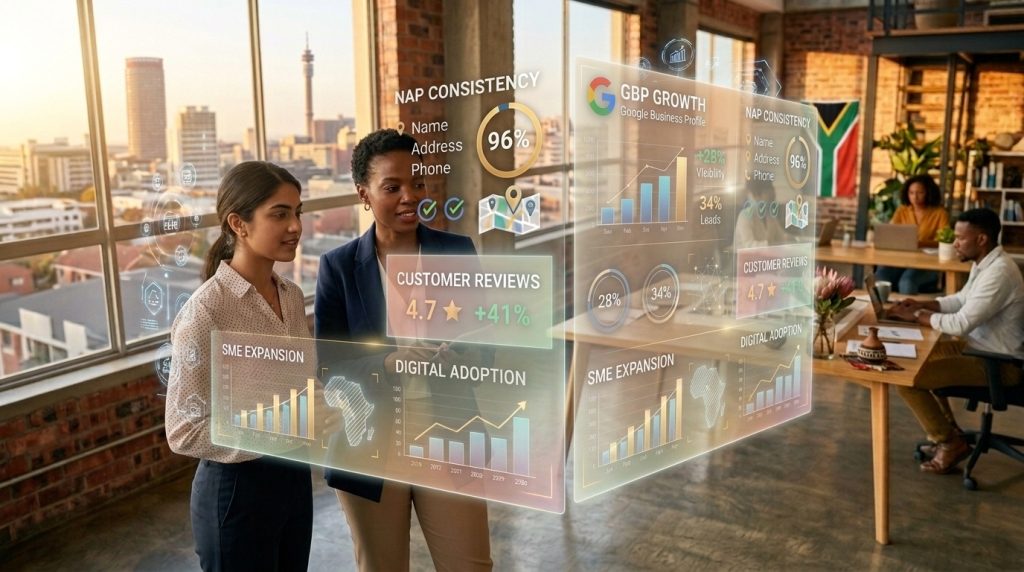
The Invisible Foundation: Why AI Skips Businesses Without GBP and NAP
Most South African SME owners think about Google in terms of their website ranking. That mental model is outdated. AI Overview systems do not work like traditional search. They synthesise information from multiple trusted sources and produce a single answer. Your business either feeds into that synthesis or it does not.
How AI Engines Source Local Business Data in South Africa
Google’s AI systems cross-reference your Google Business Profile, your website, third-party directories, social media platforms, and local news mentions to construct a picture of your business. The more consistent and complete that picture is across all these sources, the more confidently the AI can recommend you. Think of it as a trust score built from data points — every consistent mention adds to it, every conflict subtracts from it.
In the South African context, this means your data needs to align across Google Business Profile, your own website, platforms like Brabys, Yellow Pages SA, Hotfrog South Africa, and industry-specific directories relevant to your sector. AI systems treat disagreements between these sources as a red flag, not a minor inconsistency.
The NAP Consistency Problem Plaguing South African SMEs
NAP stands for Name, Address, and Phone number. It sounds almost absurdly simple, but it is one of the most common and most damaging problems affecting local businesses across South Africa. A business that registered years ago under a slightly different trading name, moved premises once, or changed phone numbers without updating every directory is already losing AI visibility without knowing it.
The problem compounds over time. Old listings persist. Aggregator databases pull outdated information. A Johannesburg-based SME might have its correct details on its own website but five different address variations spread across directories it has long forgotten it ever listed on. Each variation tells AI systems that something does not add up.
What Happens When Your NAP Data Conflicts Across Directories
When AI systems encounter conflicting NAP data, they do not pick the most common version and move on. They reduce their confidence in your business as a whole. This directly affects whether your business appears in AI-generated local summaries, map packs, and voice search results. Publishers and service businesses are already reporting organic traffic declines of 20 to 60 percent on queries where AI Overviews appear — and businesses with messy NAP data are disproportionately affected.
The fix is not glamorous, but it is highly effective. A systematic NAP audit followed by consistent corrections across every directory where your business appears can meaningfully shift your AI visibility within weeks.
Google Business Profile Is Your AI Visibility Command Centre
Your Google Business Profile is not just a listing. It is the single most important structured data source feeding AI-generated local search results in South Africa. Google’s own AI Overview system prioritises GBP data when constructing local business recommendations, which means every field you leave blank, every category you choose carelessly, and every review you fail to respond to is a missed signal.
The businesses appearing in AI summaries for high-intent local queries are not there by accident. They have optimised profiles that communicate clearly, completely, and consistently. Fortunately, this is entirely within your control.
The Complete GBP Optimisation Checklist for South African SMEs
Getting your GBP right requires attention across several areas simultaneously. It is not enough to claim your profile and fill in the basics. AI systems read the depth and freshness of your profile data as quality signals.
Work through each of these areas methodically:
- Business Name: Use your exact legal or trading name — no keyword stuffing, no location additions unless they are part of your official name
- Primary Category: Choose the single most specific category that matches your core service (e.g. “Chartered Accountant” not just “Financial Services”)
- Secondary Categories: Add up to nine additional categories that accurately reflect your other services
- Business Description: Write 750 characters that clearly describe what you do, who you serve, and what makes you different — include your primary city or region naturally
- Service Areas: If you travel to clients, define your service area by region rather than a single pin
- Opening Hours: Keep these accurate and update them for public holidays — Google flags inconsistencies between stated hours and user-reported hours
- Phone Number: Use a local South African number that matches exactly what appears on your website and in directories
- Website Link: Link to a page that is directly relevant, not just your homepage if a specific service page is more appropriate
- Products and Services: List every service with individual descriptions — this feeds AI with structured service data it can cite directly
- Photos: Upload a minimum of ten high-quality images including exterior, interior, team, and work samples — refresh these quarterly
GBP Completeness vs AI Visibility: What the Data Shows
Businesses with fully completed GBP profiles — including services listed, photos uploaded, and questions answered — are significantly more likely to appear in AI-generated local summaries than businesses with partial profiles. Google’s own documentation confirms that completeness is a direct ranking and citation factor. For South African SMEs competing in high-intent local categories like legal services, home improvement, healthcare, and hospitality, a complete profile is not optional.
Reviews, Ratings, and Review Velocity as AI Trust Signals
“AI systems do not just look at your star rating. They look at how recently reviews were left, how consistently they arrive, and whether the business owner is actively engaging with them.”
Review velocity — the rate at which new reviews are being added to your profile — is a live signal that tells AI your business is active, relevant, and trusted by real customers. A profile with 47 reviews from three years ago and nothing recent is a weaker signal than a profile with 20 reviews that arrived steadily over the past six months.
For South African SMEs, building a sustainable review strategy means making the ask a standard part of your customer journey. Send a follow-up message after a completed job. Include a QR code on your invoice that links directly to your Google review page. Train your front-of-house team to mention it at the point of a positive interaction. The mechanics are straightforward — the discipline is the hard part.
Responding to reviews is equally important. AI systems interpret owner responses as engagement signals. Respond to every review — positive and negative — within 48 hours. Keep responses professional, specific, and human. A templated copy-paste response repeated across 30 reviews is worse than no response at all.
GBP Posts, Photos, and Q&A Feed Fresh Data to AI Engines
GBP Posts are one of the most underused features in the South African SME market. Posting updates, offers, events, or new services directly to your GBP sends a freshness signal to Google’s systems that tells AI your business is active and current. Aim for at least two posts per month — more during seasonal peaks relevant to your industry.
Photos deserve a dedicated strategy, not an afterthought. Google’s systems analyse photo metadata, frequency of uploads, and user engagement with images as quality indicators. A restaurant in the Winelands uploading fresh seasonal menu photos monthly is giving AI a reason to keep citing it. A competitor with photos from 2021 is not.
The Q&A section on your GBP is another direct AI data source. Seed it yourself by asking and answering the most common questions your customers raise. Questions like “Do you offer same-day service in Cape Town?” or “What payment methods do you accept?” answered clearly in your own Q&A section give AI systems citable, structured answers that can appear directly in search summaries.
Categories, Attributes, and Service Areas Tell AI Exactly What You Do
Your primary category is the single most influential field on your entire GBP. Google’s AI uses it to decide which queries your business is eligible to appear for. Choosing “Business Centre” when you run a coworking space, or “Contractor” when you are specifically a waterproofing specialist, costs you precision — and precision is exactly what AI systems reward. Go as specific as the available categories allow, then use secondary categories to capture adjacent services you legitimately provide.
Attributes are the checkboxes most SME owners skip entirely. They tell AI systems — and customers — granular details about your business: whether you offer online appointments, whether your premises are wheelchair accessible, whether you serve specific communities. In a South African context, attributes like “women-led business,” “BBBEE compliant,” or “serves Afrikaans-speaking customers” can be decisive factors in how AI frames your business within local summaries. Fill in every attribute that honestly applies to you.
NAP Consistency Is the Boring Task That Makes or Breaks AI Trust
No section of this guide will feel less exciting than NAP consistency — and no section will have a more direct impact on your AI visibility. This is the infrastructure work that most SME owners postpone indefinitely, and it is precisely why getting it right creates a genuine competitive advantage in markets where your competitors are equally neglecting it.
What NAP Means and Why AI Models Weight It So Heavily
NAP — Name, Address, Phone — is the core identity data that AI systems use to verify that your business is real, stable, and trustworthy. When an AI model sees your business name, address, and phone number presented identically across your GBP, your website, and dozens of third-party directories, it interprets that consistency as a trust signal. The logic is simple: a legitimate, established business maintains accurate information. A fly-by-night operation or an outdated listing does not.
The weighting AI models give to NAP consistency is not a minor factor. It is foundational. Google’s systems actively cross-reference your claimed identity on your GBP against what third-party sources report. Where conflicts exist, confidence drops. Where consistency is airtight, your business becomes a reliable citation source — which is exactly what you need to appear in AI-generated summaries for high-intent local queries.
The South African Directory Landscape Where Your NAP Must Match
South Africa has a specific set of directories and data aggregators that carry meaningful weight with AI systems. These are the platforms where your NAP data must be identical — not approximately correct, not close enough, but character-for-character consistent with what appears on your GBP and website.
- Brabys — One of South Africa’s oldest and most widely scraped business directories
- Yellow Pages SA (yp.co.za) — Still actively indexed and used as a data source by aggregators
- Hotfrog South Africa — Frequently pulled into AI data synthesis pipelines
- Cylex South Africa — High domain authority, commonly cross-referenced by search engines
- Yelp South Africa — Carries international trust signals relevant to tourism and hospitality sectors
- South Africa Business Directory (sabd.co.za) — Important for B2B and professional services SMEs
- LinkedIn Company Page — Weighted heavily for professional services, consulting, and B2B operations
- Facebook Business Page — AI systems cross-reference social NAP data, particularly for service businesses
- Apple Maps — Increasingly important as Siri and Apple Intelligence expand in SA markets
- Bing Places for Business — Feeds Microsoft Copilot, which is gaining significant traction in SA corporate environments
Beyond these core platforms, consider industry-specific directories relevant to your sector. A Cape Town guesthouse needs consistent NAP on TripAdvisor and Booking.com. A Johannesburg attorney needs to be consistent on Justicia and LegalWise directories. A Durban contractor needs alignment on directories serving the construction and trades sectors. The AI systems referencing your business are pulling from wherever your industry’s customers actually search.
How to Audit and Fix NAP Inconsistencies Across 50+ Directories
Start with a simple Google search of your exact business name in quotation marks. Review every result on the first three pages and note every variation in how your name, address, or phone number appears. Then repeat the search using your phone number and your street address. Build a spreadsheet documenting every listing you find, what data it shows, and whether it matches your master NAP record. Tools like Moz Local, BrightLocal, or Synup can automate much of this discovery process and are well worth the investment for SMEs with more than a handful of directory listings.
Advanced GBP and NAP Strategies for South African Markets
Once your foundational GBP is complete and your NAP data is consistent, you can move into the strategies that separate businesses that appear occasionally in AI summaries from those that appear consistently and prominently. These advanced approaches are particularly relevant in South Africa’s unique market environment, where tourism seasonality, multilingual customer bases, and geographic spread create specific optimisation opportunities that most SME owners are not yet exploiting.
The gap between a well-maintained GBP and a neglected one is widening as AI systems become the primary discovery mechanism for local businesses. The businesses investing in these advanced strategies now are building a compounding advantage that will become increasingly difficult for late movers to close.
Multi-Location GBP Management for Growing SA SMEs
If your business operates from more than one physical location — whether that is a second retail branch in Pretoria, a satellite office in Durban, or a franchise expanding into the Western Cape — each location requires its own fully optimised GBP listing. Do not manage these as copies of your primary listing. Each location should have location-specific descriptions, locally relevant photos, location-specific service area settings, and its own review cultivation strategy. AI systems treat each GBP listing as a distinct entity. A generic listing that reads like a head office template will always underperform a listing that clearly communicates the specific value of that particular location to local customers.
Area-Based vs Pin-Based Service Businesses: Which GBP Setup to Use
South African SMEs that travel to their customers — electricians, plumbers, mobile beauticians, home tutors, cleaning services — face a specific GBP decision that significantly affects AI visibility. You must choose between displaying your physical address (pin-based) or hiding your address and defining a service area instead (area-based). For businesses where customers do not visit your premises, hiding your address and setting a precise service area by suburb, city, or region is almost always the better choice. It signals to AI systems that you serve customers across a defined geographic area rather than a single point, which increases your eligibility to appear in searches across that entire region.
The service area boundaries you set should reflect where you realistically and regularly work — not the widest possible area you could theoretically reach. Inflated service areas reduce your relevance score for the specific suburbs where you actually do most of your business. A Johannesburg-based mobile dog groomer who primarily serves Sandton, Fourways, and Midrand will perform better defining those three areas precisely than claiming all of Gauteng.
Seasonal and Tourism-Peak GBP Optimisation for South African Businesses
South Africa’s tourism calendar creates distinct seasonal demand patterns that AI-savvy SMEs can exploit through timed GBP optimisation. Businesses in the Western Cape, Garden Route, KwaZulu-Natal coast, and Kruger-adjacent areas experience significant search volume spikes during December–January, Easter, and the European summer travel season (June–August). In the weeks before these peaks, update your GBP description to include seasonal language relevant to visiting travellers. Add fresh photos reflecting the current season. Create GBP Posts highlighting seasonal offers, availability, or experiences. Ensure your hours are updated to reflect any extended operating periods.
This seasonal refresh strategy is not about gaming the system — it is about giving AI accurate, current, and contextually relevant data exactly when demand for your type of business is highest. An AI Overview summarising “where to stay near Hermanus during whale season” pulls from businesses that have fresh, complete, and locally relevant GBP data. Make sure yours is one of them.
How to Measure GBP and NAP Impact on AI Visibility
What gets measured gets managed — and GBP performance is far more measurable than most South African SME owners realise. Google provides a native insights dashboard within your GBP that tracks how customers are finding and interacting with your profile. Learning to read these metrics correctly transforms your GBP from a set-and-forget listing into a live business development tool that tells you exactly how your AI visibility is performing month over month.
GBP Insights Metrics That Actually Matter: Searches, Calls, and Direction Requests
Inside your GBP dashboard, three metrics tell you almost everything you need to know about how AI-driven local discovery is working for your business. The first is Search Impressions — how many times your profile appeared in Google Search or Maps results. The second is Customer Actions, which breaks down into calls, website clicks, and direction requests. The third is Photo Views compared to your competitors in the same category. A rising search impression count combined with flat customer actions tells you your profile is being seen but is not compelling enough to convert — that is a content and photo problem. A flat search impression count despite a well-optimised profile often points to NAP inconsistencies suppressing your visibility upstream.
Direction requests are a particularly powerful signal for South African SMEs with physical premises. A consistent month-on-month increase in direction requests is one of the clearest indicators that AI systems are actively recommending your business to high-intent customers — people who have already decided to visit you and just need to know how to get there. Track this number monthly without fail. If it is flat or declining while your competitors are growing, your GBP or NAP data needs immediate attention.
Monthly Reporting Benchmarks for South African SME Owners
Set aside 30 minutes at the end of each month to review your GBP performance against the previous month and the same month last year. Record your total search impressions, total customer actions broken down by type, your current review count and average rating, the number of new reviews received that month, and the number of GBP posts published. Over time, this simple monthly log becomes an invaluable dataset that reveals seasonal patterns, the impact of specific optimisation actions, and the direct relationship between GBP activity and real customer enquiries. It also gives you the ammunition to justify continued investment in AI visibility strategies to business partners or investors who want to see measurable returns.
Your Next Move Starts With Your GBP
- Claim and fully verify your Google Business Profile if you have not already done so
- Complete every single field in your GBP — categories, services, description, hours, attributes, and Q&A
- Audit your NAP data across the top South African directories and correct every inconsistency you find
- Build a sustainable review velocity strategy that generates fresh reviews every month
- Publish at least two GBP posts per month and upload fresh photos quarterly
- Set up your monthly GBP reporting dashboard so you can track progress and spot problems early
- Configure your service areas precisely if you are a mobile or area-based service business
- Plan seasonal GBP content refreshes aligned with South Africa’s key tourism and demand peaks
The businesses that will dominate AI-driven local search in South Africa over the next three years are not necessarily the biggest, the best-funded, or the longest-established. They are the ones that got their foundational data right while their competitors were still thinking about AI as a future problem. The window to build this advantage cleanly and cost-effectively is open right now — but it will not stay open indefinitely.
Every week that passes with an incomplete GBP or inconsistent NAP data is a week of compounding lost visibility. AI systems are actively learning which local South African businesses are trustworthy and authoritative sources of information. Every consistent data point you add, every review you earn, every post you publish, and every directory listing you correct is teaching those systems to trust and recommend your business. The compound effect of that trust, built systematically over six to twelve months, is a local search presence that becomes genuinely difficult for competitors to displace. For more insights, explore Google AI overviews for Cape Town SMEs.
Start today with the single highest-leverage action available to you: log into your Google Business Profile, open the completeness checklist, and fix every field that is incomplete, outdated, or imprecise. That one session, done thoroughly, can shift your AI visibility more than months of unfocused marketing activity. The foundation has to be right. Everything else builds from there.
FAQ’s About GBP and NAP as Your AI Visibility Foundation
South African SME owners consistently raise the same core questions when it comes to GBP optimisation and NAP consistency for AI visibility. The answers below are direct, practical, and based on how Google’s systems actually behave in the current AI-driven search environment — not how they worked five years ago.
If your question is not covered here, the fastest way to get a definitive answer is to test systematically — make one change, give it four weeks, and measure the impact in your GBP insights dashboard. AI visibility is not a mystery. It is a data problem with data solutions.
How do I claim and verify my Google Business Profile in South Africa?
Go to business.google.com and sign in with the Google account you want to associate with your business. Search for your business name — if it already exists as an unverified listing, claim it. If not, create a new profile. Google will ask you to verify ownership, most commonly via a postcard sent to your physical business address, which arrives within 5 to 14 business days in South Africa. Some businesses qualify for instant phone or email verification. Once verified, you have full control over your profile data. Complete every field before your verification arrives so your optimised profile goes live the moment verification is confirmed.
What happens if my NAP data is inconsistent across directories?
Inconsistent NAP data causes AI systems to reduce their confidence in your business as a reliable local entity. In practical terms, this means your business is less likely to appear in AI-generated local summaries, Google Maps packs, and voice search results — even if your GBP itself is well-optimised. The severity depends on how many conflicting versions of your data exist and how widely they are distributed. A single outdated listing on a low-traffic directory has minimal impact. Multiple conflicting versions across high-authority platforms like Brabys, Yellow Pages SA, and Facebook create a meaningful suppression effect that directly costs you leads and revenue.
How many reviews do I need before AI starts recommending my business?
There is no magic number, but the pattern is clear: businesses with fewer than ten reviews rarely appear in competitive AI-generated local summaries, while businesses with 25 or more recent reviews with a rating above 4.2 stars appear consistently. More important than the total count is review velocity — steady, recent reviews signal an active, trusted business. A business with 15 reviews received over the past three months will typically outperform a business with 50 reviews where the most recent is from 18 months ago. Prioritise freshness and consistency over chasing a specific total.
Is GBP optimisation enough, or do I still need website SEO for AI visibility?
GBP optimisation and website SEO are complementary, not interchangeable. Your GBP is the primary signal source for local AI discovery — map results, local summaries, and “near me” queries. Your website is the primary signal source for broader topic authority, service-specific queries, and the structured content that AI systems cite in extended summaries. For South African SMEs operating in competitive local markets, GBP is the higher-leverage starting point because the impact is faster and more direct. But a well-optimised website with clear service pages, local schema markup, and consistent NAP in the footer amplifies everything your GBP is doing. Both matter. Start with GBP, then build the website layer on top.
Which South African directories matter most for NAP consistency?
Not all directories carry equal weight with AI systems. Focus your NAP consistency efforts on the platforms that Google’s systems actively cross-reference when verifying local business data. The general rule is to prioritise high-domain-authority directories, platforms with active South African user bases, and any industry-specific directories that customers in your sector actually use to find service providers.
The following directories should be your first priority for NAP auditing and correction, listed roughly in order of their AI relevance signal strength for South African businesses:
- Google Business Profile — Your master record; all other data should match this exactly
- Your own website — Footer NAP, contact page, and About page must all be identical
- Facebook Business Page — Heavily cross-referenced for service businesses and local brands
- LinkedIn Company Page — Critical for B2B, professional services, and consulting SMEs
- Brabys — South Africa’s most widely scraped local business data source
- Yellow Pages SA (yp.co.za) — Legacy authority still actively indexed by aggregators
- Bing Places for Business — Feeds Microsoft Copilot, increasingly important in SA corporate markets
- Apple Maps Connect — Essential as Siri and Apple Intelligence adoption grows in South Africa
- Hotfrog South Africa — Frequently pulled into AI data synthesis pipelines
- Cylex South Africa — High domain authority, commonly cross-referenced by search engines
Once your NAP is consistent across these core platforms, expand your audit to industry-specific directories relevant to your sector. Hospitality businesses should prioritise TripAdvisor and Booking.com. Legal professionals should check Justicia and the Law Society of South Africa directory. Trades and construction businesses should audit Master Builders SA and local contractor directories. The AI systems that recommend your business to customers are pulling data from exactly the same places your customers search — make sure every source tells the same story.
Getting your GBP and NAP data right is the single highest-return investment available to a South African SME in the current AI-driven search environment. It costs more in attention than in money, and it compounds over time in a way that paid advertising simply cannot replicate. The businesses that understand this early — and act on it consistently — are the ones that will own local AI visibility in their markets for years to come.
Amplify Your Local Authority Globally
Consistent NAP data is the foundation, but AI Overviews prioritize local businesses that also have a broad, authoritative digital footprint backing up their GBP profile
Through the AI Visibility Blueprint, we ensure your core business topics are distributed across a global network of high-authority channels, acting as a massive trust signal that supercharges your local Google Business Profile.
Ready for an enterprise-grade digital footprint without the enterprise overhead?
📱 WhatsApp / Call Gerard: +27 (0)84 207 0131