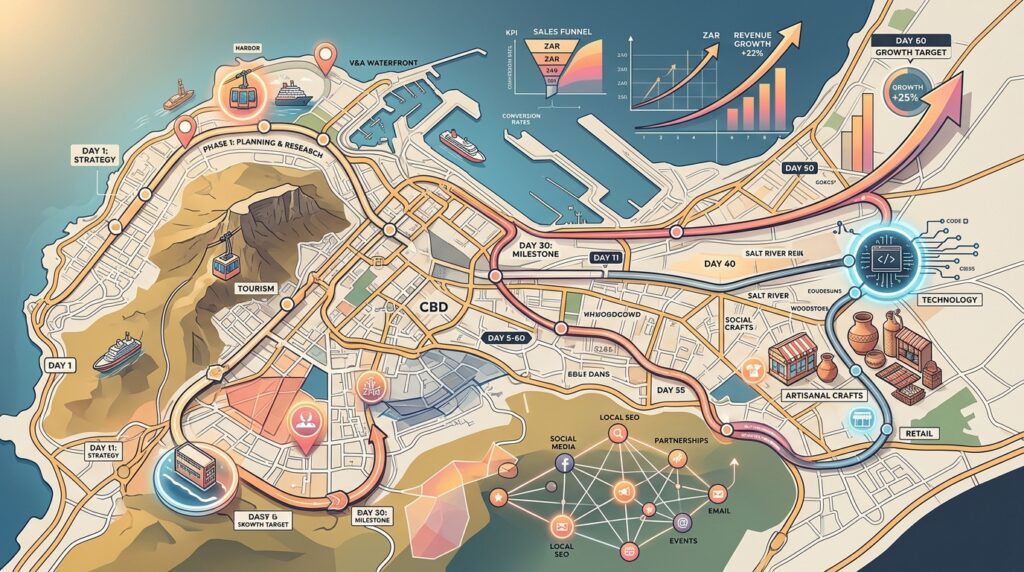
A 60-Day Plan to Boost Sales for Cape Town SMEs
Small businesses in Cape Town operate in one of South Africa’s most competitive yet opportunity-rich environments. From the bustling markets of the City Bowl to the growing entrepreneurial ecosystem in Mitchells Plain and Khayelitsha, local SMEs are constantly competing for the attention of buyers who have more choices than ever. The challenge isn’t finding customers — it’s converting them consistently.
Key Takeaways: Plan To Boost Sales for Cape Town SMEs
- A structured 60-day sales plan gives Cape Town SMEs a clear, actionable roadmap to generate more revenue without a big budget.
- The first 30 days are about building a foundation — auditing your process, defining your ideal customer, and choosing the right sales channels.
- Free tools like WhatsApp Business and local CRM platforms can replace expensive software and still deliver serious results.
- Tracking just three key metrics — conversion rate, average deal size, and lead response time — can reveal exactly where your sales are leaking.
- CapeBiz Toolkit provides Cape Town entrepreneurs with the digital tools needed to execute faster and sell smarter from day one.
Most Cape Town SMEs don’t have a sales problem — they have a system problem, and 60 days is enough time to fix it.
That’s where a structured sales plan changes everything. CapeBiz Toolkit was built specifically for Cape Town business owners who need real tools and real strategies — not generic advice. This 60-day plan draws on proven sales frameworks and adapts them to the realities of running a small business in Cape Town’s unique market.
Cape Town SMEs Can Double Sales in 60 Days With the Right Plan
Doubling sales sounds ambitious, but it becomes realistic when you stop doing things randomly and start working a plan. Most SMEs in Cape Town are sitting on untapped revenue — leads that were never followed up, customers who weren’t upsold, and channels that were never properly tested. A 60-day plan forces you to focus, execute, and measure, which is exactly what separates growing businesses from stagnant ones.
The plan is split into two phases. The first 30 days are about building a foundation that actually supports sales growth. The second 30 days are about executing with precision and closing more deals. Skip the foundation phase and your efforts in phase two will leak revenue at every step.

Days 1–30: Build the Foundation Before You Sell Anything
It’s tempting to jump straight into outreach, promotions, and social media campaigns. But without a clear picture of who you’re selling to, how you’re selling, and what’s actually working, you’ll burn time and money on the wrong activities. The first month is about getting ruthlessly clear on your sales fundamentals.
Audit Your Current Sales Process First
Before adding anything new, look at what you already have. Walk through every step a customer takes from the moment they first hear about your business to the moment they pay you. Where do people drop off? How long does it take to respond to an enquiry? Are you following up with leads at all?
Most Cape Town SMEs discover two or three major leaks during this audit — a slow response time, no follow-up system, or a checkout process that creates unnecessary friction. Fixing these leaks alone can boost your conversion rate significantly before you even spend a cent on marketing or outreach.
Write down your current process step by step. If you can’t describe it clearly, your customers are experiencing it as confusion. Clarity in your process creates confidence in your buyer.
Define Your Ideal Cape Town Customer Profile
Not every customer is the right customer. Trying to sell to everyone in Cape Town is one of the fastest ways to waste your sales energy. Your ideal customer profile (ICP) should describe the specific type of person or business most likely to buy from you, benefit from what you offer, and come back for more.
Think about your three to five best current customers. What do they have in common? Where are they located — Sea Point, Bellville, Somerset West? What problem were they trying to solve when they found you? How did they hear about you? The answers to these questions build a profile you can target with precision instead of guessing.
Set Measurable Sales Targets for the Next 60 Days
Vague goals produce vague results. Instead of saying “I want more sales,” set a specific, measurable target for each 30-day block. Your targets should be tied to real numbers you can track weekly.
Here are examples of measurable 30-day sales targets for a Cape Town SME:
- Close 10 new paying customers by the end of day 30
- Generate 50 qualified leads through WhatsApp Business and Instagram
- Increase average transaction value by 15% through upselling
- Reduce lead response time to under 2 hours for all enquiries
- Re-engage 20 past customers with a special offer or follow-up message
Targets like these give you something concrete to work toward and make it easy to spot when something isn’t working early enough to adjust.
Choose the Right Sales Channels for Your Market
Cape Town buyers don’t all live on the same platform or respond to the same message. A B2B services business in the Foreshore is going to close deals very differently than a clothing retailer in Parow Centre. Your job in the first 30 days is to identify which one or two channels give you the highest return on your time — and double down on those instead of spreading yourself thin.
Convert More Leads With a Simple Follow-Up System
Most sales in Cape Town’s SME market don’t happen on the first contact — they happen on the third, fourth, or fifth. The businesses that win are the ones that follow up consistently while their competitors go quiet after one message. A simple follow-up system doesn’t need to be complicated: a sequence of three to five touchpoints spread over seven to ten days, using a mix of WhatsApp, email, or phone depending on how the lead first contacted you.
Map out your follow-up sequence before you start outreach so it runs automatically in the background. Day one is your initial response. Day three is a value-add message — a tip, a case study, or an answer to a common objection. Day seven is a soft close. Day ten is a final check-in. This alone will recover leads that would otherwise go cold and cost you nothing but a few minutes of preparation.
The Sales Metrics Every Cape Town SME Must Track
You can’t improve what you don’t measure. Most small business owners in Cape Town have a rough sense of their monthly revenue, but very few track the specific numbers that actually explain why sales go up or down. Tracking just three core metrics gives you enough data to make smart decisions without drowning in spreadsheets.
Conversion Rate
Your conversion rate is the percentage of leads that turn into paying customers. If 50 people enquire about your product in a month and 10 of them buy, your conversion rate is 20%. This number tells you how effective your sales process and messaging are. A low conversion rate usually points to a pricing issue, a trust issue, or a follow-up gap — all of which are fixable once you know they exist. For more insights, you might consider exploring resources like the Cape Town’s Business Cheat Code which is trusted by local businesses.
Average Deal Size
Average deal size is the average rand value of each sale you close. Increasing this number — even by 10% — has a compounding effect on your monthly revenue without requiring a single extra customer. The most practical way to grow your average deal size is through bundling, upselling at the point of sale, or introducing a premium tier to your offer.
For example, a Cape Town cleaning company charging R450 per session could introduce a R700 deep-clean package and a R1,200 monthly retainer. If even 30% of customers upgrade, the revenue impact is immediate and requires zero additional marketing spend.
Lead Response Time
Lead response time measures how quickly you respond to a new enquiry. Research consistently shows that responding within the first hour dramatically increases your chances of closing a deal compared to responding after 24 hours. In Cape Town’s competitive SME environment, a slow response often means the customer has already moved on to a competitor who picked up faster. Check your average response time honestly — and if it’s longer than two hours during business hours, fixing it should be your first priority.
Common Sales Mistakes Cape Town SMEs Make in the First 30 Days
Mistake Why It Hurts Your Sales The Fix Targeting everyone in Cape Town Dilutes your message and wastes budget Define a specific ideal customer profile first No follow-up system Hot leads go cold within 48 hours Build a 3–5 step follow-up sequence before outreach Focusing on features, not outcomes Buyers don’t care what you do — they care what changes for them Rewrite your pitch around the result the customer gets Ignoring past customers Existing customers cost 5x less to convert than new ones Create a re-engagement campaign for lapsed buyers No clear call to action Interested buyers don’t know what to do next End every message, post, and conversation with one clear next step
The most damaging mistake on this list isn’t any single one — it’s combining several of them at once. An SME that targets too broadly, never follows up, and has no clear call to action is essentially doing outreach for the benefit of their competitors.
The good news is that these mistakes are all fixable within your first 30 days without spending any additional money. They are process problems, not budget problems. Identifying which ones apply to your business right now and eliminating them one by one is the fastest path to a measurable sales improvement before the 60-day plan even reaches its halfway point.
Take the mistakes table above and use it as a quick audit checklist. If you can honestly say you’re making even two of those five mistakes, correcting them alone could lift your conversion rate significantly. Start there before launching any new campaign or adding any new channel to your sales mix.
Low-Cost Sales Tools That Work for South African Small Businesses
You don’t need an enterprise sales stack to grow a Cape Town SME. The tools available for free or at very low cost today are powerful enough to manage leads, automate follow-ups, track performance, and run targeted outreach — all from your phone if needed. The key is choosing tools that fit how your business actually operates rather than adopting software that looks impressive but adds complexity without results.
Free and Affordable CRM Options Available in South Africa
Cape Town SMEs can benefit from HubSpot CRM, which offers a genuinely capable free tier that lets you track contacts, log interactions, set follow-up reminders, and monitor your sales pipeline in real time. For most Cape Town SMEs handling under 200 active leads, the free version is more than sufficient. Zoho CRM is another strong option with a free plan for up to three users, which makes it practical for small teams. Both platforms integrate with Gmail and WhatsApp through third-party connectors, so your communication history stays in one place rather than scattered across five different apps.
WhatsApp Business as a Sales Tool for Cape Town SMEs
WhatsApp Business is arguably the single most powerful free sales tool available to South African SMEs right now. With over 90% of South African smartphone users active on WhatsApp, it’s where your customers already are. The business version lets you set up a product catalogue, create quick reply templates for common enquiries, automate greeting messages, and set away messages outside business hours — all of which reduce response time and improve the buyer experience without any additional staff. Used correctly, WhatsApp Business functions as a lightweight CRM, a follow-up tool, and a direct sales channel simultaneously.
Social Media Platforms That Drive Local Sales
Facebook and Instagram remain the two highest-converting social platforms for Cape Town SMEs selling to consumers. Facebook’s local awareness ads let you target buyers within a specific radius of your business address — useful if you operate from a fixed location in areas like Claremont, Woodstock, or Tygervalley. Instagram works particularly well for product-based businesses where visual presentation drives purchase decisions: food, fashion, home décor, beauty, and lifestyle brands all perform strongly here.
LinkedIn is the channel most B2B service businesses in Cape Town underuse. If your SME sells to other businesses — accounting, logistics, HR services, digital marketing, cleaning contracts — a consistent LinkedIn presence with direct outreach to decision-makers in the Western Cape can generate qualified leads at zero cost. The key is sending personalised connection requests followed by a value-first message rather than a cold pitch.
TikTok is growing fast among South African audiences under 35 and rewards consistency over production quality. A Cape Town restaurant, hair salon, or retail store posting three to five short videos per week showing behind-the-scenes content, product demos, or customer results can build a local following quickly. The algorithm favours new accounts, which means a brand-new TikTok profile can reach thousands of local viewers within weeks if the content resonates.
- Facebook: Best for local awareness ads, community groups, and retargeting past website visitors
- Instagram: Ideal for visual products, stories, reels, and influencer collaborations with local Cape Town creators
- LinkedIn: Most effective for B2B outreach, thought leadership content, and connecting with Western Cape decision-makers
- TikTok: High organic reach for businesses willing to post short-form video content consistently
- WhatsApp Status: Often overlooked but extremely effective for nurturing existing contacts with offers, updates, and social proof
The biggest mistake SMEs make with social media is trying to be active on every platform at once. Pick the one or two channels where your ideal Cape Town customer actually spends time, show up there consistently for 60 days, and measure what works before expanding to a new platform.
How to Keep Sales Momentum Going After Day 60
The 60-day plan gives you a foundation — but momentum is what turns a good month into a great quarter. Once day 60 arrives, run a full review of your three core metrics: conversion rate, average deal size, and lead response time. Identify what worked, cut what didn’t, and set a new 30-day target that builds on your results. The businesses that sustain sales growth beyond the initial plan are the ones that treat every 30 days as a new sprint with updated goals, not a moment to coast on early wins. Build a simple monthly rhythm: review your numbers on the first of every month, adjust your top two or three sales activities, and keep your follow-up system running without gaps. That rhythm, compounded over six months, is what creates the kind of consistent revenue growth that changes the trajectory of a Cape Town SME.
Start Your 60-Day Sales Plan Today
The gap between a Cape Town SME that struggles and one that scales is rarely talent, product quality, or even budget — it’s whether there’s a system in place that turns interest into income, consistently, every single month. Start with day one of this plan today: audit your current process, write down your ideal customer profile, and set one measurable sales target for the next 30 days. Everything else builds from there. The businesses that commit to the full 60 days almost always find revenue they didn’t know they were leaving on the table — and that discovery alone makes the process worth it. For more insights, check out the 30-60-90 day sales plan guide.
FAQ’s On How To Boost Sales for Cape Town SMEs
Cape Town SME owners ask similar questions when they first approach a structured sales plan. The answers below cut straight to what matters most for local small businesses operating in South Africa’s current economic environment.
These questions come up repeatedly because they address the real barriers most small business owners face — uncertainty about targets, budget constraints, and not knowing where to start. Here are direct, practical answers to the most common ones.
What is a realistic sales growth target for a Cape Town SME in 60 days?
A realistic target for most Cape Town SMEs following a structured plan is a 15% to 30% increase in monthly revenue within 60 days. The range depends on your starting point, your industry, and how consistently you execute the plan. Businesses that are currently losing leads due to slow response times or no follow-up system often see faster gains because fixing those leaks alone drives immediate results without any additional marketing spend.
Do I need a big budget to boost sales as a small business in Cape Town?
No. The majority of the tactics in this plan cost nothing beyond your time. WhatsApp Business is free. Cape Town’s Business Cheat Code offers free essential marketing tools. HubSpot CRM’s core features are free. Organic social media posting is free. Re-engaging past customers costs nothing but a message. Even paid social ads on Facebook and Instagram can be effective starting from as little as R50 per day when they’re targeted correctly at a defined local audience.
The businesses that waste money on marketing are usually the ones that skip the foundation phase and start paying to drive traffic to a broken sales process. Fix the process first — then amplify it with a small paid budget once you know what’s converting. For more insights, explore SME resources provided by the Banking Association South Africa.
How do I find new customers in Cape Town quickly?
The fastest path to new customers in Cape Town is through your existing network and past customer base. Ask your best current customers for referrals directly — not with a generic message, but with a specific ask: “Do you know one other business owner who could benefit from what we do?” Simultaneously, join two or three active Cape Town business Facebook groups or LinkedIn communities relevant to your industry and start contributing value before pitching. Local visibility compounds quickly when you show up consistently in spaces where your buyers already gather.
Is WhatsApp Business effective for SME sales in South Africa?
WhatsApp Business is one of the most effective sales tools available to South African SMEs, full stop. South Africa has one of the highest WhatsApp adoption rates in the world, and buyers in Cape Town are far more likely to respond to a WhatsApp message than a cold email or phone call. The business version’s catalogue feature, quick replies, and automated greetings make it function as a lightweight sales system that runs from your phone with zero monthly cost. For more insights on SME tools, check out the Banking Association South Africa.
What is the biggest reason Cape Town SMEs fail to grow their sales?
The single biggest reason is the absence of a consistent follow-up system. Most SMEs respond to the first enquiry and then go silent if the customer doesn’t buy immediately. In reality, the majority of buyers need three to five touchpoints before they make a decision — and the business that follows up wins the sale while the one that doesn’t loses it to a competitor who did.
The second most common reason is targeting too broadly. Trying to sell to “everyone in Cape Town” means your message resonates deeply with no one. The SMEs that grow fastest are the ones that get specific about who they serve, where those people are, and what problem they’re solving — and then speak directly to that audience across every channel they use. For more insights, visit The Banking Association South Africa.
Both of these problems are fixable within the first 30 days of this plan without spending a single additional rand. They are execution problems, not resource problems, which means the solution is within reach for any Cape Town SME willing to commit to the process.