
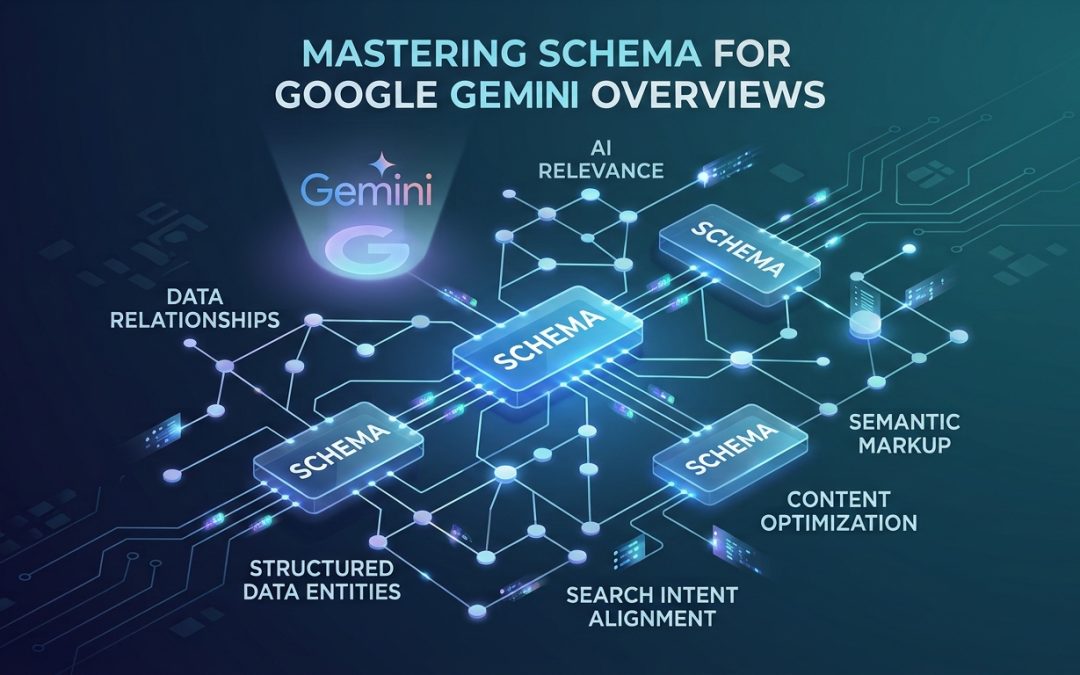
Mastering Schema Markup for Google Gemini Overviews – Boost Google AI Ranking for Cape Town SMEs
Schema for Google Gemini is structured data markup added to your website’s HTML that allows Gemini’s AI systems to read, classify, and cite your business content directly inside AI-generated search overviews. By implementing Gemini schema, your site gains enhanced visibility in AI-powered search results, helping users discover and trust your content more quickly.
Key Takeaways: Mastering Schema Markup for Google Gemini Overviews
- Schema markup is the single most actionable technical step Cape Town SMEs can take right now to appear in Google Gemini AI Overviews — it makes your content machine-readable at the entity level.
- Google Gemini pulls from structured data first, meaning businesses without LocalBusiness, Service, FAQ, and Review schema are effectively invisible to AI-generated answers.
- Your Google Business Profile and website schema must be consistent — mismatched NAP data, categories, or service descriptions actively suppresses your Gemini visibility.
- Western Cape commercial districts are underrepresented in Gemini Overviews — firms in Century City, Paarden Eiland, and Bree Street agencies that implement schema now gain a compounding first-mover advantage.
- Keep reading to discover exactly which schema types to implement first, how to validate them, and why your Google Business Profile is the missing link most Cape Town SMEs overlook.
If your Cape Town business isn’t showing up when potential clients search for your services on Google, schema markup is almost certainly part of the problem — not your product, not your pricing. CapeBiz Toolkit works specifically with Western Cape SMEs to close this gap through structured AI visibility strategies, and what follows is the technical playbook they use.
Schema Markup Is the Fastest Way Cape Town SMEs Get Into Gemini Overviews
Google Gemini doesn’t read your website the way a human does. It scans for machine-readable signals — structured metadata that tells it who you are, what you offer, where you operate, and why you’re credible. Mastering schema markup for Google Gemini overviews, is that signal. Without it, Gemini has to guess your business context from unstructured text, and it will almost always choose a competitor who made that job easier.
The gap between businesses that have implemented schema and those that haven’t is widening fast. In high-competition commercial zones like Century City B2B firms and Paarden Eiland industrial hubs, the businesses already marked up with LocalBusiness and Service schema are the ones Gemini cites by name in AI Overviews. Everyone else is invisible — even if they rank on page one of traditional search results.
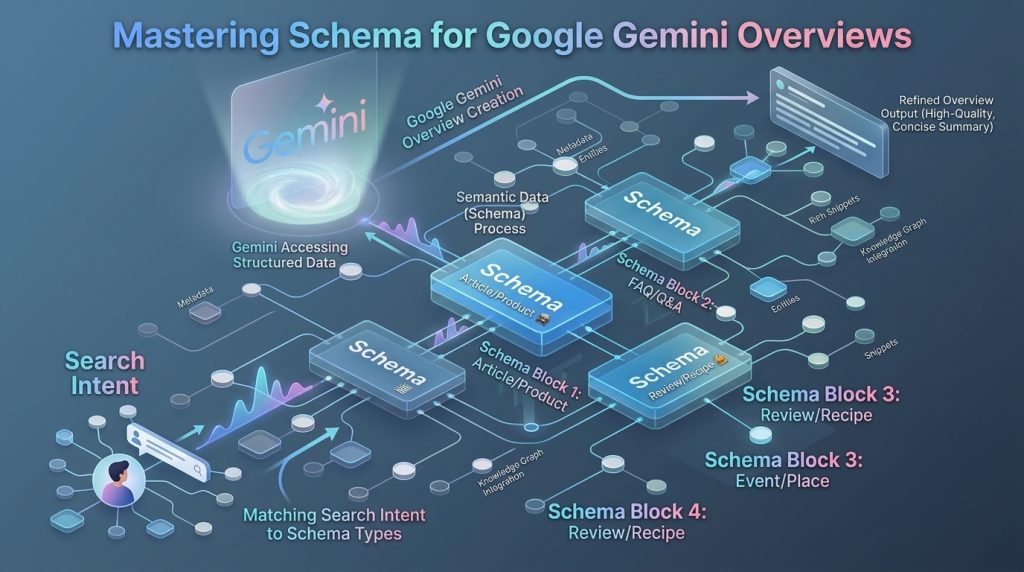
What Google Gemini Overviews Actually Are (And Why They Matter for Your Business)
Google AI Overviews (previously called Search Generative Experience) are AI-generated answer panels that appear at the very top of Google search results — above organic listings, above ads, above everything. Gemini generates these answers by synthesizing content from multiple sources it deems authoritative, then cites those sources with a link. Being cited in an AI Overview is the new page-one ranking.
How Gemini Overviews Differ From Traditional Google Search Results
Traditional search returns ten blue links and lets the user decide which to click. Gemini Overviews synthesize an answer and present it as fact, with one to four source citations underneath. This fundamentally changes the game: click-through rates on traditional organic listings drop when an AI Overview is present, because users get their answer without clicking. The only way to stay in the flow of traffic is to be one of those cited sources.
Why Gemini Pulls From Schema-Marked-Up Content First
Gemini’s underlying systems are built on the same knowledge graph infrastructure Google has been developing for over a decade. Schema markup speaks directly to that graph — it maps your business as an entity with defined properties: name, location, services, reviews, operating hours. When Gemini constructs an answer about “commercial electricians in Cape Town,” it prioritises entities it can fully resolve. A business with complete LocalBusiness schema, geo coordinates, and Service schema is a fully resolved entity. One without is an ambiguous text fragment.
The Local Search Advantage Cape Town SMEs Are Missing Right Now
Here’s the opportunity hiding in plain sight: adoption of proper schema markup among Cape Town SMEs — particularly in Western Cape commercial districts outside of the CBD — is still remarkably low. Businesses operating out of Bree Street creative agencies, Salt River workshops, and Paarden Eiland industrial hubs are competing in Gemini Overviews against national brands with dedicated SEO teams. Mastering schema markup for Google Gemini overviews is the leveller. A properly structured local business website with strong GBP alignment can outrank a national brand for hyper-local queries — and Gemini serves those local queries at scale.
How Google Gemini Ranks and Selects Content for AI Overviews
Gemini doesn’t have a separate ranking algorithm running in isolation. It sits on top of Google’s existing search infrastructure and inherits its signals — with some critical additions specific to AI answer generation.
Core Ranking Systems Gemini Still Relies On: RankBrain, BERT, and PageRank
RankBrain interprets the intent behind ambiguous queries. BERT processes natural language to understand context within sentences. PageRank still measures the authority of a page based on inbound links. All three systems feed into the pool of content Gemini draws from when constructing AI Overviews. This means your traditional SEO foundation — backlinks, crawlability, page authority — still matters. Schema doesn’t replace that foundation; it amplifies it.
What schema does is give Gemini the entity-level clarity it needs to confidently cite your content. RankBrain can match your page to a query. BERT can parse your service descriptions. But without schema, Gemini still has to make probabilistic guesses about what your business actually is and where it operates. Structured data removes that uncertainty entirely.
E-E-A-T: The Trust Signal Gemini Weighs Heavily
Experience, Expertise, Authoritativeness, and Trustworthiness (E-E-A-T) is Google’s quality framework, and it’s deeply baked into how Gemini selects citation sources. For Cape Town SMEs, this translates into very practical signals: author credentials on service pages, verified business information, consistent NAP (Name, Address, Phone) data across directories, and review volume on Google Business Profile.
The “Experience” component added to the original E-A-T framework is particularly relevant for local businesses. Gemini gives weight to content that demonstrates firsthand knowledge — case studies, project-specific outcomes, location-specific expertise. A construction firm in Bellville that publishes detailed project write-ups with geo-specific context is demonstrating Experience in a way that generic service-page copy never can.
- Author schema — Links named contributors to content, boosting Experience and Expertise signals
- Organization schema — Connects your brand entity to verified web presences and contact data
- Review/AggregateRating schema — Surfaces star ratings as structured trust signals within Gemini’s entity graph
- LocalBusiness schema — Anchors your business geographically with coordinates, service areas, and operating hours
How Google Business Profile Data Feeds Directly Into Gemini Results
Google Business Profile (GBP) is not a separate system from Gemini — it is a primary data source. For local queries, Gemini synthesises GBP data, Maps data, and website structured data into a unified entity profile. If these three sources conflict — different phone numbers, inconsistent service categories, mismatched business names — Gemini’s confidence in your entity drops, and so does your likelihood of being cited.
- Business name must be identical across your GBP, website schema, and all directory citations
- Primary and secondary GBP categories must align with your Service schema definitions
- Your GBP service descriptions should mirror the language used in your website’s Service schema
- Geo coordinates in your LocalBusiness schema should match your GBP pin location exactly
GBP posts, Q&A responses, and photo metadata also feed into Gemini’s understanding of your business. A GBP profile that is actively maintained — with weekly posts, answered questions, and geotagged images — signals recency and engagement, both of which Gemini weights in time-sensitive query responses.
Why Freshness and Content Updates Signal Relevance to Gemini
Gemini applies a freshness weighting to content, particularly for queries with commercial or time-sensitive intent. A service page that was last updated in 2022 competes at a disadvantage against one refreshed in the last 90 days — even if the older page has more backlinks. For South African retail and service businesses operating in a fast-moving national economic landscape, this means your website content strategy needs a quarterly refresh cycle at minimum.
Updating schema itself also triggers re-crawling. When you modify your structured data — adding a new service, updating your operating hours, adding review markup — Google’s crawlers re-evaluate the page. That re-evaluation is an opportunity to improve your entity resolution score in Gemini’s knowledge graph. Treat schema updates as a recurring maintenance task, not a one-time implementation.
The Schema Types That Get Cape Town SMEs Featured in Gemini
Not all schema types carry equal weight in Gemini’s entity resolution process. For local service businesses across Western Cape commercial districts, five schema types do the heavy lifting — and implementing them in the right order matters. To learn more about optimizing your schema for Gemini, check out this Gemini SEO guide.
1. LocalBusiness Schema: Your NAP, Hours, and Service Area
LocalBusiness schema is the non-negotiable foundation. It tells Gemini exactly who you are, where you operate, and when you’re available — in machine-readable format that maps directly to Google’s local knowledge graph. Without it, every other schema type you implement is building on sand.
The most critical fields inside LocalBusiness schema are name, address (with full PostalAddress sub-properties including addressLocality and addressRegion), geo (latitude and longitude coordinates), telephone, openingHoursSpecification, and areaServed. The areaServed property is particularly powerful for Cape Town SMEs — it lets you explicitly define your service radius, whether that’s the Cape Winelands, the entire Western Cape, or specific suburbs like Woodstock, Observatory, or Milnerton.
Consistency is everything here. The business name, address, and phone number inside your LocalBusiness schema must be character-for-character identical to what appears on your Google Business Profile and across every online directory citation — Brabys, Yellow Pages South Africa, and any industry-specific listings your business appears on.
- @type: Use the most specific sub-type available (e.g., ElectricalContractor, LegalService, FinancialPlanningService)
- geo: Include precise latitude/longitude coordinates matching your GBP pin
- areaServed: List specific Cape Town suburbs or regions you actively service
- openingHoursSpecification: Use structured day-by-day format, not a plain text string
- priceRange: Even a general indicator (e.g., RR to RRRR) improves entity completeness scoring
- sameAs: Link to your GBP URL, LinkedIn company page, and any other verified brand profiles
2. Service Schema: Telling Gemini Exactly What You Offer
Service schema is where most Cape Town SMEs leave significant Gemini visibility on the table. It allows you to describe each individual service as a distinct entity — with its own name, description, provider, area served, and even pricing structure. This is what enables Gemini to answer hyper-specific queries like “who offers commercial refrigeration repair in Paarden Eiland” by citing your exact service page.
Service Schema Example — Commercial Refrigeration Company, Paarden Eiland:
"@type": "Service"
"name": "Commercial Refrigeration Repair Cape Town"
"provider": { "@type": "LocalBusiness", "name": "Your Business Name" }
"areaServed": { "@type": "City", "name": "Cape Town" }
"serviceType": "Refrigeration Repair"
"description": "Emergency and scheduled commercial refrigeration repair for food service businesses across the Western Cape, including Cape Town CBD, Paarden Eiland, and Montague Gardens industrial areas."
Each service you offer should have its own dedicated schema block on its own dedicated page. Consolidating multiple services into a single schema block on a single page is a common mistake — it reduces Gemini’s ability to match your specific service to a specific query. A logistics company in Blackheath should have separate schema blocks for warehousing, last-mile delivery, and freight forwarding, each on its own URL.
The description field inside Service schema deserves particular attention. Write it the way a customer would ask Gemini about your service — conversational, specific, and geographically anchored. Gemini’s natural language processing is tuned to match query phrasing to content phrasing. If your service description uses the same language as your target customer’s search query, your citation probability increases measurably.
3. FAQ Schema: Answering the Questions Gemini Gets Asked About Your Industry
FAQ schema is one of the most direct pipelines into Gemini AI Overviews available to any business. When Gemini receives a conversational query — “how much does it cost to register a company in South Africa?” or “what certifications do I need for electrical work in Cape Town?” — it actively looks for structured FAQ content that directly answers that question. Your FAQ schema turns your website into an answer engine that Gemini can pull from verbatim.
The implementation rule is simple but frequently violated: each FAQ entry must contain a genuine, complete answer inside the schema markup itself — not a teaser that sends users to read more. Gemini’s crawlers evaluate the acceptedAnswer field for completeness. A one-sentence non-answer gets deprioritised. A 40-to-80-word answer that fully resolves the question gets cited. For B2B firms in Century City or professional services firms in the Cape Town CBD, building a library of 15 to 20 schema-marked FAQ entries covering your industry’s most common queries is one of the highest-ROI schema investments available.
4. Review Schema: Why Your Star Ratings Appear in AI Answers
Review schema — specifically AggregateRating schema — is what tells Gemini your business has been independently validated by real customers. When implemented correctly, it surfaces your star rating, review count, and rating scale as structured entity properties that Gemini can include in AI Overview citations. For any Cape Town SME competing in a crowded service category, the visual trust signal of a 4.8-star rating appearing next to your business name in a Gemini Overview is a significant conversion advantage. The schema requires four properties: ratingValue, reviewCount, bestRating, and worstRating — and the values must reflect your actual verified review data, not aspirational figures.
5. BreadcrumbList Schema: Helping Gemini Navigate Your Site Structure
BreadcrumbList schema maps your website’s navigation hierarchy into a structured format that Gemini uses to understand how your content is organised and how individual pages relate to each other. For a Cape Town SME with a multi-service website, BreadcrumbList schema tells Gemini that your payroll services page is a child of your services section, which belongs to your root domain. This hierarchical context improves Gemini’s confidence in citing specific deep-link pages rather than just your homepage, which means individual service pages in high-intent categories get surfaced directly in AI Overviews.
How to Implement Schema Markup on Your Cape Town Business Website
Implementation is where the theory becomes real — and where most SMEs either stall or make errors that neutralise the entire effort. The process has three non-negotiable steps, and the order matters.
Step 1: Choose Between JSON-LD, Microdata, or RDFa (JSON-LD Wins)
JSON-LD (JavaScript Object Notation for Linked Data) is Google’s explicitly recommended format for structured data, and it’s the format Gemini’s crawlers are optimised to process. Unlike Microdata or RDFa — which require you to embed schema attributes directly inside your HTML elements — JSON-LD sits in a separate <script> block in your page’s <head> or <body>. This separation makes it dramatically easier to implement, audit, and update without touching your visual page design.
For Cape Town SMEs using WordPress — which powers a significant portion of small business websites in the Western Cape — plugins like Yoast SEO Premium, Rank Math Pro, and Schema Pro generate JSON-LD automatically from your page settings. However, plugin-generated schema should always be manually reviewed for completeness. Plugins routinely omit critical fields like areaServed, geo coordinates, and sameAs links — precisely the fields that most directly improve Gemini entity resolution for local businesses.
Step 2: Use Google’s Rich Results Test to Validate Your Markup
Before any schema goes live on a public page, run it through Google’s Rich Results Test at search.google.com/test/rich-results. Paste either your live URL or raw JSON-LD code directly into the tool. It will flag syntax errors, missing required properties, and recommended fields you haven’t populated. For LocalBusiness schema specifically, also run your implementation through validator.schema.org — Google’s tool checks for Rich Result eligibility, while Schema.org’s validator checks for structural correctness against the full specification. Both checks together take under five minutes and prevent the most common implementation errors before they cost you indexing cycles.
Step 3: Add Schema to Your Highest-Traffic Service Pages First
Don’t try to schema-mark every page simultaneously. Pull your Google Search Console data, identify the five to ten pages generating the most impressions for commercial-intent queries, and implement schema there first. For most Cape Town service businesses, this will be your primary service landing pages — the pages already getting traffic but not converting at the rate they should because Gemini isn’t surfacing them in AI Overviews. Schema implementation on high-traffic pages generates faster indexing signals and delivers measurable visibility improvements within two to four weeks of Google re-crawling those URLs.
Content Structure That Makes Gemini Quote Your Website
Schema markup tells Gemini what your business is. Your content structure tells Gemini what your business knows. Both signals are required for consistent AI Overview citations — one without the other produces incomplete entity resolution.
Gemini constructs AI Overviews by identifying the most direct, complete answer to a query from within a pool of authoritative sources. Content that is buried inside dense paragraphs, hidden behind vague headings, or structured for human reading rather than machine parsing gets deprioritised. The pages Gemini cites most frequently share a common architecture: direct answers immediately below descriptive headings, short declarative sentences for key claims, and geographic specificity that anchors the content to a searchable location context.
Write in Direct Question-and-Answer Format for Conversational Queries
Conversational search queries — the kind Gemini is specifically optimised for — expect conversational answers. If your H3 heading is “How long does a commercial lease review take in Cape Town?” then the first sentence of that section must answer the question directly: “A commercial lease review in Cape Town typically takes three to seven business days, depending on lease complexity and whether a commercial attorney conducts the review.” Gemini’s NLP systems match query phrasing to heading phrasing, then evaluate whether the content immediately below that heading resolves the query. If it does, that section becomes a citation candidate. If the first paragraph hedges or contextualises instead of answering, Gemini moves to the next source.
Use Headers That Mirror How Cape Town Customers Actually Search
Your H2 and H3 headings are Gemini’s primary navigation layer through your content. They function as query-matching anchors — Gemini scans headings to determine whether a page contains relevant content before evaluating the body text. This means your heading strategy should be built directly from real search query data: Google Search Console’s Performance report, Google’s autocomplete suggestions for your service category, and the “People Also Ask” boxes that appear in search results for your target keywords.
For Western Cape commercial and industrial businesses, this means your headings should include suburb-level geographic modifiers where natural. “What are the zoning requirements for industrial storage facilities in Paarden Eiland?” is a heading that mirrors an actual Gemini query — and a Cape Town industrial property firm that answers it directly under that exact heading has a credible shot at being cited in Gemini’s response. Generic headings like “Our Services” or “Why Choose Us” contribute nothing to Gemini’s entity resolution and should be replaced with query-matched alternatives on every high-priority page.
Your Google Business Profile Is Non-Negotiable for Gemini Visibility
Your Google Business Profile is not a directory listing — it is a primary data source that Gemini queries directly when constructing AI Overviews for local searches. The distinction matters because most Cape Town SMEs treat GBP as a set-and-forget asset: they claimed the profile years ago, added basic information, and haven’t touched it since. That approach was acceptable in 2019. In 2025, an under-maintained GBP actively suppresses your Gemini visibility by presenting Gemini with incomplete or stale entity data.
The relationship between your GBP and your website schema is bidirectional. Gemini uses both to cross-validate your business entity — if your website schema says you offer commercial cleaning services across the Western Cape and your GBP only lists residential cleaning in Cape Town CBD, that contradiction reduces Gemini’s confidence in your entity profile. Low confidence means lower citation probability. High internal consistency between your GBP and your schema means Gemini can resolve your entity cleanly and cite you with confidence in relevant AI Overviews.
The GBP Fields Gemini Reads Most: Categories, Services, and Descriptions
Not all GBP fields carry equal weight in Gemini’s entity resolution process. The three highest-signal fields are your primary business category, your services list, and your business description. Your primary category is the single most important classification signal in your entire GBP — it determines which query categories Gemini even considers your business for. Your services list should mirror your website’s Service schema — same service names, same geographic scope language, same terminology. Your business description should be written to answer the question “what does this business do and who does it serve?” in 250 to 300 characters, using the exact commercial language your target customers use in search queries.
How Review Volume and Recency Affect Your Gemini Ranking
Gemini weights review signals heavily for local queries, and it evaluates two dimensions simultaneously: total review volume and review recency. A Cape Town B2B firm with 200 reviews — but none in the past eight months — scores lower on the recency dimension than a competitor with 60 reviews and four posted in the last 30 days. Both dimensions matter. The practical implication is that review generation needs to be a continuous business process, not a one-time push. Review responses also feed into the signal: businesses that respond to reviews, both positive and negative, demonstrate active profile management, which Gemini interprets as a freshness and engagement indicator.
Keeping GBP Data Consistent With Your Website Schema
Consistency between your GBP and your website schema is a binary proposition — either the data matches or it creates entity resolution conflicts that suppress your visibility. Any variation across your GBP, your LocalBusiness schema, and your directory citations — even something as minor as “St” versus “Street” in your address — registers as a data conflict in Google’s knowledge graph. For businesses operating across multiple Western Cape locations, each location needs its own GBP listing, its own LocalBusiness schema block on its own location page, and its own consistent NAP data set. Managing this at scale is operationally demanding, but it is the architecture that enables multi-location Gemini visibility.
Cape Town SMEs That Ignore Schema Will Fall Further Behind in 2026 and Beyond
The window for early-mover advantage on schema and Gemini optimisation in the Cape Town market is real but closing. SMEs in Bree Street creative agencies, Salt River light industrial operators, and Bellville professional services firms that implement comprehensive schema now — LocalBusiness, Service, FAQ, Review, and BreadcrumbList — are establishing entity authority that compounds over time. Those that delay are not standing still; they are actively falling behind as the competition around them builds structured data. Mastering schema markup for Google Gemini overviews is not a future-proofing exercise. It is a current-state survival requirement for any Cape Town SME that depends on Google for client acquisition.
FAQ’s About Mastering Schema Markup for Google Gemini Overviews
The questions below reflect the most common points of confusion Cape Town SMEs encounter when implementing schema for Gemini visibility. Each answer is direct and actionable — no hedging, no speculation.
Does Schema Markup Guarantee My Cape Town Business Appears in Gemini Overviews?
No — schema markup does not guarantee Gemini citation, and any service provider claiming otherwise is misrepresenting how the system works. What schema does is make your business eligible for citation by giving Gemini the machine-readable entity data it needs to confidently include you in AI Overviews. Citation decisions are ultimately made by Gemini’s ranking systems based on query relevance, entity authority, content quality, and competition. Schema dramatically improves your probability of citation for relevant queries — it does not override Gemini’s ranking logic. Think of schema as the entry requirement for the competition, not the guarantee of winning it.
How Long Does It Take for Schema Markup to Affect My Google Gemini Visibility?
The timeline has two phases. The first phase is technical: Google needs to crawl and process your updated schema markup. For actively maintained websites with regular content updates, this typically takes between three and fourteen days from implementation. You can accelerate this by submitting your updated URLs through Google Search Console’s URL Inspection tool immediately after deploying your schema changes.
The second phase is competitive: once Google has processed your schema, Gemini begins evaluating your entity against competing sources for relevant queries. How quickly you start appearing in AI Overviews depends on your domain authority, your GBP optimisation level, your review volume, and the competitive density of your service category in the Cape Town market. For low-competition local queries — “heritage building restoration contractor in Woodstock Cape Town,” for example — citation can occur within two to four weeks of schema indexing. For high-competition categories in densely listed commercial zones like Century City or the Cape Town CBD, building consistent Gemini visibility typically takes two to four months of sustained optimisation across schema, GBP, and content freshness signals.
Can I Add Schema Markup to My Website Without a Developer?
Yes, depending on your website platform. WordPress users have access to schema plugins — Rank Math Pro and Schema Pro are the two most capable options for SME use cases — that generate and inject JSON-LD schema without requiring any code editing. Both plugins support LocalBusiness, Service, FAQ, and Review schema types through visual configuration interfaces. Google Tag Manager is another no-code option: you can deploy JSON-LD schema blocks as custom HTML tags that fire on specific pages, giving you granular control over which schema appears where without touching your site’s theme files.
The honest caveat is that plugin-generated schema requires manual review and supplementation. Plugins are reliable for generating correct JSON-LD syntax, but they routinely omit the high-value fields — areaServed, geo coordinates, sameAs links, and sub-type @type declarations — that most directly improve Gemini entity resolution for Cape Town local businesses. If you’re using a plugin, treat its output as a starting point and manually edit the generated JSON-LD to add those fields before going live. Google’s Rich Results Test will validate your final output regardless of how it was generated.
Is Google Business Profile Optimization Separate From Schema Markup?
They are separate technical systems that function as a unified entity signal in Gemini’s knowledge graph. Your website’s LocalBusiness schema and your Google Business Profile both describe the same entity — your business — to Google’s AI systems. Gemini cross-references both to build its confidence in your entity profile. Optimising one without the other produces incomplete entity resolution.
The short answer to whether you need both: yes, unconditionally. A perfect GBP with no website schema leaves Gemini without the extended entity data it needs to cite you for complex queries. Perfect website schema with a neglected GBP leaves Gemini with an entity it can’t fully validate against its highest-trust local data source. Both must be optimised, and both must be aligned.
- Business name: Identical formatting across GBP, schema, and all directory citations — including punctuation and abbreviations
- Primary category: GBP primary category must map directly to your LocalBusiness schema @type sub-classification
- Service list: Every service listed in GBP should have a corresponding Service schema block on your website
- Address: Street address, suburb, city, and postal code must be character-for-character identical in both systems
- Phone number: Use the same format consistently — including country code (+27) if used in one system, use it in all
- Website URL: The URL listed in your GBP must resolve to the exact page carrying your primary LocalBusiness schema
Does AI-Generated Website Content Hurt My Chances of Ranking in Gemini?
Google’s official position is that it evaluates content quality regardless of how the content was produced — human-written or AI-generated. What Gemini’s systems actually penalise is low-quality, undifferentiated content that fails to demonstrate genuine expertise, geographic specificity, or firsthand experience. Generic AI-generated service page copy — the kind that could describe any business in any city — scores poorly on E-E-A-T signals because it lacks the specific, verifiable details that distinguish authoritative content from mass-produced filler.
The practical implication for Cape Town SMEs is nuanced. AI-assisted content that is edited for accuracy, enriched with location-specific detail, and reviewed for factual correctness by a subject-matter expert can perform well in Gemini citations — particularly when paired with proper schema markup that anchors the content to a verified local business entity. The problem is not AI generation per se; it is the tendency to publish AI output without the human refinement layer that adds the Experience and Expertise signals Gemini rewards. A well-edited, schema-backed, geographically specific service page written with AI assistance will consistently outperform a page of raw, unedited AI output — and will often outperform generic human-written copy that lacks the same specificity.
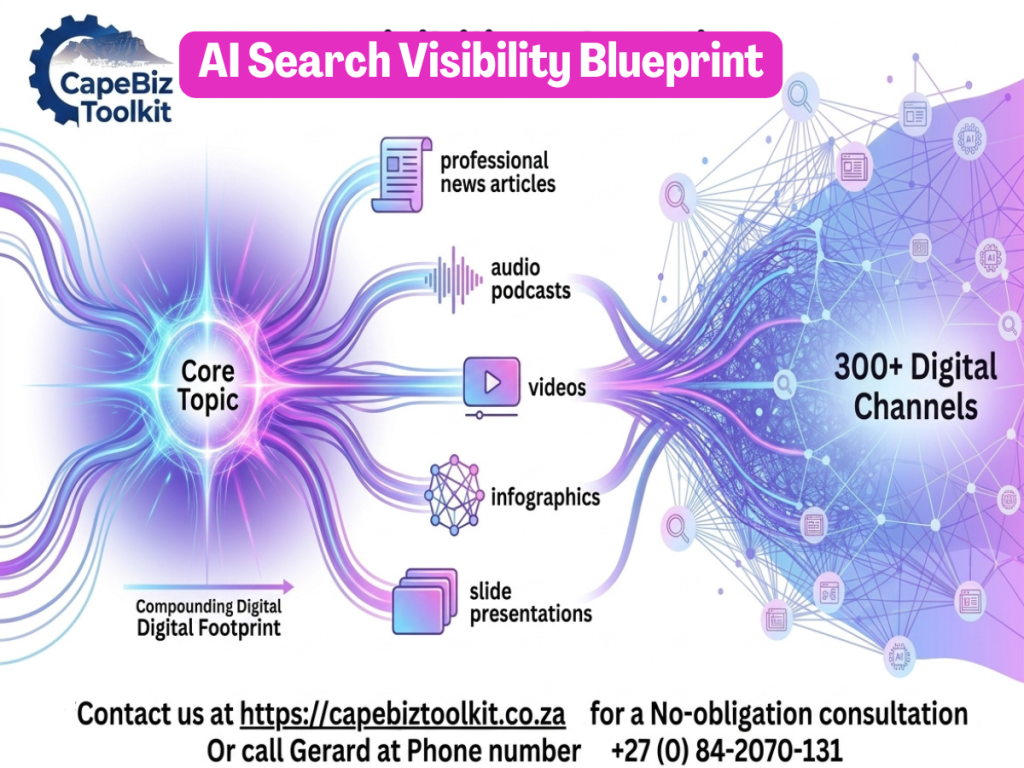
If your Cape Town business needs a structured, expert-led approach to schema implementation and AI search visibility, CapeBiz Toolkit’s AI Visibility Blueprint provides exactly the multi-channel content syndication and structured data framework that gets Western Cape SMEs consistently cited in Google Gemini Overviews.