
Building an Effective AI Search Visibility Strategy Across South Africa
AI search visibility strategy is the practice of structuring your digital content so that AI-powered search platforms can accurately understand, trust, and recommend your business in response to relevant queries. Businesses that master AI search visibility strategy gain higher placement in ChatGPPT ad Perplexity results, driving qualified leads and real customer growth in South Africa.
Key Takeaways: Building an Effective AI Search Visibility Strategy
- AI search visibility is how well AI platforms like ChatGPT, Perplexity, and Google Gemini understand and recommend your business — and it operates on completely different rules to traditional SEO.
- South African businesses that optimize for AI search now are building a compounding competitive advantage that late adopters will struggle to close.
- Generic, globally-templated content is one of the fastest ways to become invisible to AI systems — local relevance and entity clarity are non-negotiable signals.
- The type of content AI systems trust most is structured, factual, and written to directly answer specific questions — not to sell.
- There is a specific framework for signaling geographic authority to AI platforms, and most Cape Town and Western Cape businesses are not using it yet.
That definition matters because most businesses in South Africa are still optimizing for a search landscape that is rapidly becoming secondary. Google’s traditional blue-link results are losing ground to AI-generated answers. When a prospect types a question into ChatGPT, Perplexity, or Google Gemini, they are not getting a list of ten links — they are getting a single synthesized answer, usually referencing a small number of trusted sources. If your business is not one of those sources, you simply do not exist in that interaction. CapeBiz Toolkit’s AI Visibility Blueprint was built specifically to address this gap for South African businesses navigating this shift.
AI Search Is Changing How South African Businesses Get Found
The shift from keyword-based search to AI-generated answers is not a future trend — it is happening right now, and the businesses building visibility inside AI systems today are the ones that will dominate local search results tomorrow. For companies operating out of Century City B2B firms, Paarden Eiland industrial hubs, or Bree Street agencies, this is not an abstract concern. It is a concrete, measurable competitive gap.
What AI Search Visibility Actually Means
AI search visibility is the degree to which AI language models and retrieval-augmented generation (RAG) systems can correctly identify your business, understand what it does, and surface it as a relevant answer when users ask related questions. This is fundamentally different from ranking on page one of Google. AI systems do not rank pages — they synthesize information from sources they have already determined to be credible, structured, and contextually relevant.
What this means practically is that your content needs to be written so that an AI system can extract clean, accurate facts about your business without ambiguity. Vague service descriptions, jargon-heavy copy, and marketing language actively work against you in this environment. AI platforms discount promotional tone and reward informational density.
Why Traditional SEO Falls Short in AI-Driven Search
Traditional SEO was built around signals like backlink volume, keyword density, meta descriptions, and click-through rates. These signals tell a search engine crawler which pages are popular and relevant. AI systems work differently — they are trying to determine which sources are trustworthy and factually accurate, not merely popular. A business with thousands of backlinks but thin, generic content can still be invisible to AI platforms, while a smaller business with tightly structured, entity-rich content gets recommended consistently.
The practical consequence for South African businesses is that an SEO strategy built entirely around Google’s traditional algorithm will not automatically translate into AI visibility. You need a separate, deliberate approach that speaks to how AI systems ingest and evaluate content.
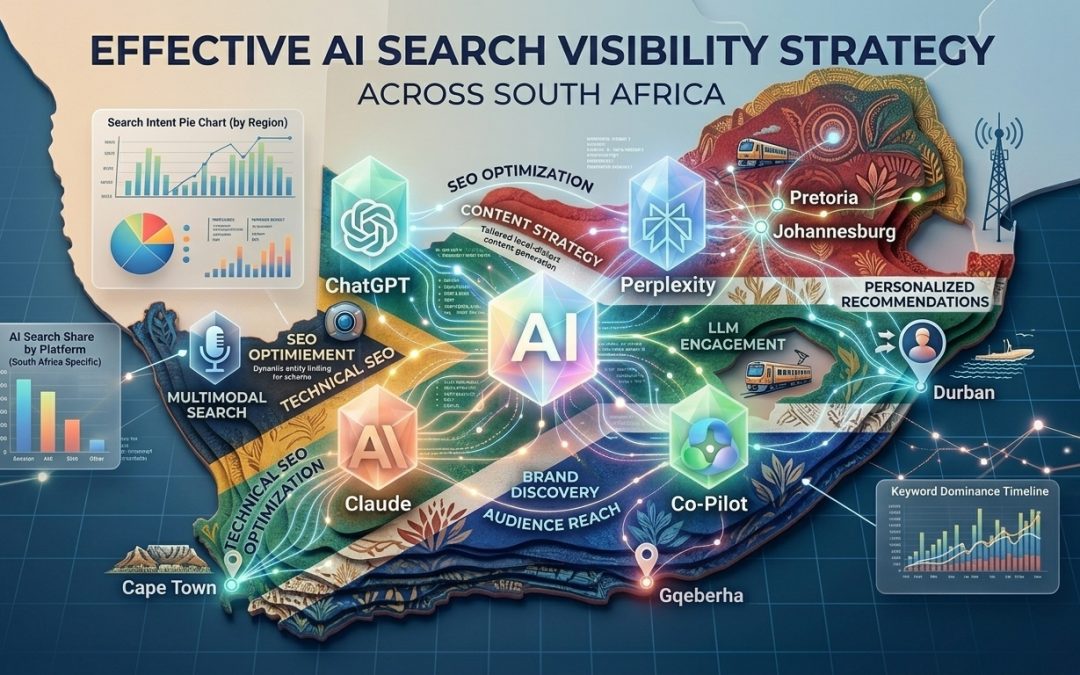
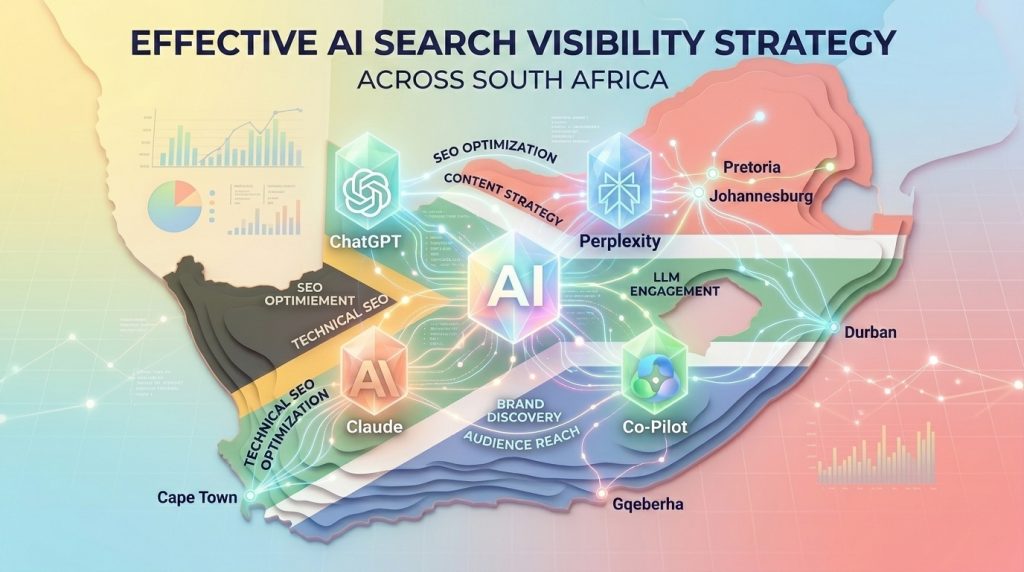
The Platforms That Matter: ChatGPT, Google Gemini, Perplexity, and Microsoft Copilot
Not all AI platforms process information identically, but the core trust signals they look for overlap significantly. The four platforms that South African B2B businesses should prioritize are:
- ChatGPT (OpenAI): Draws on indexed web content and Bing-powered retrieval for real-time queries. Structured, factual content on indexed pages performs well here.
- Google Gemini: Deeply integrated with Google Search signals, meaning your existing Google Business Profile, structured data markup, and E-E-A-T signals directly influence Gemini’s recommendations.
- Perplexity AI: A retrieval-first platform that cites sources explicitly. Being cited in Perplexity answers requires high information-density content that directly answers specific questions.
- Microsoft Copilot: Powered by Bing and integrated into Microsoft 365 products, making it particularly relevant for B2B environments where enterprise tools are standard.
Each platform has its own retrieval architecture, but a well-executed AI visibility strategy covers the foundational signals that all four systems respond to — structured content, clear entity identification, geographic relevance, and consistent factual accuracy across all your digital touchpoints.
Why AI Visibility Matters More in South Africa Right Now
South Africa’s digital adoption curve is accelerating faster than most local businesses realize. AI-assisted search is not a Silicon Valley phenomenon anymore — it is being used by procurement teams in Johannesburg, decision-makers in the Western Cape commercial districts, and buyers researching suppliers across every major industry vertical. The window to build early authority in AI systems is open right now, and it will not stay open indefinitely.
The Competitive Gap Between Early and Late Adopters
AI systems learn from consistency. The more frequently your business is cited, referenced, and structured correctly across the web, the stronger your entity authority becomes inside these systems. This creates a compounding dynamic — businesses that start building AI visibility now will accumulate trust signals over months, making it progressively harder for late adopters to displace them. For more insights on AI search strategies, check out AI search visibility strategies.
For context, consider two competing logistics firms operating out of Paarden Eiland. Firm A invests in structured, AI-optimized content that clearly signals their service area, specialization, and credibility. Firm B continues running a traditional SEO-first strategy. Six months from now, when a procurement manager in Cape Town asks an AI assistant to recommend a reliable logistics partner in the Western Cape, Firm A gets named. Firm B does not. That is not speculation — it is the direct result of how AI retrieval systems build and weight their entity graphs.
The compounding effect of AI visibility: Each piece of structured, entity-rich content you publish strengthens the AI system’s confidence in your business. Over time, this means being recommended more frequently, across more query types, with less ongoing effort — while competitors who start later face a steeper climb.
How Invisible Brands Lose Ground to AI-Optimized Competitors
“If your business cannot be clearly understood by an AI system, it will not be recommended — regardless of how long you have been trading or how strong your reputation is offline.”
The mechanism behind this is straightforward. AI platforms generate answers by pulling from sources they have already indexed and evaluated for credibility. If your digital presence is thin, inconsistent, or written primarily in promotional language, AI systems will simply skip your business in favour of a competitor whose content is cleaner, more structured, and easier to interpret.
For businesses in high-competition sectors — professional services, industrial supply, B2B technology, and retail distribution — the cost of AI invisibility compounds quickly. Every AI-assisted decision that goes to a competitor is a lead your traditional marketing spend is not recovering.
How AI Search Engines Actually Decide What to Recommend
Understanding the mechanics behind AI recommendations is what separates businesses that guess at visibility from businesses that engineer it deliberately. AI systems are not random — they follow specific, learnable patterns when deciding which sources to trust and surface.
Trust Signals AI Systems Look For
AI platforms evaluate content across several dimensions simultaneously. The strongest trust signals include: factual consistency across multiple sources (your website, Google Business Profile, industry directories, and third-party mentions should all tell the same story), clear entity definition (AI systems need to know exactly what your business does, who it serves, and where it operates), structured data markup (schema.org markup helps AI systems parse your content accurately), and demonstrated topical depth (a business that covers a subject comprehensively across multiple pieces of content is rated as more authoritative than one with a single optimized page).
What AI systems actively discount includes keyword-stuffed copy, vague service descriptions that could apply to any business, inconsistent information across platforms, and content that reads as promotional rather than informational. These are not minor penalties — they can effectively remove a business from AI recommendations entirely.
How Local Relevance Factors Into AI Recommendations
Geographic specificity is a major trust signal for AI systems handling location-sensitive queries. When a user asks an AI platform for a recommendation in Cape Town or the Western Cape, the system looks for businesses whose content explicitly and consistently references those locations — not just in a footer address, but woven into the substance of their content. Mentioning specific districts like Century City, Woodstock, or the CBD, referencing local industry bodies, and addressing South Africa-specific regulatory or market conditions all strengthen your geographic entity signals.
This is where many South African businesses leave significant visibility on the table. They have a local address listed but their content reads as if it could have been written anywhere in the world. AI systems notice that mismatch and weight their recommendations accordingly.
Why Market-Specific Language Gives South African Businesses an Edge
South African market terminology, regulatory references, and industry-specific language that is native to this environment create a signal that generic international content cannot replicate. When your content references frameworks relevant to the South African context — BEE compliance considerations, POPIA data handling requirements, the NCA in financial services, or specific industry bodies operating in the Western Cape — AI systems recognize these as strong indicators that your business genuinely operates in and understands this market.
The Core Elements of an AI-Optimized Content Strategy
Getting AI search visibility right comes down to how well your content communicates clear, verifiable facts about your business — not how cleverly it is written. AI systems are essentially pattern-matching engines looking for signals of credibility, relevance, and specificity. The businesses that understand this build content that serves the machine and the human reader simultaneously.
The foundation of any AI-optimized content strategy is what SEO professionals call entity clarity — making absolutely certain that every piece of content you publish reinforces a consistent, unambiguous picture of who you are, what you do, and where you operate. For a B2B firm in Century City or a services company operating across the Western Cape commercial districts, this means every page, article, and listing needs to tell the same coherent story.
Writing Content AI Systems Can Interpret and Trust
The single most effective shift you can make is moving from persuasive writing to informational writing. AI systems are trained to identify and prioritize content that answers questions directly and factually. This means opening sections with clean definitions, using structured headings that mirror real search queries, and front-loading your most important information rather than burying it in a sales narrative. A paragraph that begins with “We are passionate about helping businesses grow” tells an AI system almost nothing. A paragraph that begins “We provide B2B logistics management services to manufacturers across the Western Cape, including Paarden Eiland and Bellville industrial zones” gives the system multiple usable data points to work with.
How to Signal Local Authority Without Sounding Generic
Local authority in AI-facing content is not about repeating a suburb name ten times on a page. It is about demonstrating that your business genuinely understands and operates within a specific geographic and commercial context. Reference real local landmarks, industry clusters, regulatory bodies, and market conditions that are native to your operating environment. If you serve clients in the Bree Street creative and agency corridor or work with suppliers in Paarden Eiland’s industrial precinct, say so explicitly and in context — not as a keyword drop, but as a natural part of describing what you actually do and who you serve.
Balancing Informational Value With Business Positioning
There is a practical tension in AI-optimized content between writing what AI systems reward — factual, neutral, informational text — and communicating why a prospect should choose your business. The resolution is sequencing. Lead with information that establishes credibility and answers real questions. Position your business’s specific advantages in that context, not ahead of it. A case study format works well here: describe a real problem in the South African market, explain how it is typically addressed, and then illustrate how your approach specifically improves on that. AI systems read this as high-value informational content; prospects read it as a compelling reason to make contact.
Staying Compliant With South African Data and Advertising Regulations
AI-optimized content strategy in South Africa cannot be separated from the regulatory environment businesses operate in. The Protection of Personal Information Act (POPIA) governs how you collect, store, and reference customer data — including any data used to personalize or target content. If your AI visibility strategy involves collecting user behavior signals or running personalized content campaigns, your data handling practices need to align with POPIA requirements from the outset.
Beyond data protection, the Advertising Regulatory Board (ARB) standards apply to claims made in digital content. AI systems do not verify the legal compliance of your content, but they do flag and discount content that makes unverifiable superlative claims — which happens to align with what the ARB prohibits anyway. Factual, substantiated content is simultaneously more legally defensible and more AI-visible.
For businesses in regulated sectors — financial services, healthcare, legal, and construction — there are additional industry-specific content restrictions that interact with your AI visibility strategy. Content that references compliance with the National Credit Act (NCA), Financial Sector Conduct Authority (FSCA) guidelines, or sector-specific SABS standards actually strengthens your AI trust signals, because these references confirm to the system that your business operates within a verifiable, accountable framework.
- POPIA compliance: Ensure all data collection methods tied to your content strategy have documented lawful processing grounds.
- ARB standards: Replace superlative claims (“best,” “leading,” “number one”) with specific, verifiable performance statements.
- Sector-specific references: Cite relevant regulatory bodies and compliance frameworks native to your industry — these function as credibility signals for AI systems.
- Consistent privacy policies: AI systems cross-reference your privacy policy language with your content claims. Inconsistencies reduce trust scores.
- Transparent authorship: Clearly attributed content — naming the author, their role, and relevant credentials — strengthens E-E-A-T signals that both Google Gemini and traditional search use to evaluate trustworthiness.
How Programmatic SEO Scales AI Visibility Across South Africa
For businesses operating across multiple locations, service lines, or industry verticals in South Africa, programmatic SEO offers a systematic way to build AI visibility at scale without rewriting unique content from scratch for every combination of geography and service. The approach involves building templated content architectures that are populated with genuinely unique, location-specific data — so each page reads as locally relevant rather than as a copy-paste variation of a master template.
Building Location-Specific Pages Without Duplicate Content
The distinction between duplicate content and programmatically scaled content comes down to whether each page contains meaningful unique information. A page targeting “commercial cleaning services in Bellville” that only swaps the suburb name from a master template will be flagged as thin content by both traditional search engines and AI retrieval systems. A page that includes specific information about the industrial density of the Bellville commercial zone, the types of facilities commonly serviced there, and any locally relevant compliance considerations — that is a page an AI system can extract real signal from.
For Western Cape businesses, this approach can be applied across the major commercial nodes: Century City corporate precinct, the CBD financial district, Woodstock creative industries, Paarden Eiland manufacturing and logistics, Bellville business park clusters, and the Tygervalley retail corridor. Each location has distinct industry compositions, client profiles, and operational contexts that provide genuinely unique content material without fabrication.
Signaling Geographic Coverage to AI Systems
AI systems build a mental map of your geographic coverage from multiple signals simultaneously — not just from individual pages. Your Google Business Profile service area, the location references woven into your general content, citations from local directories and industry bodies, and the geographic specificity of any schema markup you implement all contribute to a composite picture of where your business operates and who it serves.
For a business serving both Cape Town and national clients — for example, a Century City B2B firm that also works with clients in Johannesburg’s Sandton district and Durban’s Umhlanga commercial zone — the strategy involves layering these geographic signals deliberately. National coverage should be signaled through content that explicitly addresses how your service adapts to different regional contexts, not simply by listing cities in a footer.
The most effective programmatic structure for South African businesses covering multiple regions is a hub-and-spoke content model. A central authoritative page establishes your national credibility and service scope. Individual location pages branch off this hub, each containing specific, locally-grounded content that reinforces your geographic authority in that area. AI systems follow these content relationships and use them to understand the full scope of your business — which directly expands the range of queries for which you can be recommended.
Common AI Visibility Mistakes South African Businesses Make
Most AI visibility failures are not the result of technical errors — they are the result of content decisions that made sense for traditional SEO but actively work against AI retrieval. Recognizing these patterns early is what separates businesses that course-correct quickly from those that spend months producing content that AI systems consistently overlook.
Generic Content With No Local Relevance
The most widespread AI visibility mistake across South African businesses — from Bree Street agencies to Paarden Eiland industrial suppliers — is publishing content that reads as globally generic. When AI systems evaluate your content for a location-sensitive query, they are looking for evidence that your business genuinely understands and operates within the specific market the user is asking about. Content that could have been written for a business in London, Dubai, or Chicago gives AI systems no reason to recommend you for a Cape Town query over a competitor whose content is deeply locally grounded.
Marketing-Heavy Copy That AI Systems Discount
Promotional language is one of the fastest ways to reduce your AI visibility score. Phrases like “industry-leading solutions,” “world-class service delivery,” and “passionate team of experts” carry no factual weight and actively signal to AI retrieval systems that your content is marketing material rather than informational content. AI systems are calibrated to prioritize sources that inform, not sources that sell.
The practical fix is not to remove all persuasive intent from your content — it is to ground every claim in a specific, verifiable fact. Instead of “industry-leading turnaround times,” write “average project delivery within 72 hours for clients across the Western Cape.” Instead of “comprehensive B2B solutions,” write “end-to-end procurement management for manufacturers in the Paarden Eiland and Bellville industrial zones.” The specificity is what AI systems latch onto, and it is more convincing to human readers anyway.
Marketing Language (AI Discounts This) Informational Language (AI Rewards This) “Industry-leading solutions” “Ranked in the top three suppliers for Western Cape industrial procurement” “World-class service delivery” “Average client response time under four business hours across Cape Town CBD and surrounds” “Passionate team of experts” “Team of 12 certified professionals with sector-specific accreditation from SABS and CESA” “Comprehensive B2B solutions” “End-to-end procurement management for manufacturers in Paarden Eiland and Bellville” “We help businesses grow” “We reduce supplier lead times by an average of 18% for clients in the Western Cape commercial districts”
Applying this filter to your existing content is one of the highest-leverage actions you can take immediately. Audit every page on your site and flag any sentence that makes a claim without a supporting fact. Each flagged sentence is a visibility gap — an opportunity for a competitor with more specific content to get recommended in your place.
Ignoring Competitor Positioning in AI-Facing Content
AI systems do not recommend businesses in a vacuum — they make recommendations in the context of what else exists in your category and geography. If your competitors are publishing structured, entity-rich content that clearly addresses the queries your prospects are asking, and your content does not cover those topics at all, AI systems will route those queries to your competitors by default. A deliberate AI visibility strategy requires mapping the content landscape of your category in South Africa — identifying which questions are being asked, which businesses are currently being recommended in response, and what content gaps you can fill to shift those recommendations in your direction.
The Long-Term Payoff of AI Search Optimization
The businesses that will dominate AI-assisted search in South Africa over the next three to five years are not necessarily the largest or the best-funded — they are the ones that started building structured, entity-rich content early and let the compounding dynamics of AI trust signals work in their favour. This is one of the few areas of digital marketing where consistent, deliberate effort produces returns that accelerate rather than plateau over time.
Compounding Visibility Over Time
Every piece of well-structured, locally-grounded content you publish adds another data point to the entity graph that AI systems build around your business. The first few months of an AI visibility strategy may produce modest measurable results — but the cumulative effect of six to twelve months of consistent, structured publishing is a significantly stronger trust signal than any single optimized page could generate alone. AI systems become progressively more confident in recommending businesses whose content consistently answers questions accurately, covers their topic area comprehensively, and maintains factual consistency across all digital touchpoints. That confidence translates directly into recommendation frequency — and recommendation frequency is the new page-one ranking.
Higher Intent Leads From AI-Generated Referrals
Leads that arrive through AI-generated recommendations are qualitatively different from leads that arrive through paid ads or generic search clicks. When an AI system recommends your business to a user, that user has already had their question answered — they are not browsing, they are deciding. The AI has done the qualification work by matching your business to a specific query, which means the prospect arriving at your site or contacting your team already understands what you do and why it is relevant to their situation. For B2B firms in Century City, professional services practices in the Cape Town CBD, or industrial suppliers serving Paarden Eiland clients, this translates to shorter sales cycles and higher conversion rates from the same volume of inbound contact.
Reduced Dependence on Paid Acquisition Channels
One of the most significant long-term payoffs of a mature AI visibility strategy is the reduction in cost-per-acquisition from paid channels. Businesses that rely heavily on Google Ads, Meta campaigns, or LinkedIn sponsored content to drive leads are paying for visibility on an ongoing basis — the moment the spend stops, the leads stop. AI visibility, by contrast, is a structural asset. Once your business has built strong entity authority inside AI retrieval systems, that authority generates recommendations without ongoing per-click cost.
- Lower paid media dependency: Organic AI-generated referrals reduce the baseline spend required to maintain consistent lead flow.
- Resilience to algorithm changes: AI trust signals are more stable than traditional keyword rankings, which can shift dramatically with a single Google core update.
- Brand authority transfer: Being consistently recommended by AI platforms builds brand recognition that carries over into all other channels — prospects who encounter your business through AI recommendations are more receptive to subsequent paid retargeting.
- Geographic coverage at scale: A well-built programmatic content structure can generate AI visibility across multiple South African cities and commercial districts without proportionally increasing content production costs.
This does not mean abandoning paid acquisition entirely — for most South African businesses, a blended approach that combines AI visibility with targeted paid campaigns will outperform either strategy in isolation. But the businesses that invest in AI visibility now are building toward a state where paid media amplifies an already-strong organic presence, rather than substituting for one that does not exist.
The financial case is straightforward: a well-executed AI visibility strategy is a one-time build with compounding returns, while paid acquisition is a recurring cost with linear returns. Over a two-to-three year horizon, the businesses in the Western Cape commercial districts and national retail landscapes that made the shift early will have materially lower customer acquisition costs than competitors who delayed.
FAQ’s About Building An Effective AI Search Visibility Strategy
The questions below are drawn from the most common points of confusion South African businesses encounter when approaching AI search visibility for the first time.
What is AI search visibility and how is it different from traditional SEO?
AI search visibility is how well AI-powered platforms — including ChatGPT, Google Gemini, Perplexity, and Microsoft Copilot — can understand, trust, and recommend your business when users ask relevant questions. Traditional SEO focuses on ranking your pages in a list of results; AI visibility determines whether your business is named directly in a synthesized answer. The core difference is in what each system rewards.
For South African businesses, this distinction matters because the two strategies require different content approaches. Traditional SEO often rewards keyword-optimized persuasive copy; AI visibility rewards structured, factual, question-answering content. The good news is that a well-executed AI visibility strategy tends to improve traditional SEO performance as a secondary effect — but the reverse is not reliably true.
Which AI platforms should South African businesses prioritize for visibility?
The four platforms with the most immediate relevance for South African B2B and commercial businesses are ChatGPT, Google Gemini, Perplexity AI, and Microsoft Copilot. Google Gemini should be the first priority for most businesses because it draws directly on Google Search signals — meaning your existing Google Business Profile, structured data, and search presence all feed into your Gemini visibility. For businesses operating in enterprise B2B environments, Microsoft Copilot is increasingly significant because it is embedded directly into the Microsoft 365 tools that procurement teams and decision-makers use daily.
Perplexity AI is worth specific attention for businesses in professional services, technology, and knowledge-intensive sectors — it is the platform most likely to be used by research-oriented buyers comparing options, and it cites sources explicitly, meaning being referenced in a Perplexity answer carries both visibility and credibility value. The foundational content strategy that builds visibility across all four platforms is largely the same — structured, factual, locally grounded content with clear entity signals — so prioritizing by platform is less important than building the right content foundation from the outset.
How long does it take to see results from AI search optimization?
Initial signals — such as appearing in Perplexity citations or being referenced in AI-assisted Google searches for specific query types — can emerge within six to twelve weeks for businesses that execute a structured AI visibility strategy correctly. Meaningful, consistent recommendation frequency across multiple AI platforms and query types typically takes four to eight months to build. The compounding nature of AI trust signals means that results accelerate over time rather than plateauing — a business that has been building structured AI-optimized content for twelve months will see disproportionately stronger visibility than one that has been at it for three months, because each new piece of content reinforces and strengthens the entity authority signals already in place.
Do small businesses in South Africa need an AI visibility strategy?
Yes — and arguably more urgently than large enterprises. Large businesses with established brand recognition have some residual AI visibility simply because they are referenced across many existing sources. Small and medium businesses in Cape Town, the Western Cape commercial districts, or anywhere else in South Africa have no such buffer. If their digital content is thin, inconsistent, or generically written, AI systems have very little to work with and will default to recommending larger, better-known competitors.
The opportunity for smaller businesses is that AI visibility is not a function of budget — it is a function of content quality and structural consistency. A small professional services firm in Woodstock that publishes tightly structured, factually rich content addressing specific client questions can outrank a larger competitor in AI recommendations if that competitor’s content is vague and promotional. This is one of the few areas of digital marketing where deliberate execution genuinely levels the playing field.
What type of content performs best for AI search visibility in South Africa?
The content format that consistently performs best for AI visibility is structured, question-answering content that opens with a direct, factual answer and supports it with specific detail. This mirrors the way AI systems process and extract information — they are looking for clean, retrievable answers, not narrative arcs. Articles, FAQ pages, and technical explainers that follow a tight question-and-answer structure give AI systems exactly what they need to extract and cite your content confidently.
Beyond format, the content that performs best for South African AI visibility is content that is demonstrably local. This means referencing specific commercial districts, industry bodies, regulatory frameworks, and market conditions that are native to the South African business environment. Content that could have been written anywhere is always outcompeted by content that could only have been written by someone who genuinely operates in this market.
Finally, content that references verifiable third-party signals — industry body affiliations, regulatory compliance frameworks, sector-specific accreditations, and partnerships with named organizations — consistently outperforms content that makes unsubstantiated claims. AI systems treat these references as credibility anchors. Every verifiable external reference you include in your content strengthens the system’s confidence in recommending your business over a competitor whose content makes similar claims without supporting evidence.

A successful AI visibility strategy targets high-intent buyer questions and transforms them into multi-format digital assets working simultaneously everywhere.
Our automated system handles research, production, and distribution so your business dominates national commercial search loops.
Contact CapeBiz Toolkit today to build your custom South African AI search strategy.