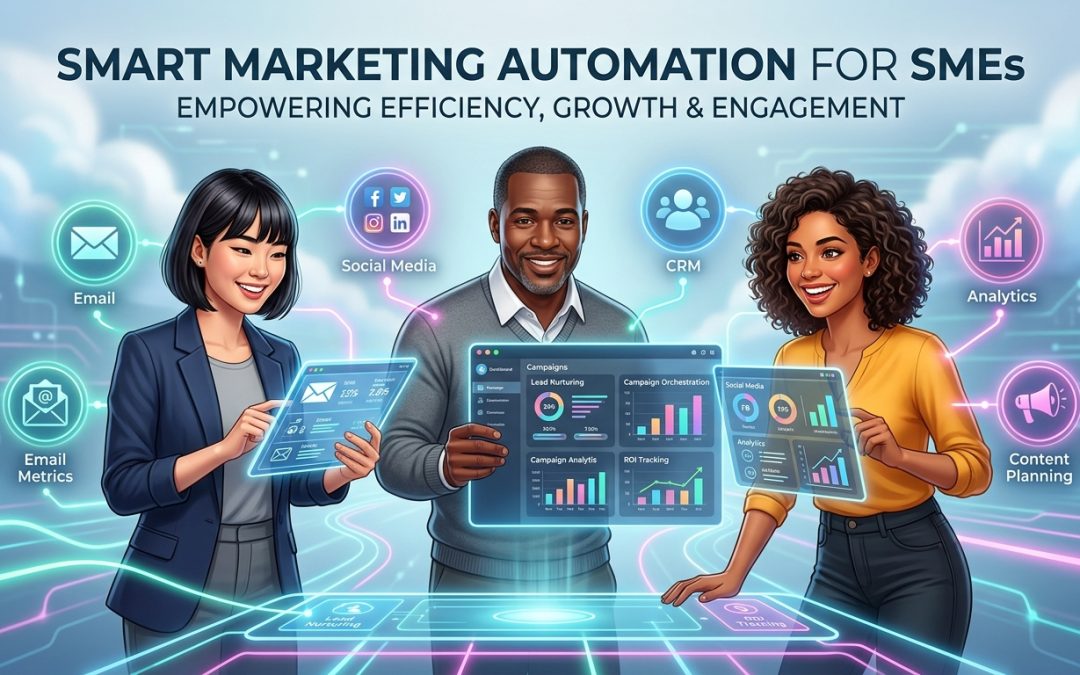
Smart Marketing Automation for SMEs: Scaling Without Staff
There can be little doubt that marketing automation helps small and medium-sized businesses grow revenue without hiring more staff. By automating repetitive tasks and using AI-powered tools to respond at the right time, even a small team can serve more customers, stay consistently engaged, and convert more leads into sales.
Key Takeaways: Marketing Automation for SMEs
- Marketing automation lets Cape Town SMEs run sophisticated campaigns without hiring extra staff — tools like Mailchimp, WhatsApp Business API, and Meta Business Suite can handle email, social, and customer communication on autopilot.
- The biggest wins come from automating email follow-ups, lead nurturing, and social media scheduling first — these three alone can save a small business owner 10+ hours per week.
- Cape Town businesses face a unique challenge: load shedding, mobile-first customers, and tight budgets mean the wrong automation strategy can waste money fast — the right one scales you without the overhead.
- You do not need a website or a marketing team to start — several free tools work directly from your phone and integrate with platforms your customers already use.
- Most SMEs make one critical mistake when starting with automation — and it has nothing to do with picking the wrong tool. More on that inside.
Cape Town SMEs Can Compete With Bigger Brands — Without Hiring More Staff
Big brands have marketing teams. You have Tuesday afternoons and a WhatsApp group. That gap is exactly what marketing automation was built to close.
For Cape Town small and medium enterprises, the playing field has shifted dramatically. The same software that enterprise companies pay their marketing departments to manage is now accessible, affordable, and in many cases completely free. CapeBiz Toolkit was built specifically to help local Cape Town businesses find and use these tools without needing a tech background or a big budget. The opportunity is real — but only if you know where to start and what to avoid.
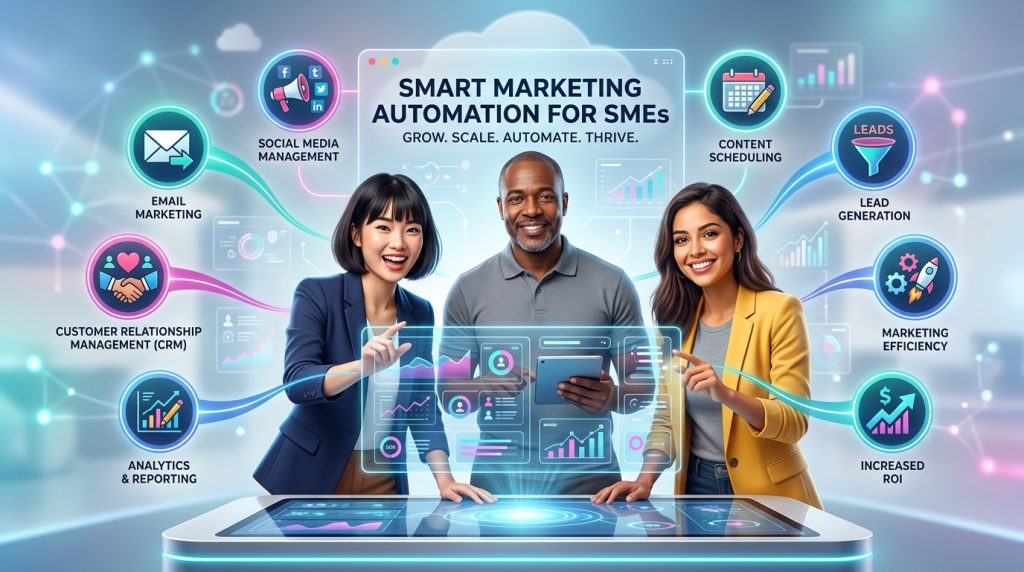
What Marketing Automation Actually Does for a Small Business
Marketing automation for SMEs is software that handles repetitive marketing tasks for you — automatically, on a schedule, or triggered by a customer action. Think of it as setting a rule: “When someone fills in my contact form, send them a welcome email immediately.” You set it once. It runs forever.
The Difference Between Manual Marketing and Automated Marketing
Manual marketing means you are the engine. Every email gets written and sent by you. Every follow-up depends on you remembering. Every social post requires you to be online at the right moment. It works — until it doesn’t, because you get busy, distracted, or simply exhausted.
Automated marketing flips that. You design the system once, and the system does the repeating. A customer browses your online store and abandons their cart? An automated message goes out within the hour. A lead fills in a quote form on your website? They get a follow-up email sequence for the next five days without you lifting a finger. The result is consistent, professional communication that runs even when you’re dealing with a supplier, handling a delivery, or sitting through load shedding.
Which Tasks Can Be Automated Right Now
The short answer: more than most SME owners realise. Here is what is genuinely automatable today, even on a tight budget:
- Welcome emails when someone joins your mailing list
- Follow-up sequences after a quote request or enquiry
- Appointment reminders via SMS or WhatsApp
- Social media posts scheduled days or weeks in advance
- Customer birthday or anniversary messages
- Review requests after a purchase or service
- Monthly performance reports pulled automatically from your ad accounts
What Marketing Automation for SMEs Cannot Replace
Automation handles the repetitive — it does not replace the relational. A long-term client who needs a difficult conversation, a community partnership that requires face-to-face trust, creative strategy that reflects your brand’s personality — these still need a human. The goal is to free up your time for those high-value interactions by automating everything underneath them.
Why Cape Town SMEs Face a Unique Scaling Challenge
Scaling a business in Cape Town is not the same as scaling one in Johannesburg, London, or New York. The local context creates specific constraints that generic marketing advice simply does not account for.
The Cost of Hiring vs. The Cost of Automating
A junior marketing coordinator in Cape Town costs between R12,000 and R18,000 per month in salary alone — before you factor in UIF, skills levies, equipment, and onboarding time. For most SMEs, that is not a realistic option in the early stages of growth.
Contrast that with a stack of automation tools that covers email marketing, social scheduling, CRM, and reporting for under R800 per month — or in many cases, for free. Mailchimp’s free plan handles up to 500 contacts and 1,000 emails per month. Meta Business Suite costs nothing and schedules posts across Facebook and Instagram simultaneously. The financial case for automation over hiring is not even close for a business under 20 employees.
How Load Shedding and Connectivity Affect Local Digital Marketing
Load shedding is not just an inconvenience — it is a marketing liability. If your follow-up strategy depends on you being online at a specific time, Stage 4 will break it. Automation removes that dependency entirely. Your scheduled emails go out at 9am whether you have power or not. Your social posts publish on time. Your chatbot responds to customer enquiries while you are offline.
Connectivity inconsistency also shapes how Cape Town customers engage. A significant portion of local consumers access the internet primarily on mobile data, which means heavy, slow-loading marketing experiences get abandoned. Automation tools that are optimised for mobile delivery — like WhatsApp Business API or SMS-based sequences — consistently outperform desktop-first email strategies in this market.
There are three connectivity realities every Cape Town SME should factor into their automation setup:
- Mobile-first delivery matters: Over 80% of South African internet users access the web via smartphone. Your automated messages must render perfectly on a small screen.
- Timing windows are narrow: Load shedding schedules affect when customers are online. Tools like WhatsApp and SMS reach customers even on low-data connections.
- Cloud-based tools are non-negotiable: Any automation platform that requires a desktop or local server to function will fail you during outages. Choose cloud-hosted platforms exclusively.
The Core Marketing Tasks Worth Automating First
Not all automation is created equal. Some workflows deliver immediate, measurable returns. Others are nice-to-have features that distract you from what actually moves the needle. For Cape Town SMEs with limited time and budget, the priority list matters enormously.
1. Email Follow-Ups and Lead Nurturing
Email remains the highest ROI marketing channel available to small businesses — and automated email sequences are where that ROI multiplies. When a potential customer enquires about your service, the speed and consistency of your follow-up determines whether you win or lose that sale. Studies show that responding to a lead within the first five minutes makes you 100 times more likely to connect with them than if you wait 30 minutes. Automation makes that five-minute response happen every single time, without you watching your inbox.
A basic lead nurturing sequence for a Cape Town service business might look like this:
- Email 1 (Immediate): Confirmation that their enquiry was received, with a clear expectation of when they will hear back.
- Email 2 (Day 2): A piece of useful content — a tip, a case study, or a simple explainer about your service.
- Email 3 (Day 4): Social proof — a customer testimonial or a before-and-after result.
- Email 4 (Day 6): A direct, low-pressure call to action — book a call, request a quote, or visit your store.
Tools like Mailchimp, MailerLite, and Brevo (formerly Sendinblue) all offer this functionality on their free plans. You build the sequence once, and it runs for every new lead automatically.
2. Social Media Scheduling and Publishing
Consistency on social media is what builds an audience over time — but posting consistently when you are also running a business is where most SME owners fall apart. Social media scheduling tools solve this by letting you batch-create content in one focused session and publish it across days or weeks automatically. Meta Business Suite lets you schedule posts to both Facebook and Instagram at no cost. For businesses also active on LinkedIn or X (Twitter), tools like Buffer’s free plan handle up to three connected accounts and ten scheduled posts at a time — enough for a lean SME content calendar.
3. WhatsApp and SMS Customer Communication
In South Africa, WhatsApp is not just a messaging app — it is the primary communication channel for a massive portion of the population. WhatsApp Business (the free app) allows you to set automated greeting messages, away messages, and quick replies for frequently asked questions. For SMEs ready to go further, the WhatsApp Business API — accessible through platforms like Twilio or 360dialog — enables full automation sequences, appointment reminders, order confirmations, and broadcast messages to opted-in customers. SMS automation through local providers like BulkSMS.co.za remains highly effective for time-sensitive promotions, especially for customers who may not have consistent data access.
4. QR Code Campaigns for Foot Traffic Businesses
For Cape Town SMEs with a physical presence — a restaurant in the City Bowl, a salon in Claremont, a hardware store in Bellville — QR codes bridge the gap between offline foot traffic and online automation. A QR code placed on your counter, menu, or receipt can direct customers to a WhatsApp opt-in, an email signup form, or a Google review prompt. Once they scan and opt in, they enter your automated communication system. What was a once-off walk-in customer becomes a contact in your database receiving your promotions, updates, and loyalty offers automatically. Tools like QR Code Generator and Beaconstac make this setup straightforward and free at a basic level.
5. Automated Reporting and Campaign Tracking
One of the most underrated automations for SMEs is reporting. Without data, you are guessing. But pulling reports manually from multiple platforms every week is time-consuming and inconsistent. Tools like Google Looker Studio (free) connect directly to your Google Analytics, Google Ads, and Meta Ads accounts and generate live dashboards that update automatically. You set up the dashboard once and check in whenever you need a clear picture of what is working.
For email marketing, platforms like Mailchimp and MailerLite automatically track open rates, click rates, and unsubscribes after every campaign send. This means you always have performance data without any manual effort — and you can make better decisions about what content your Cape Town audience actually responds to.
How to Set Up Your First Automation Without a Marketing Team
The biggest barrier for most SME owners is not budget — it is knowing where to start. The temptation is to research every tool available, compare features endlessly, and delay implementation while searching for the perfect setup. That approach costs you months. The better move is to start narrow, prove the value quickly, and expand from there.
Start With One Workflow, Not Five
Pick the single most repetitive marketing task that is currently eating your time or falling through the cracks. For most service businesses, that is the lead follow-up. For most product businesses, it is the abandoned cart or post-purchase review request. Automate that one workflow completely before touching anything else. Get it running, monitor it for two weeks, refine the messaging if needed, and only then consider adding a second automation. This approach builds real competence and real results, rather than a half-finished system across five platforms that none of them do well.
Map Your Customer Journey Before Touching Any Tool
Before you open Mailchimp or WhatsApp Business, sit down with a piece of paper and draw out what happens when a new customer discovers your business. Where do they find you? What do they do next? Where do they drop off? What information do they need before they buy? This customer journey map becomes the blueprint for your automation. Every touchpoint where a customer currently waits for a response, receives inconsistent information, or gets no follow-up at all is an automation opportunity. Without this map, you are just setting up tools with no strategy behind them.
Free Tools That Cape Town SMEs Can Use Today
Here is a practical starting stack that costs nothing and covers the core automation needs of most Cape Town small businesses:
| Tool | What It Automates | Free Plan Limit |
|---|---|---|
| Mailchimp | Email sequences, welcome flows | 500 contacts, 1,000 emails/month |
| Meta Business Suite | Facebook & Instagram scheduling | Unlimited |
| WhatsApp Business App | Auto-replies, quick responses | Unlimited |
| Google Looker Studio | Automated marketing reports | Unlimited |
| Buffer (Free Plan) | Social scheduling across platforms | 3 channels, 10 posts queued |
| Tidio | Website chatbot and live chat | 50 conversations/month |
Common Mistakes SMEs Make With Marketing Automation
Automation amplifies whatever process you feed into it. If your follow-up messaging is unclear, automation will send that unclear message to every single lead, at scale, consistently. This is why the most damaging mistake SMEs make is automating before they have a working manual process. If your current follow-up email gets no replies when you send it yourself, an automated version will perform just as poorly — except now it will do so across hundreds of contacts without you noticing until significant damage is done.
The second major mistake is building for desktop when your audience is on mobile. A beautifully designed HTML email that renders perfectly on a laptop becomes an unreadable mess on a budget Android device with a small screen. In a market where the majority of customers engage on mobile, every automated message — email, WhatsApp, SMS — must be tested on a smartphone before it goes live. Keep subject lines under 40 characters, use short paragraphs, and avoid image-heavy templates that load slowly on mobile data. These are not optional refinements. In Cape Town’s mobile-first market, they are the difference between a campaign that converts and one that gets ignored.
Automating a Broken Process Makes It Break Faster
Before you automate anything, make sure the underlying process actually works. If your manual follow-up email gets no replies, automating it will not fix the message — it will just deliver a broken message to every lead, at scale, without you noticing. The same applies to social posting schedules, chatbot scripts, and SMS campaigns. Garbage in, garbage out is not just a tech saying. In marketing automation, it is a warning.
The fix is straightforward: run any workflow manually at least five to ten times before you automate it. If your welcome email consistently gets replies and your follow-up sequence books calls, then you have something worth automating. If it does not, refine the message first. Automation should be a multiplier for what works — not a shortcut around figuring out what does not.
Ignoring Mobile Optimisation for a Mobile-First Market
Cape Town consumers are overwhelmingly mobile-first. A beautifully formatted email that renders flawlessly on a laptop becomes an unreadable, slow-loading mess on a budget Android device running on limited data. Every automated message you send — email, WhatsApp, SMS — must be tested on a smartphone before it goes live. Keep email subject lines under 40 characters. Use short paragraphs. Avoid heavy image templates. These are not minor design preferences; in this market, they directly determine whether your message gets read or ignored.
WhatsApp and SMS naturally sidestep many of these issues because they are built for mobile delivery. If you are still early in your automation journey and unsure about your email design capabilities, leaning into WhatsApp Business automation first is a smart move for a Cape Town audience. It meets customers on the platform they already use most, on the device they always have with them, without any rendering issues to worry about.
When Your Automation Is Working: Signs to Look For
The clearest sign that your automation is working is that you stop noticing it — because it is running quietly in the background while your business moves forward. More specifically, watch for these indicators that your setup is delivering real results:
- Response time drops to near-zero: Leads receive replies within seconds of enquiring, regardless of the time of day or whether you are available.
- Lead conversion rate improves: More enquiries are converting to actual sales or appointments because no lead is being left without follow-up.
- Social engagement becomes consistent: Your audience is growing steadily because content is publishing regularly, not in bursts when you remember to post.
- Review volume increases: Automated post-service review requests generate a steady stream of Google and Facebook reviews without you manually chasing each customer.
- You are spending less time on admin: The hours you previously spent on repetitive marketing tasks are now available for higher-value work — or for leaving the office earlier.
If you are not seeing at least two or three of these signs within the first 60 days, revisit the messaging in your automations rather than the tools themselves. The platform is rarely the problem.
Marketing Automation for SMEs Is Not a Luxury — It Is Your Next Hire
Every Cape Town SME owner who says “I’ll look into automation when things slow down” is unknowingly choosing to stay behind. The competitors who figured this out six months ago are now nurturing leads while they sleep, publishing content while they serve customers, and collecting reviews while they take weekends off. Marketing automation for SMEs is not a future upgrade for when your business gets bigger. It is the tool that gets you bigger — without the payroll that comes with hiring someone to do it manually. Start with one workflow this week. Build from there. The compounding effect of consistent, automated marketing is one of the few genuine advantages available to a small business willing to set it up properly.
Frequently Asked Questions About Marketing Automation for SMEs
What is the cheapest way for a Cape Town SME to start with marketing automation?
The cheapest way to start is with tools that are completely free at entry level. The most practical starting point is the WhatsApp Business app combined with Mailchimp’s free plan. WhatsApp Business costs nothing, is already installed on most South African smartphones, and allows you to set automated greeting messages, away replies, and quick-response shortcuts immediately. Mailchimp’s free tier supports up to 500 contacts and 1,000 emails per month — more than enough for most SMEs just getting started with email automation.
Together, these two tools cover your two most important communication channels without spending a rand. Once you have outgrown the free limits and can see a direct revenue connection to your automation, upgrading to paid plans becomes an easy business decision rather than a speculative expense.
Do I need a website to use marketing automation tools?
No. Several of the most effective automation tools for Cape Town SMEs work entirely without a website. WhatsApp Business automation, Meta Business Suite social scheduling, and SMS broadcast tools all operate independently of any website. A Google Business Profile — which is free to set up — can serve as your digital home base while you build out other channels.
That said, a basic website unlocks significantly more automation capability. A simple contact form connected to a Mailchimp list, for example, triggers an automated welcome sequence the moment someone submits their details. If budget is the barrier to a website, platforms like Google Sites and Carrd offer free options that are sufficient to support basic automation integrations. Start where you are, and layer in more infrastructure as your results justify the investment.
Is WhatsApp automation legal and effective for South African businesses?
WhatsApp automation is legal in South Africa provided you have obtained explicit consent from the people you are messaging. South Africa’s Protection of Personal Information Act (POPIA) requires that customers opt in before receiving automated marketing messages. The WhatsApp Business API — used for more advanced automation sequences — enforces this by design, only allowing businesses to initiate conversations with customers who have actively opted in. The WhatsApp Business app (the free version) is even more straightforward, as most interactions are customer-initiated. In terms of effectiveness, WhatsApp message open rates in South Africa consistently outperform email open rates, making it one of the highest-performing channels available to local SMEs.
How long does it take to see results from marketing automation?
The first results typically appear within the first two to four weeks, particularly with lead follow-up automation. When every enquiry receives an immediate, professional response followed by a structured nurture sequence, conversion rates improve noticeably and quickly. This is the fastest-feedback automation a small business can implement.
Social media automation takes slightly longer to show audience growth, typically three to six months of consistent publishing before compounding engagement effects become visible. Reporting and review automation produce ongoing, incremental improvements rather than single dramatic results. The overall principle is this: the closer the automation is to your sales process, the faster you will see a measurable return. Start there, then build outward.
Can I automate my Google Business Profile activity as a Cape Town local business?
Partially. Google Business Profile does not offer native scheduling for posts, but third-party tools like Semrush, Publer, and Broadly allow you to schedule Google Business Profile posts in advance as part of a broader content calendar. This means your profile stays active and updated — showing specials, events, and updates — without manual daily effort.
What you cannot fully automate is the review response process, and you should not try to. Google’s guidelines and customer expectations both favour personalised, genuine responses to reviews. However, you can automate the request for reviews using post-service SMS or WhatsApp messages that include a direct link to your Google review page. Tools like Broadly and NiceJob specialise in exactly this workflow for local service businesses.
For Cape Town businesses that rely heavily on local search visibility — restaurants, salons, contractors, retailers — keeping your Google Business Profile active with regular posts and a growing review count is one of the highest-impact local SEO actions available. Automating the content scheduling and review request process means this critical channel gets consistent attention even during your busiest periods. CapeBiz Toolkit offers resources specifically designed to help Cape Town small businesses navigate exactly these kinds of local digital marketing decisions.