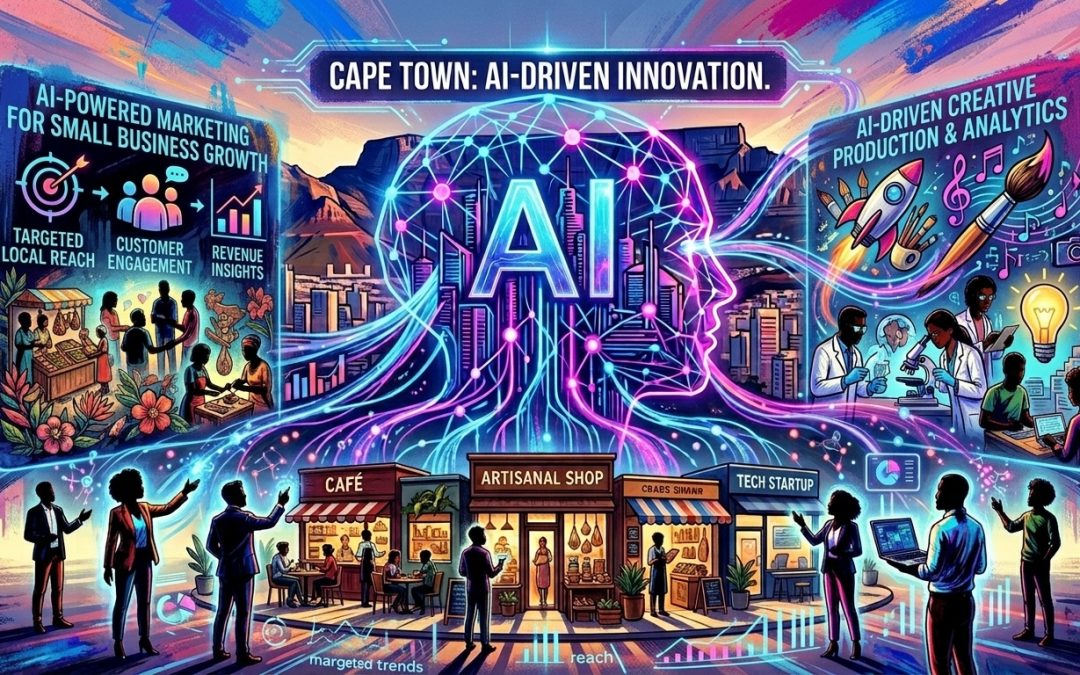
AI Marketing For Small Businesses: Cape Town’s Edge
Innovative AI marketing uses intelligent software to automate repetitive tasks, personalize customer experiences, and scale content. It acts like an extra employee. It helps small businesses in Cape Town compete with larger brands by working faster.
Key Takeaways: AI Marketing For Small Businesses
- AI marketing tools can replace the need for a full agency — small businesses can now generate content, run targeted ads, and track performance without hiring expensive specialists.
- About half of small businesses are already using AI in some form, and those who aren’t risk falling behind competitors who are moving faster with less effort.
- CapeBiz Toolkit is built specifically for Cape Town SMEs, offering free and premium AI-powered marketing tools designed for local business realities.
- The biggest AI marketing mistake small businesses make is using generic content — keep reading to find out how to avoid it and speak directly to your Cape Town customers.
- You don’t need technical skills or a big budget to start using AI marketing for small businesses today — the barrier to entry has never been lower.
Cape Town Small Businesses Now Have an AI Marketing Advantage
AI marketing has quietly become the great equalizer for small businesses — and Cape Town SMEs are starting to take full advantage of it.
For years, effective marketing meant either having a big budget or hiring an agency. Local businesses in areas like Bellville, Claremont, and Woodstock were left competing with larger brands that had entire marketing departments behind them. That gap is closing fast. AI tools now handle everything from writing social media captions to identifying which customers are most likely to buy — tasks that used to take hours or cost thousands of rands. CapeBiz Toolkit was built with exactly this reality in mind, giving Cape Town’s local businesses access to practical AI-powered tools without the agency price tag.
This isn’t about replacing the human touch that makes local businesses special. It’s about removing the tedious, time-consuming marketing work so you can focus on what you actually do well — serving your customers.
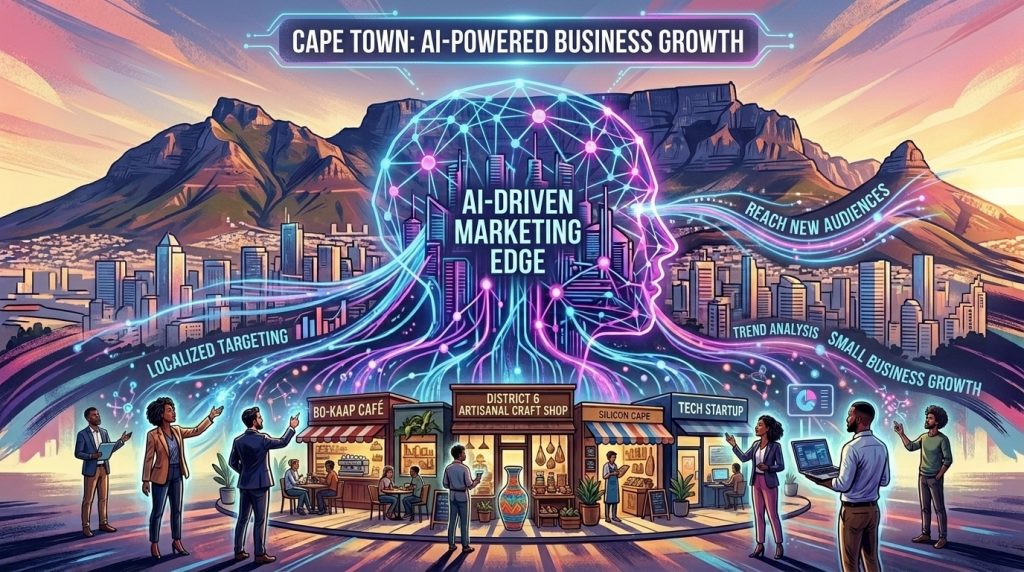
What AI Marketing Actually Does For a Small Business
AI marketing uses machine learning, data analysis, and automation to help businesses attract, engage, and convert customers more effectively. For a small business owner, that translates into fewer late nights writing copy, fewer wasted rands on ads that don’t work, and more consistent marketing output with less effort.
It Handles the Repetitive Marketing Work For You
Think about how much time goes into writing a week’s worth of social media posts, drafting a promotional email, or updating your Google Business listing. AI tools like ChatGPT, Canva’s Magic Write, and purpose-built platforms can generate this content in minutes. You give it a prompt — your product, your tone, your audience — and it produces a first draft ready to refine and publish.
This alone can save a small business owner several hours every week. Over a month, that’s time you could spend on customer relationships, product development, or simply running your business better.
It Helps You Reach the Right People at the Right Time
AI-powered ad platforms like Meta Ads Manager and Google Ads use machine learning to identify who is most likely to respond to your marketing based on browsing behavior, purchase history, and demographic data. Instead of guessing who your customer is, the algorithm figures it out for you — and keeps optimizing as more data comes in.
It Works Around the Clock Without Extra Staff
An AI chatbot on your website handles customer inquiries at 2am. An automated email sequence follows up with a lead three days after they visited your online store. Scheduled social posts go out on Sunday morning while you sleep in. AI doesn’t take lunch breaks or weekends, which means your marketing keeps working even when you’re not.
The Real Marketing Challenges Cape Town SMEs Face
Cape Town is a vibrant, diverse city — but for small business owners, that also means navigating a uniquely competitive and economically complex market. Load shedding disrupts operations. Consumers are price-sensitive. And the digital landscape moves faster than most small teams can keep up with.
Understanding these challenges is the first step to seeing why AI marketing for small businesses isn’t just a nice-to-have — it’s becoming essential.
Limited Budgets Make Traditional Advertising Difficult
A half-page ad in a community newspaper, a radio spot, or even a basic agency retainer can eat through a small business’s entire monthly marketing budget in one go. AI tools dramatically reduce this cost. Many of the most powerful platforms — including AI content generators, email marketing tools, and social schedulers — have free tiers or affordable entry-level plans that deliver serious value.
Local Competition Has Never Been More Intense
From the informal traders in Khayelitsha to the boutique retailers in Constantia, every Cape Town business is fighting for attention. Social media has made it easier for new competitors to appear overnight. Without a consistent, targeted marketing presence, even well-established local businesses lose ground quickly.
AI levels this playing field by letting a two-person bakery in Observatory run campaigns with the same strategic precision as a national chain — without needing a marketing director to make it happen.
AI Marketing Tools Cape Town Business Owners Can Use Right Now
The good news is that you don’t need to be tech-savvy to get started. The AI marketing tools available today are designed for regular people, not developers. Here’s a breakdown of what’s actually useful for a local Cape Town SME.
Each category of tool addresses a different part of your marketing — and you don’t have to adopt all of them at once. Start with one, get comfortable, and build from there.
- AI Content Generators — Tools like ChatGPT, Jasper, and Canva’s Magic Write produce social media captions, blog posts, ad copy, and promotional content in seconds.
- AI Email Marketing Platforms — Mailchimp and Brevo (formerly Sendinblue) use AI to optimize send times, personalize subject lines, and segment your audience automatically.
- QR Code and Digital Material Generators — Platforms that create branded QR codes, flyers, and digital menus help local businesses bridge the gap between offline foot traffic and online engagement.
- Local SEO Tools — Google Business Profile combined with AI SEO assistants like Surfer SEO or Semrush help Cape Town businesses appear in “near me” searches where buying intent is highest.
- AI Ad Optimizers — Meta’s Advantage+ and Google’s Performance Max campaigns use AI to automatically test creatives, audiences, and placements to get the best return on your ad spend.
The barrier to entry for all of these tools is remarkably low. Most have free trials, tutorial libraries, and no technical setup required beyond creating an account.
The key is choosing tools that align with where your customers actually spend their time. A restaurant in Sea Point may get better returns from Instagram AI content tools, while a B2B service provider in Century City might prioritize LinkedIn and email automation.
AI Content Generators for Social Media and Promotions
Tools like ChatGPT, Jasper, and Canva’s Magic Write have made it possible for any business owner to produce professional-quality content without a copywriter on staff. You type in your product, your promotion, and your tone — and within seconds you have a caption for Instagram, a headline for a flyer, or a script for a short video. The output isn’t always perfect on the first try, but it gives you a strong starting point that would have taken 30 to 45 minutes to write from scratch.
AI-Powered Email Marketing on a Small Budget
Email remains one of the highest-returning marketing channels available — and AI has made it dramatically more effective for small businesses. Platforms like Mailchimp and Brevo use AI to automatically segment your contact list, personalize subject lines based on past behavior, and schedule sends at the exact times your audience is most likely to open them.
For a Cape Town business with a few hundred customers on a mailing list, this level of personalization used to require a dedicated CRM specialist. Now it’s built into the platform. A clothing boutique in Claremont, for example, can send one campaign that automatically shows summer stock to customers who bought summer items before — and winter clearance to everyone else — with zero manual sorting.
QR Code and Digital Material Generators
For brick-and-mortar businesses in Cape Town, the bridge between foot traffic and digital engagement is critical. AI-powered QR code generators and digital material tools — including platforms available through CapeBiz Toolkit — let you create branded QR codes that link to your menu, booking page, Google review link, or WhatsApp number in minutes. Stick one on your till point, your packaging, or your front window and you’ve created a direct digital connection with every customer who walks in.
Beyond QR codes, AI design tools like Adobe Firefly and Canva’s AI suite can generate professional-looking flyers, social media graphics, and promotional banners without any graphic design experience. What used to cost R800 to R1,500 per design at an agency can now be done in-house in under ten minutes.
Local SEO Tools That Put You on the Map
When someone in Wynberg searches “best plumber near me” or “affordable hair salon in Mitchells Plain,” the businesses that appear at the top of those results aren’t there by accident. AI-assisted SEO tools like Semrush, Surfer SEO, and Google’s own Business Profile insights help local businesses identify exactly which search terms their customers are using — and then optimize their website and listings to rank for them. Keeping your Google Business Profile active and optimized with AI-assisted content updates is one of the highest-leverage, lowest-cost marketing moves a Cape Town SME can make right now.
How AI Gives Cape Town Businesses a Hyper-Local Edge
National brands can afford to run broad campaigns across the country. As a local business, your strength is specificity — you know your neighbourhood, your customers, and your community better than any head office in Johannesburg ever will. AI marketing tools let you weaponize that local knowledge at scale.
The most effective AI marketing for Cape Town SMEs isn’t generic. It’s deeply local — referencing the areas customers live in, the events they attend, and the cultural context that makes Cape Town unlike anywhere else in South Africa. When your marketing feels like it was written by someone who actually knows the Mother City, it connects in a way that a templated national campaign never can.
Targeting Specific Neighbourhoods Like Bellville, Langa, and Sea Point
Meta Ads Manager and Google Ads both allow you to target audiences by radius, suburb, and postcode. A hair salon in Langa doesn’t need to advertise to the entire Cape Town metro — it needs to reach women within a 5km radius who are actively searching for hair services. AI-powered audience targeting makes this level of precision accessible even on a R500 monthly ad budget, automatically learning which demographic responds best and shifting spend toward them in real time.
Speaking Directly to Cape Town’s Diverse Customer Base
Cape Town’s population spans languages, cultures, income levels, and lifestyles — from Afrikaans-speaking families in the Northern Suburbs to young professionals in the City Bowl. AI content tools can help you generate marketing copy in multiple languages, adapt your tone for different audiences, and create variations of the same campaign that feel native to each segment. This kind of nuanced, audience-aware communication used to require a skilled multicultural marketing team. Now it requires a well-crafted AI prompt.
Competing With Bigger Brands Without a Big Brand Budget
Large retailers spend millions on brand awareness campaigns that keep their names top of mind. A small business can’t match that spend — but it can match their consistency and targeting precision. By using AI to maintain a regular posting schedule, respond to customer queries instantly via chatbot, and run tightly targeted local ads, a small Cape Town business can occupy just as much mental real estate in its specific neighbourhood as a national brand does across the country.
Common Mistakes Small Businesses Make With AI Marketing
AI marketing tools are powerful — but they’re not foolproof. The businesses that get the best results treat AI as a skilled assistant, not an autopilot. The ones that struggle tend to make the same avoidable mistakes, and understanding them upfront will save you wasted time and money. For further insights, you can explore how to grow your small business with artificial intelligence.
Using Generic Content That Ignores the Local Audience
The single biggest waste of AI marketing potential is using it to produce content that could have been written for any business, anywhere in the world. If your Instagram caption says “Check out our amazing products today!” it tells a Cape Town customer nothing about why your business is relevant to them, in their neighbourhood, right now. AI tools are only as local as the instructions you give them. Always include your suburb, your customer demographic, and any relevant local context in your AI prompts — and the output will be dramatically more effective.
Relying on AI Without a Clear Marketing Goal
AI can generate content, optimize ads, and schedule posts — but it cannot tell you what your business actually needs to achieve. Before you open a single AI tool, get specific about your goal. Are you trying to get more foot traffic into your store? Grow your email list? Increase repeat purchases from existing customers? Each of these goals requires a completely different marketing approach, and feeding an AI tool vague instructions produces vague results.
A common scenario: a small business owner in Parow uses an AI content generator to pump out daily Instagram posts, gets a handful of likes, and concludes that AI marketing doesn’t work. The problem wasn’t the tool — it was the absence of a strategy behind it. Likes don’t pay rent. Sales do. Every piece of AI-generated content should connect to a specific, measurable business outcome.
Set your goal first. Then use AI to execute toward it at scale. The combination of clear human strategy and AI-powered execution is what separates the Cape Town businesses that grow from the ones that stay stuck.
- Define one primary marketing goal before using any AI tool — more bookings, more walk-ins, more online orders, or more email subscribers.
- Give every AI prompt local context — include your suburb, your customer type, and your offer to avoid generic output.
- Review AI-generated content before publishing — a quick human edit ensures tone, accuracy, and brand voice stay consistent.
- Track results weekly — most AI marketing tools include built-in analytics. Use them to cut what isn’t working and double down on what is.
- Start with one tool, master it, then expand — trying to implement five AI platforms at once leads to overwhelm and poor execution across all of them.
How to Start AI Marketing For Small Businesses In Cape Town Today
Starting is simpler than most business owners expect. Set up or optimize your Google Business Profile first — it’s free, it directly impacts how you appear in local searches, and AI tools like Semrush’s local SEO features can immediately tell you what to improve. From there, choose one content tool like Canva with Magic Write or ChatGPT and commit to using it to produce your social media content for the next 30 days. Once that becomes routine, layer in an email marketing platform like Mailchimp’s free tier and begin building your customer list. Each step compounds on the last, and within 90 days you’ll have a functioning AI-assisted marketing system that runs with a fraction of the time and cost of traditional methods.
Frequently Asked Questions About AI Marketing For Small Businesses
Below are the most common questions Cape Town small business owners ask when exploring AI marketing for the first time.
Is AI Marketing Affordable for a Small Cape Town Business?
Yes — AI marketing is one of the most cost-effective options available to small businesses today. Most entry-level tools have free plans that deliver genuine value. Canva’s free tier includes AI content features. ChatGPT’s free version handles most content generation needs. Mailchimp’s free plan supports up to 500 contacts. Google Business Profile costs nothing. A small business can build a fully functional AI marketing setup for R0 per month, and upgrade to paid tiers only when growth justifies the investment.
Do I Need Technical Skills to Use AI Marketing Tools?
No technical skills are required. Today’s AI marketing tools are designed for everyday business owners, not developers. If you can type a message on WhatsApp, you can use an AI content generator. If you can send an email, you can operate an AI email platform. Most tools include step-by-step onboarding guides, video tutorials, and template libraries that get you producing results on day one.
Which AI Marketing Tool is Best for a Local Cape Town SME?
The best tool depends on your business type and where your customers are. For most Cape Town SMEs, the highest-impact starting point is a fully optimized Google Business Profile combined with a simple AI content tool for social media. Restaurants and retail shops tend to get strong returns from Canva AI and Instagram scheduling tools. Service providers — plumbers, tutors, cleaning companies — often benefit most from local SEO tools and AI-assisted Google Ads. Platforms like CapeBiz Toolkit bundle several of these capabilities into one place specifically built for the Cape Town market.
Can AI Marketing Replace a Human Marketing Team?
AI marketing significantly reduces the need for a large team, but it works best when a human sets the strategy and reviews the output. For most small businesses, AI effectively replaces what would have required a content creator, a social media manager, and a basic data analyst — at a fraction of the cost.
Here’s a practical comparison of what AI handles versus what still benefits from human input:
| Task | AI Handles It | Human Input Needed |
|---|---|---|
| Writing social media captions | ✓ Yes | Quick review and tone check |
| Designing promotional graphics | ✓ Yes | Brand alignment approval |
| Scheduling and posting content | ✓ Fully automated | None required |
| Responding to complex customer complaints | ✗ Limited | Human response essential |
| Setting the overall marketing strategy | ✗ No | Human decision-making required |
| Optimizing ad targeting | ✓ Yes | Budget decisions remain human |
| Personalizing email campaigns | ✓ Yes | Offer and messaging approval |
Think of AI as a highly capable team member who never calls in sick, works 24 hours a day, and gets faster and smarter the more data it has — but still needs a business owner to point it in the right direction.
How Quickly Can AI Marketing Show Results for My Business?
Some results are almost immediate. An optimized Google Business Profile can start appearing in local searches within days of being updated. An AI-written email campaign sent to your existing customer list can drive sales the same day it goes out. A well-targeted Meta ad using AI audience optimization can begin generating leads within 48 to 72 hours of launch.
Longer-term results — like consistent organic social media growth, improved search engine rankings, and a growing email subscriber base — typically take 60 to 90 days of consistent effort to show meaningful momentum. The key word is consistent. AI makes consistency dramatically easier, but you still need to show up and use the tools regularly.
The businesses that see the fastest results share one trait: they start with the channels where their customers already are, rather than trying to build a presence on every platform at once. A restaurant with an active WhatsApp customer list will see faster returns from WhatsApp broadcast campaigns than from building a YouTube channel from scratch.